Write the uniform surface charge density on the annulus as , and let be signed distance along its axis. A ring of radius and width contains electric charge . Its transverse electric field components cancel in pairs, and its electric potential is . Setting and integrating gives the axial field of a uniformly charged annulus:At , each element's electric field cancels that of the diametrically opposite element, so . There is no surface charge at the centre because ; the axis electric field is continuous there.
For positive and , differentiate the signed axial electric field:Its stationary condition is . Factoring with and givesThe derivative starts positive, has exactly one positive zero and is negative at large , so this is the positive-side maximum. For either sign of , the electric field magnitude has equal maxima at . As , the thin-ring limit is .
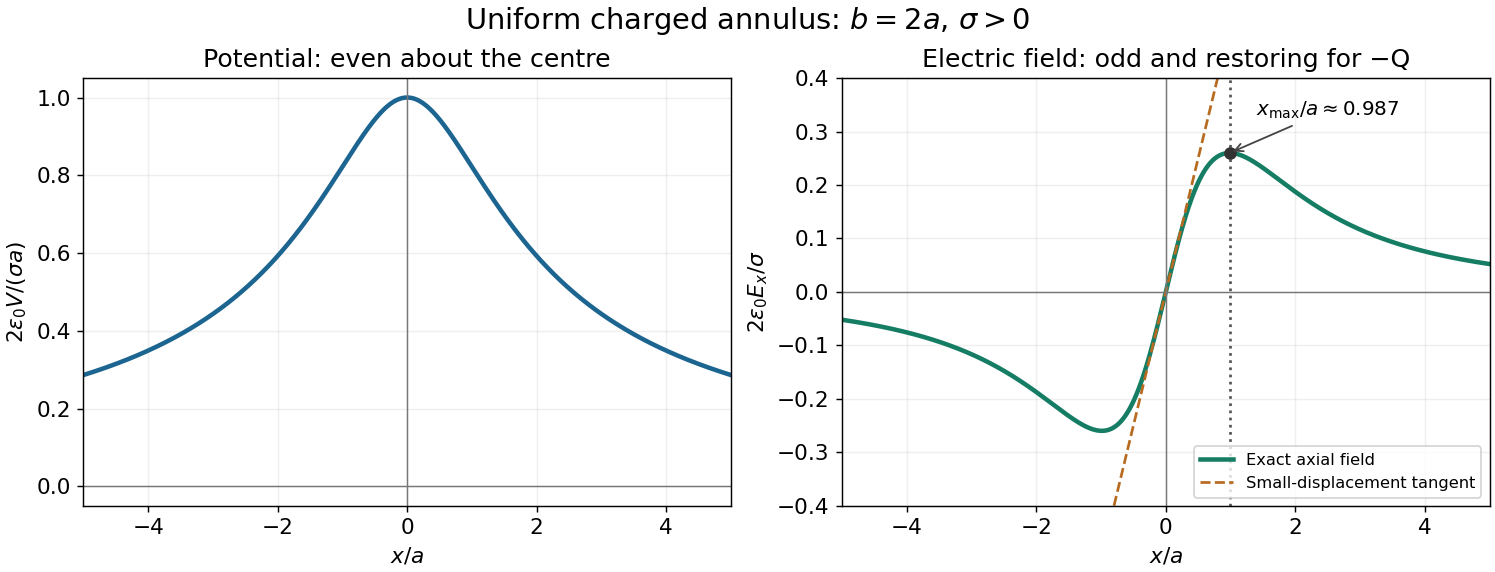
Axial potential and electric field of a uniformly charged annulus
. Original dimensionless curves for and positive surface charge density. The dotted line marks the calculated positive-side maximum of the electric field; the dashed tangent shows its linear behaviour near the centre. Details.
Articles by others on the same topic
There are currently no matching articles.