The integral and differential forms of Gauss's law in electrostatics areHere is a closed surface bounding a volume , is its outward area vector, is the electric field, is total volume charge density, and is enclosed electric charge. The divergence theorem converts one form to the other. For ideal sheets or point charges, interpret the differential equation with their distributional charge densities.
Write the uniform surface charge density on the annulus as , and let be signed distance along its axis. A ring of radius and width contains electric charge . Its transverse electric field components cancel in pairs, and its electric potential is . Setting and integrating gives the axial field of a uniformly charged annulus:At , each element's electric field cancels that of the diametrically opposite element, so . There is no surface charge at the centre because ; the axis electric field is continuous there.
For positive and , differentiate the signed axial electric field:Its stationary condition is . Factoring with and givesThe derivative starts positive, has exactly one positive zero and is negative at large , so this is the positive-side maximum. For either sign of , the electric field magnitude has equal maxima at . As , the thin-ring limit is .
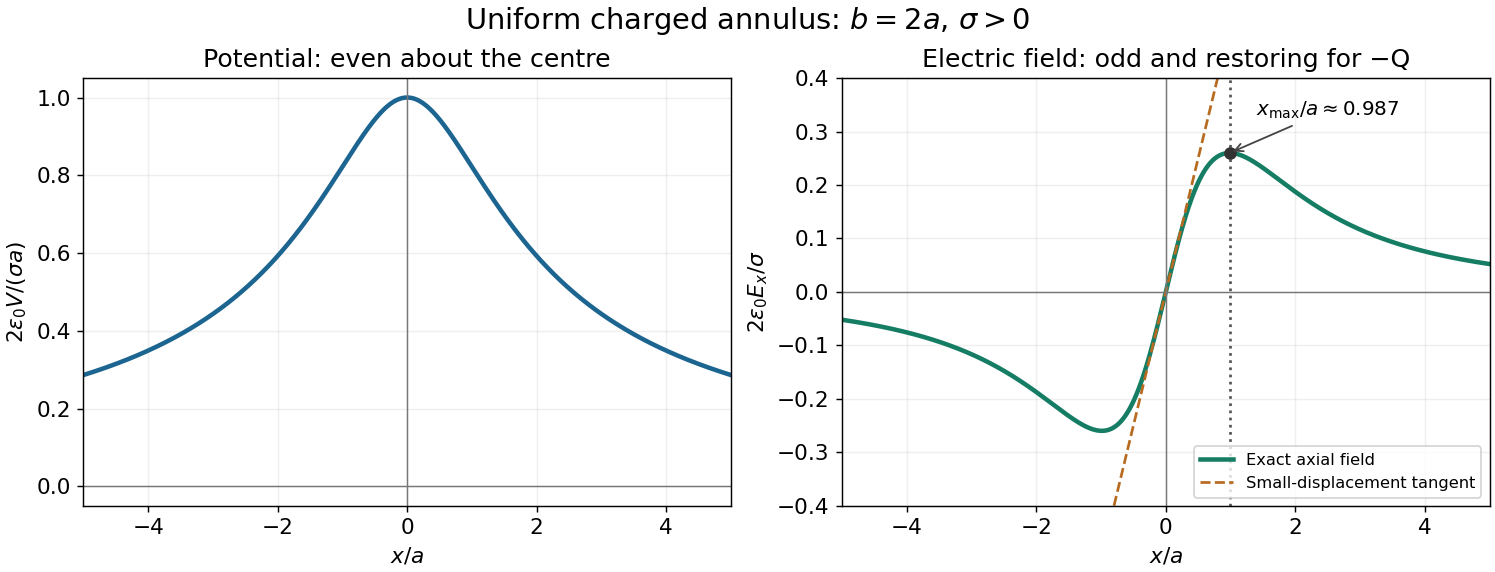
Axial potential and electric field of a uniformly charged annulus
. Original dimensionless curves for and positive surface charge density. The dotted line marks the calculated positive-side maximum of the electric field; the dashed tangent shows its linear behaviour near the centre. Details.
Let be the sliding point charge's mass. Expanding the axial field of a uniformly charged annulus for givesIts electric charge is , so its electric force points toward the centre. Newton's second law becomesTo leading order this is simple harmonic motion, withThe mass is an additional parameter, since the source supplies no numerical value. The constraint is essential: stability along the axis does not imply unconstrained three-dimensional trapping by a static electric field.
For a steady filamentary electric current , the Biot-Savart law isHere is the observation position, the source position, points in the direction of positive electric current, and is the vacuum permeability. A circular loop has centre magnetic field : the cross product has magnitude and a constant axial direction, and .
Introduce the constant signed angular velocity about the positive axis. A ring's electric charge crosses any radial cut once per rotation, so its electric current is . Adding loop contributions yields the magnetic field of a rotating charged annulus:The direction follows the right-hand rule for positive electric charge; reversing either or reverses the magnetic field. The source supplies no rotation rate, so the answer necessarily retains .
Articles by others on the same topic
There are currently no matching articles.