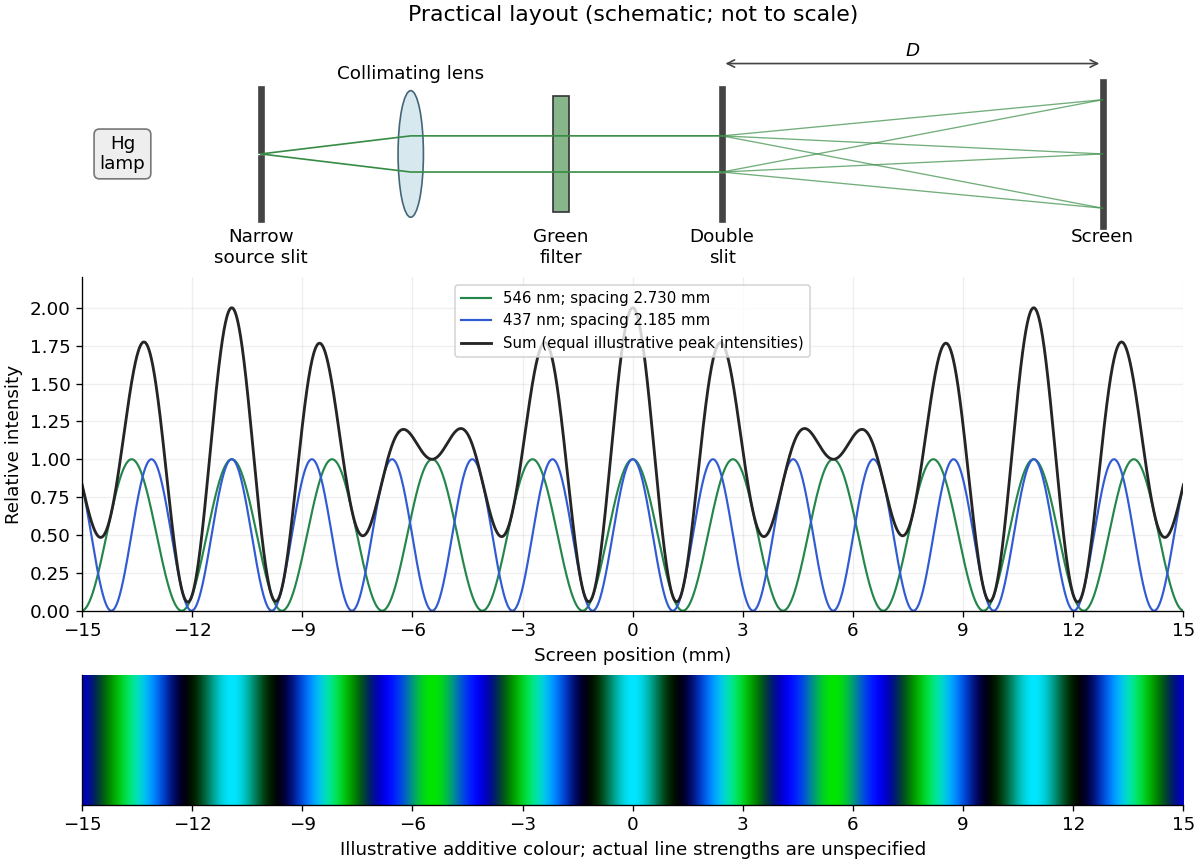
Illuminate a narrow entrance slit with the mercury-vapor lamp, use a collimating lens to illuminate two parallel narrow slits coherently, and insert a bandpass filter selecting the green line. Place a screen or scanning detector a measured distance beyond the double slit. The source slit and the two apertures should be parallel. The aperture widths should be appreciably smaller than their separation to provide an extended diffraction envelope; the green filter should reject the other strong mercury lines. The layout is drawn below.
For slit separation and observation angle , the optical path difference in air is . At a bright interference fringe, . For a distant screen and small angles, , givingMeasuring several interference fringe spacings and dividing by their number reduces relative position error. The derivation assumes the slits have equal phase on illumination and that the screen region lies within their common diffraction envelope.

Articles by others on the same topic
There are currently no matching articles.