For image charges in a sixty-degree conducting wedge, use polar coordinates in a cross-section normal to the planes' intersection, putting the physical wedge at and the real point charge at . Repeated reflection in the two grounded faces produces five image charges, all at radius and the same coordinate along the intersection:Equivalently, the positive copies are at and the negative copies at , for . Only the original point charge lies inside the physical wedge.
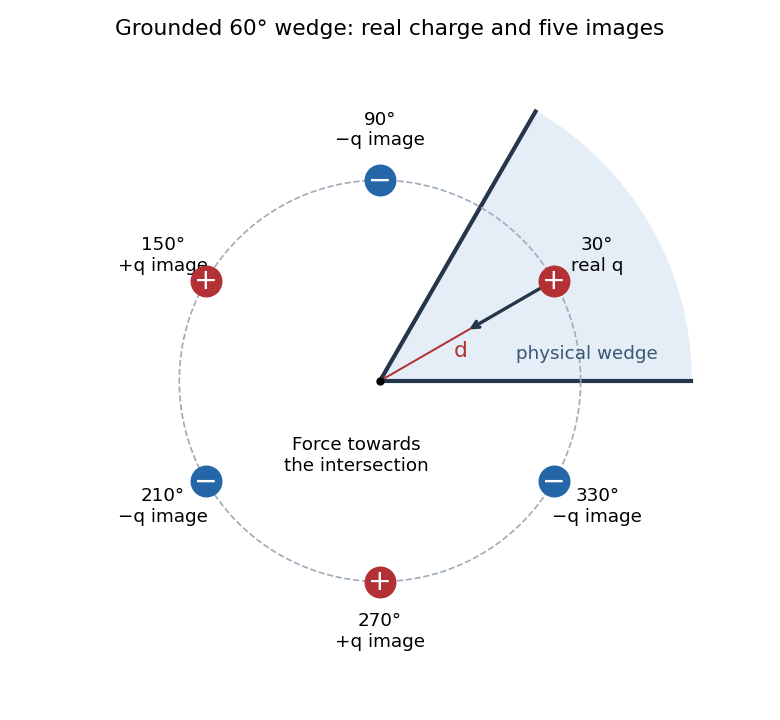
Five image charges outside the physical sixty-degree conducting wedge
. Details. 
For any observation point on either face, reflection pairs every positive point charge with an equidistant negative one. Their Coulomb potentials cancel, so both grounded faces have zero electric potential. The electric potential also tends to zero at infinity. The uniqueness theorem for the electrostatic potential then identifies this method of images construction with the physical solution.
Articles by others on the same topic
There are currently no matching articles.