The two optical frequencies have no persistent mutual optical coherence over the detector's averaging time, so their light intensities add. Assuming equal strengths and using , let be the one-slit light intensity at either wavelength. ThenThe identity rewrites this asThe slowly varying interferometric visibility is approximately . Its first zero occurs atThe rapid fringes have effective wavelength , so the first contrast minimum is at order . Thus the conventional estimate is about 13 fringes on each side, before their first washout, plus the central maximum. “Clearly” is not a specified visibility threshold: the last of those fringes already has low contrast.
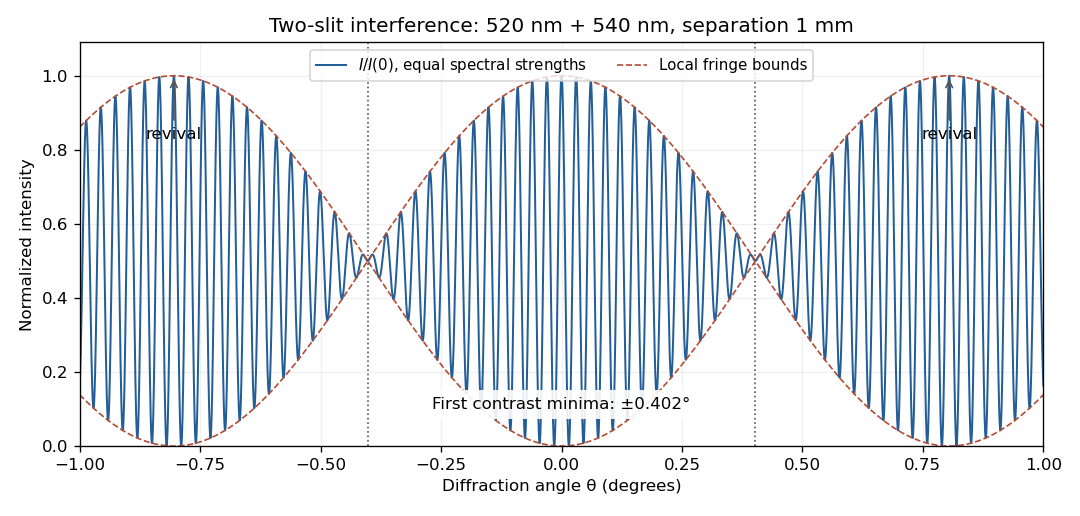
Two-wavelength interference, its first visibility minima, and contrast revival over minus one to plus one degree
. Details. 
The fringes do not disappear permanently beyond that point. Their contrast revives; the first exact common maximum satisfies , at . This is a concrete counterexample to interpreting 13 as a global bound on visible fringes. Unequal spectral strengths would leave nonzero residual contrast at the nominal washout; the plotted equal-strength case is the natural interpretation in the absence of specified strengths.
Articles by others on the same topic
There are currently no matching articles.