Let each slit alone give local light intensity , and assume equal coherent illumination. In Fraunhofer diffraction, the two wave amplitudes differ in wave phase by . Adding the wave amplitudes before squaring givesFor a flat screen, . In the paraxial region , the double-slit interference profile is thereforeThe given justifies the far-field expansion. Slit widths have been neglected; a finite width multiplies this profile by the single-slit diffraction envelope. At large angles the one-slit light intensity and geometric spreading must also be retained, rather than treating as constant.
The screen now lies in the back focal plane of the lens. In paraxial geometrical optics, a light ray arriving at the lens at height and angle leaves at angle , and reaches the screen atThus all light rays with the same incident direction reach the same screen coordinate, independently of their height at the lens. The Fraunhofer diffraction pattern is an angular pattern mapped to :Here is the one-slit light intensity after focusing. Its absolute value depends on collected light and the lens aperture, which are unspecified; it need not equal the no-lens value . Propagation from the slits to the lens introduces a common angular wave phase, so it does not alter the relative wave phase responsible for these fringes, provided the aperture passes the required light.
The slide adds optical path length to the covered beam. Put the covered slit at transverse coordinate . For positive screen coordinate its geometrical path is shorter by approximately , so the total covered-minus-uncovered optical path difference isThe zero-order fringe follows equal total optical path lengths, . HenceThe covered beam needs a shorter geometric path to compensate its extra optical path length. This is the paraxial estimate; exact point-to-point distances give . “Central” here follows the zero-order fringe continuously as the slide is introduced. At one fixed wavelength, the final monochromatic wave interference pattern is periodic, so intensity alone identifies a fringe position only modulo the fringe spacing. Slide reflections and absorption have been neglected.
The two optical frequencies have no persistent mutual optical coherence over the detector's averaging time, so their light intensities add. Assuming equal strengths and using , let be the one-slit light intensity at either wavelength. ThenThe identity rewrites this asThe slowly varying interferometric visibility is approximately . Its first zero occurs atThe rapid fringes have effective wavelength , so the first contrast minimum is at order . Thus the conventional estimate is about 13 fringes on each side, before their first washout, plus the central maximum. “Clearly” is not a specified visibility threshold: the last of those fringes already has low contrast.
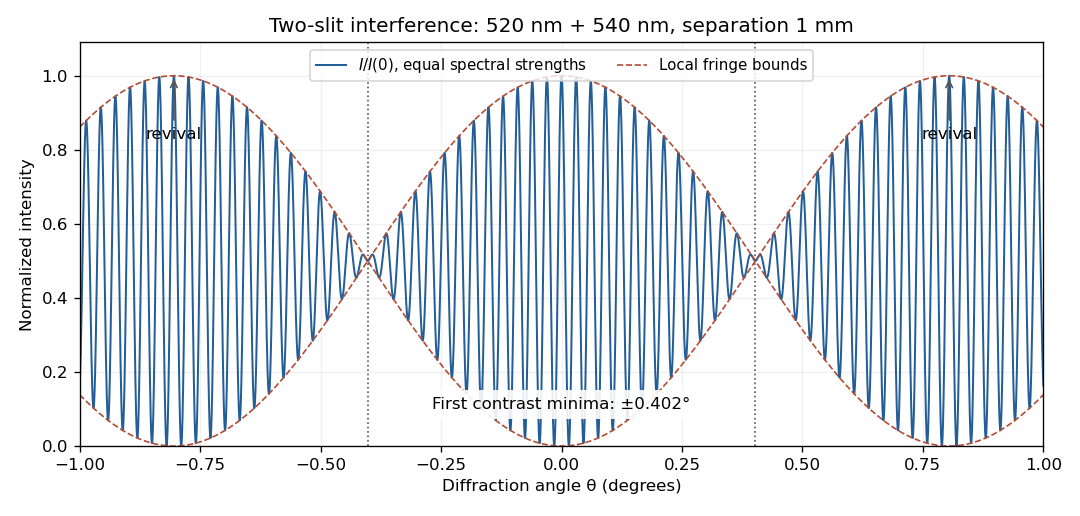
Two-wavelength interference, its first visibility minima, and contrast revival over minus one to plus one degree
. Details. 
The fringes do not disappear permanently beyond that point. Their contrast revives; the first exact common maximum satisfies , at . This is a concrete counterexample to interpreting 13 as a global bound on visible fringes. Unequal spectral strengths would leave nonzero residual contrast at the nominal washout; the plotted equal-strength case is the natural interpretation in the absence of specified strengths.
Articles by others on the same topic
There are currently no matching articles.