One mass per cell. If is the displacement from equilibrium, the two springs give . Substituting yieldsThe first Brillouin zone is ; adding leaves the sampled displacements unchanged. The branch is linear near zero, with sound speed , and reaches at either zone edge.
Two masses per cell. Take a cell of length , with light displacement and heavy displacement . The coupled equations reduce toA nonzero displacement requires determinant zero:Solving this quadratic in givesNow the first zone is . The minus branch is acoustic: as , both sublattices move together and . Its sound speed is . The plus branch is optical: at the atoms move oppositely with , giving finite frequency . This terminology describes relative motion; optical activity itself also requires coupling to the electromagnetic field.
diatomic-chain zone-edge polarizations and dimensionality. At the edge, , so the heavy and light sublattices decouple: the acoustic edge frequency is and the optical edge frequency is . HenceThe acoustic edge mode moves only the heavy sublattice; the optical edge mode only the light one. If , the gap closes and the two branches are the zone-folded monatomic branch.
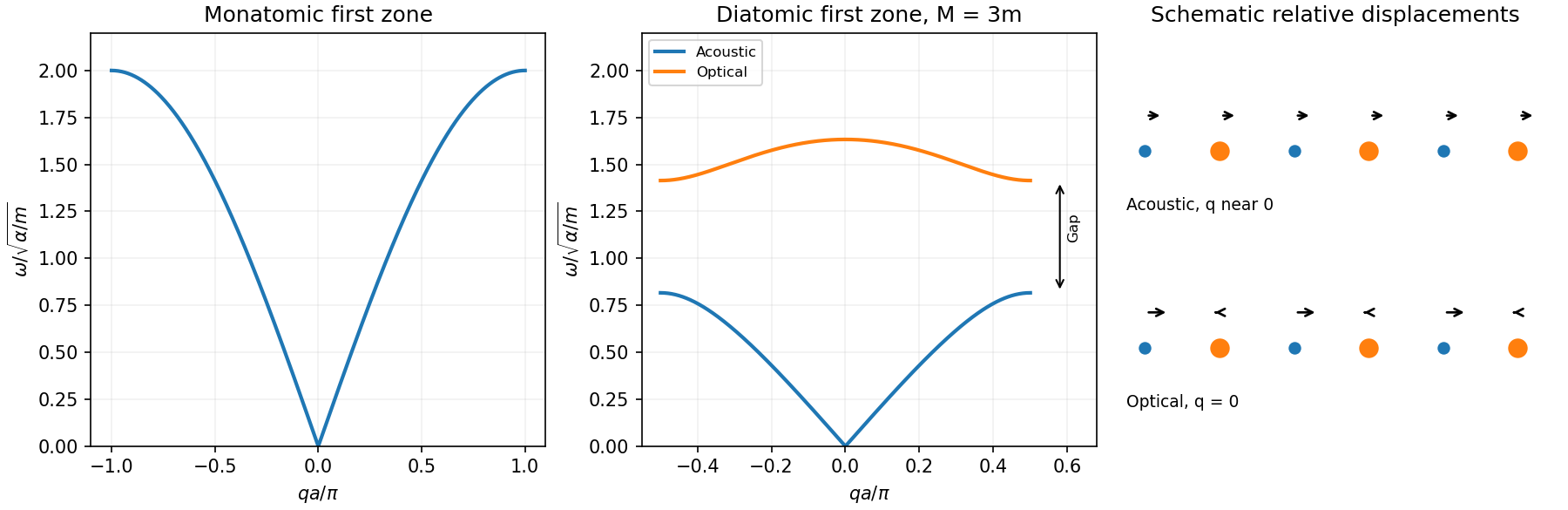
Original monatomic and diatomic chain dispersions, zone-edge gap and long-wavelength displacement patterns
. Details. 
A three-dimensional crystal with two atoms per primitive cell has six branches: three acoustic and three optical. For propagation along a suitable symmetry direction these resolve into one longitudinal and two transverse branches of each type. The wavevector and Brillouin zone are three-dimensional; anisotropic force constants determine the dispersions, and polar crystals can have longitudinal–transverse optical splitting. A universal six-branch curve cannot be specified from masses alone.
Articles by others on the same topic
There are currently no matching articles.