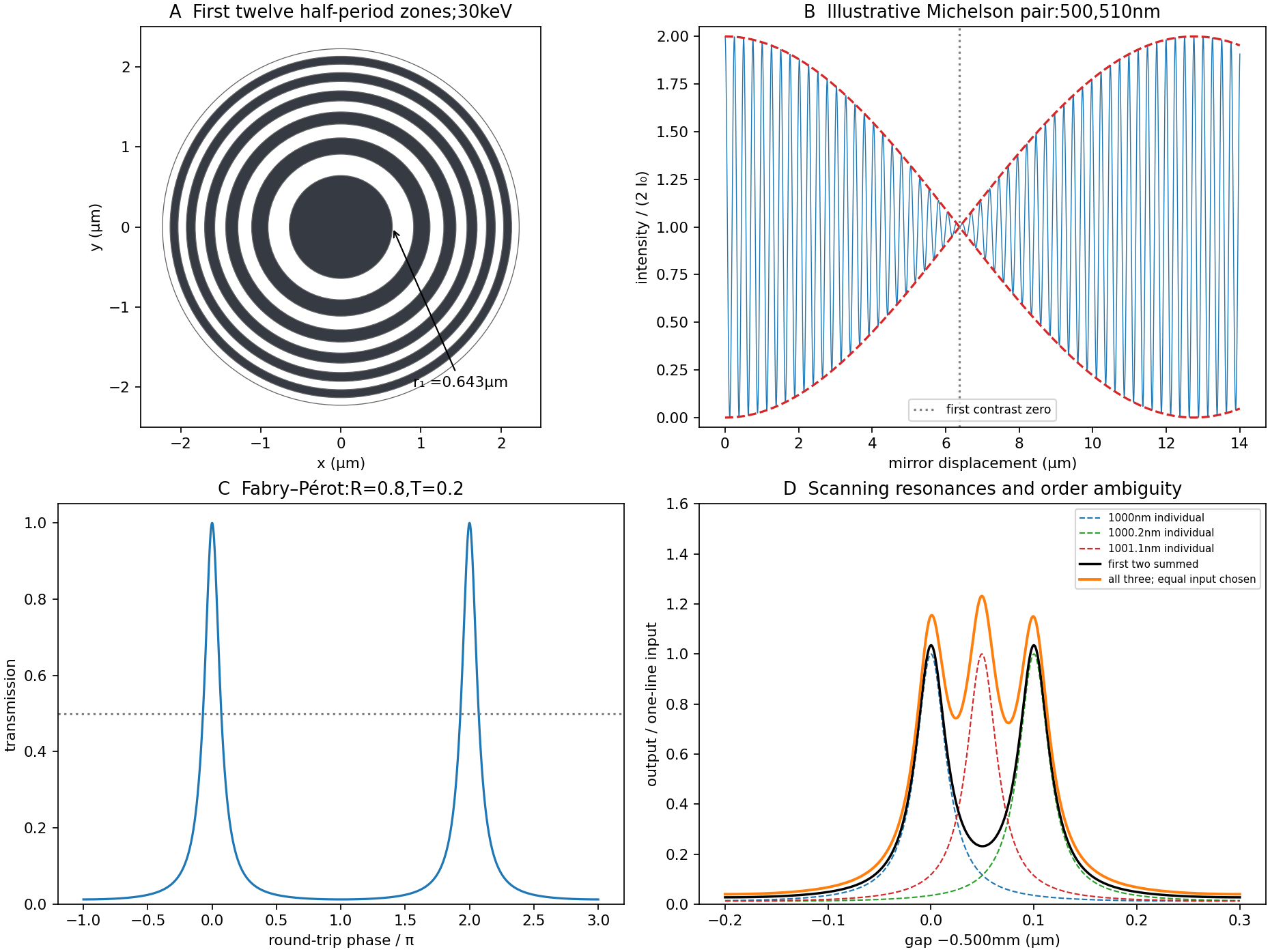
A Fresnel zone plate replaces a conventional refracting surface by concentric alternating transmitting and absorbing annuli. Successive annuli span half a wavelength of optical-path excess to the chosen focus; blocking alternate zones prevents their approximately opposite wave phases from cancelling. For a normally incident plane wave,The paraxial radii grow as , so the zones become narrower outwards.
Using the photon energy relation gives . For ,The first three boundaries are approximately , and . This fixes the zone pattern but does not fix a unique outside diameter: the number of zones is a design choice. For example, gives radius , diameter and outermost zone width about . A larger usable diameter requires finer outer zones.
One could pattern absorbing metal annuli on a thin X-ray-transparent support, choosing absorber thickness from its attenuation at the selected photon energy; that thickness cannot be determined from energy and focal length alone. The design is chromatic: for fixed radii , so a narrow energy band is needed for a sharp common focus.

Articles by others on the same topic
There are currently no matching articles.