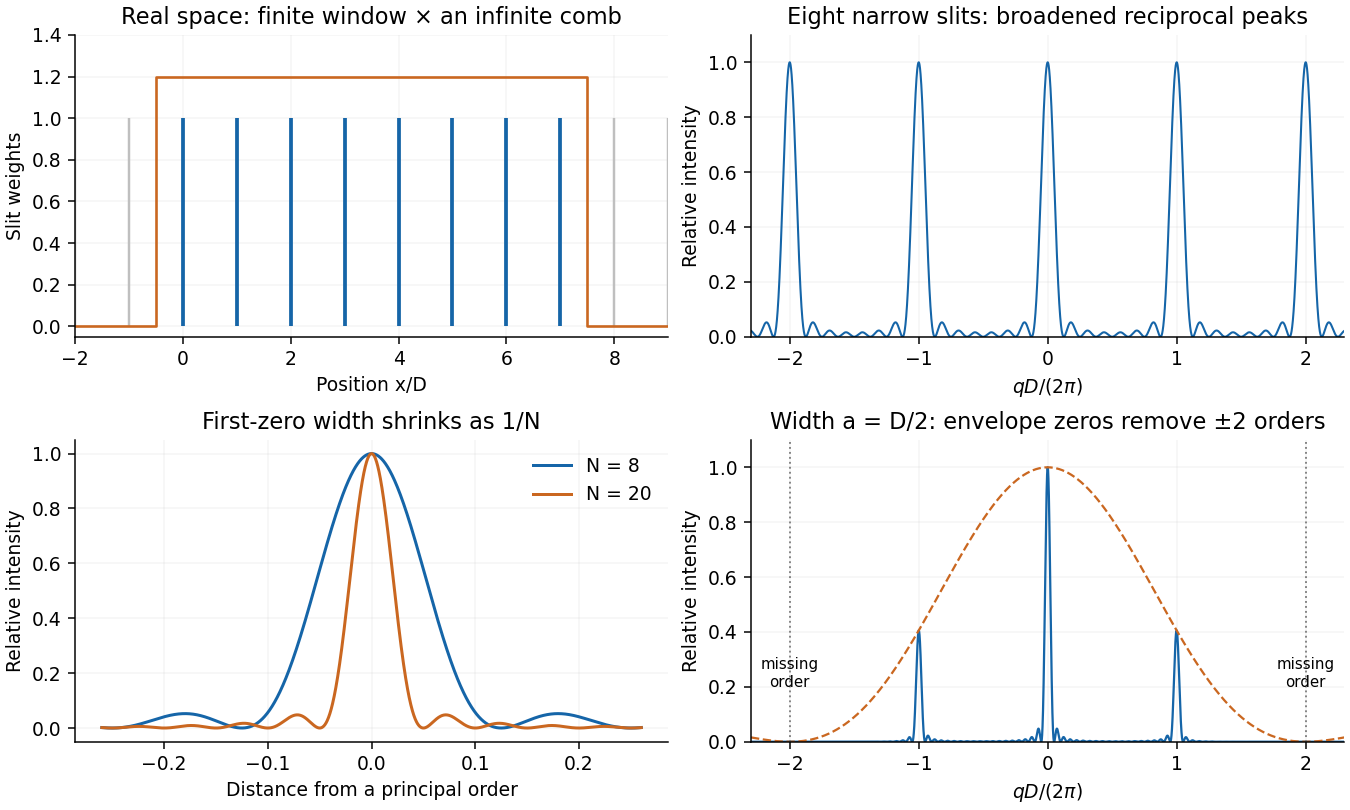
Use Fourier transform convention . The convolution theorem givesA finite array of very narrow slits at , , has transmission proportional to . It can be constructed by multiplying an infinite Dirac comb by a finite window. The infinite comb transforms to a reciprocal comb; the finite window convolves each reciprocal peak with a narrow sinc-shaped amplitude. Thus increasing the illuminated length narrows each Fraunhofer diffraction peak.
The exact finite sum makes the argument quantitative:Its normalized intensity is . Principal maxima occur at ; their first zeros are displaced by . Replacing the ideal narrow slit by a finite slit function convolves the array in real space, multiplying this field by the single-slit Fourier transform. Field amplitudes are transformed and combined before their squared modulus is taken.

Articles by others on the same topic
There are currently no matching articles.