Use Fourier transform convention . The convolution theorem givesA finite array of very narrow slits at , , has transmission proportional to . It can be constructed by multiplying an infinite Dirac comb by a finite window. The infinite comb transforms to a reciprocal comb; the finite window convolves each reciprocal peak with a narrow sinc-shaped amplitude. Thus increasing the illuminated length narrows each Fraunhofer diffraction peak.
The exact finite sum makes the argument quantitative:Its normalized intensity is . Principal maxima occur at ; their first zeros are displaced by . Replacing the ideal narrow slit by a finite slit function convolves the array in real space, multiplying this field by the single-slit Fourier transform. Field amplitudes are transformed and combined before their squared modulus is taken.
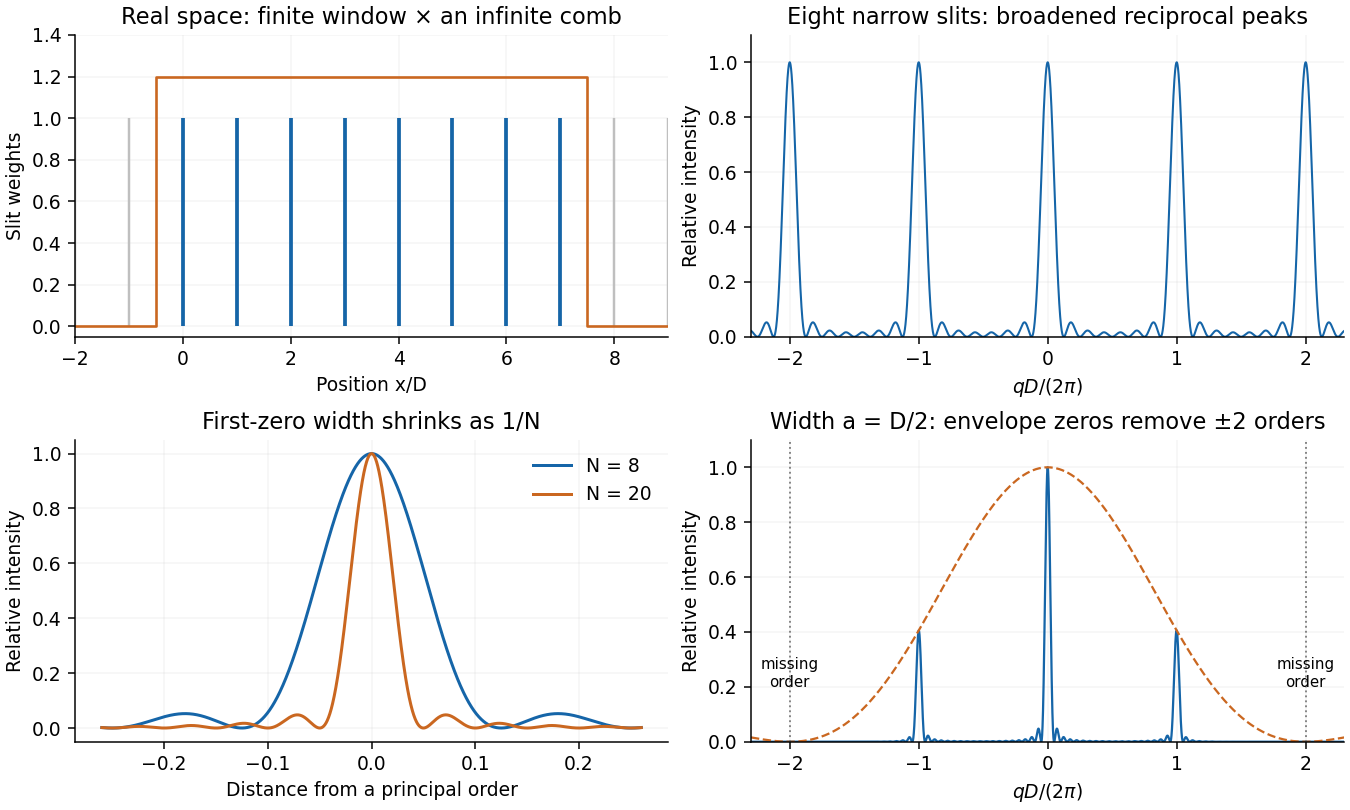
A finite narrow-slit array and its Fourier intensity, showing how the principal peaks narrow with slit count
. Details. 
The pitch corresponding to is . The normal-incidence diffraction grating equation givesThis locates the array-factor maximum; the single-slit envelope must also be nonzero for an observable peak.
Near order , the first angular zero from a principal maximum is . Two wavelengths have peak separation . Equating them applies the Rayleigh criterion and gives the resolving power of a diffraction grating,Here the required resolving power is , so in second order . The illuminated width is thereforeWhether one counts the full illuminated window or the first-to-last slit-centre distance changes the width by one pitch and is immaterial at this precision. The result assumes negligible aberrations and adequate slit illumination and coherence.
The angular dispersion at the chosen order isFor a collecting lens with its axis directed along the selected second-order beam, the local focal-plane separation isA basic one-pixel separation criterion is therefore . A more reliable two-pixels-per-resolution-interval choice is . Finite pixels integrate the pattern, so sampling and pixel response should not degrade the grating's optical resolution.
This pixel sampling of a grating spectrum depends on the layout and criterion, neither of which is fully specified. If the detector is instead described by relative to the incident-axis coordinate, the derivative contains an additional and gives separation, or about for two-pixel sampling. The more approximate paraxial mapping gives . These are stated alternatives rather than one falsely precise universal pixel width.
For a slit of width , the single-slit diffraction amplitude is proportional to . At a grating maximum, , so the envelope factor isThe specified gives at . ThusThe grating maximum coincides exactly with the first single-slit minimum for each wavelength. The preceding width and detector calculations describe the ideal array factor, but this particular rectangular-aperture grating cannot deliver the assumed second-order signal. Pixel refinement cannot repair the missing optical peak. One must change the aperture duty cycle or grating profile, or use an available order and recalculate its resolving power.
Articles by others on the same topic
There are currently no matching articles.