The characteristic impedance of a stretched string is , since its wave speed obeys . Put the endpoint at and use displacement complex amplitudes incident and reflected:At the massless end, the string's transverse force balances the damper's force . Thus , or . This viscous termination of a stretched string hasHalf the incident mean power is reflected when , giving two positive solutions:They are approximately and , in . The smaller coefficient produces no reflected displacement-phase reversal; the larger produces a reversal. Both dissipate the remaining half of the incident power. Choosing the impedance-matched value would instead absorb all of it.
For an object near the front focal plane, the objective's numerical aperture in air isThe Rayleigh criterion for a circular objective gives object-space diffraction-limited resolutionThe factor comes from the first zero of the Airy disk. Using the exact changes the result by less than . A coarser estimate gives ; the chosen criterion must be stated. This estimates the aperture limit, before aberrations and detector sampling.
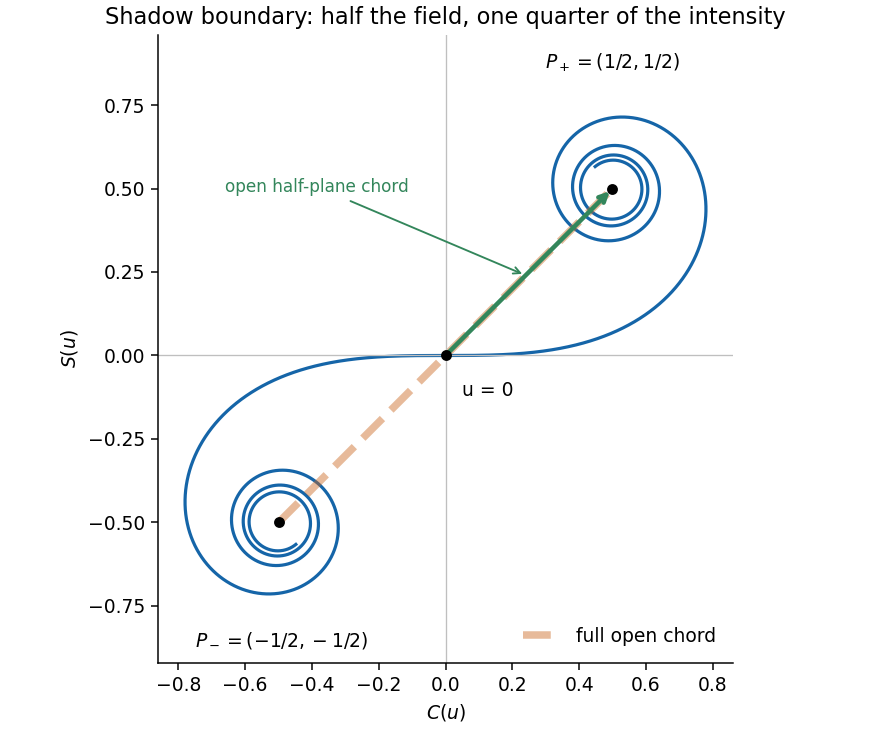
The original diagram puts the upper edge of the obstruction exactly on the straight line from source to detector. The detector is therefore at the geometric shadow boundary, not deep inside the shadow. In the optical convention, the Cornu spiral iswith limiting points and . The unobstructed Fresnel diffraction amplitude is the chord joining both endpoints, proportional to . The open half-plane supplies only the chord from to , proportional to . The coordinate perpendicular to the page contributes the same factor in both cases.This is the half-plane shadow-boundary intensity. The missing half of the aperture removes half the field here, so taking half the intensity would be incorrect.
In a conventional face-centered cubic lattice cell of side , touching nearest-neighbour hard spheres lie along a face diagonal. Four radii span that diagonal, so and . In a conventional body-centered cubic lattice cell, the contact lies on the body diagonal: , giving . ThereforeThese are the nonprimitive cubic unit cells requested. They contain four and two atoms respectively, so their volume ratio should not be confused with the volume-per-atom ratio, which is half as large, . The common sphere radius cancels.
For fixed Electron number , the specified electron degeneracy pressure scales as . Differentiating at fixed low temperature gives the degeneracy-pressure bulk modulus,A monovalent sample has one conduction Electron per atom. Its carrier density isusing the Avogadro constant . Substitution with reduced Planck constant and electron mass givesEquivalently, and for this free electron model. This is the assumed electronic contribution, not a calculation of the complete equation of state of real potassium: ionic cohesion and interaction corrections have been excluded as instructed. The supplied pressure is the zero-temperature form, appropriate to leading order for .
Use the convention for the harmonic force and displacement complex amplitudes. Substitution in the forced harmonic oscillator equation givesIts magnitude and phase relative to the force areAt zero frequency, and . At , ; at high frequency the phase approaches . For light viscous damping, the quality factor is large and there is a tall narrow displacement peak close to .
To find the displacement peak, minimize the squared denominator:The nonzero minimum givesFor stronger damping there is no positive-frequency displacement maximum. When and ,The inertia then dominates the restoring and damping forces.
The four supporting springs act in parallel, so their total spring constant is . The driving angular frequency is . The force-driven vibration isolation estimate givesAt this mass, , and , so the assumptions are consistent. The exact forced amplitude isIt is indeed close to , but it is slightly above the strict requested bound. Setting the exact expression to gives the high-mass thresholdChoose a mass strictly greater than this threshold for a strict inequality; is a suitable rounded choice. Simply rounding the high-frequency estimate down would not guarantee the bound.
Measure downward displacement relative to the former mean equilibrium. The added changes the equilibrium byAssume the load is deposited without a significant impact impulse and then moves with the table. The moving mass becomes . Ignoring the tiny pre-existing vibration in the sketch, the added-load step response of a supported table isFor the estimated mass, , the envelope time is , and the period is about . The table overshoots and rings about the new equilibrium, with the displacement starting continuously at zero and with zero initial slope. A real impact adds an initial-velocity transient; the problem gives no impact history. The residual driven vibration, of order a micrometre, can be superposed.
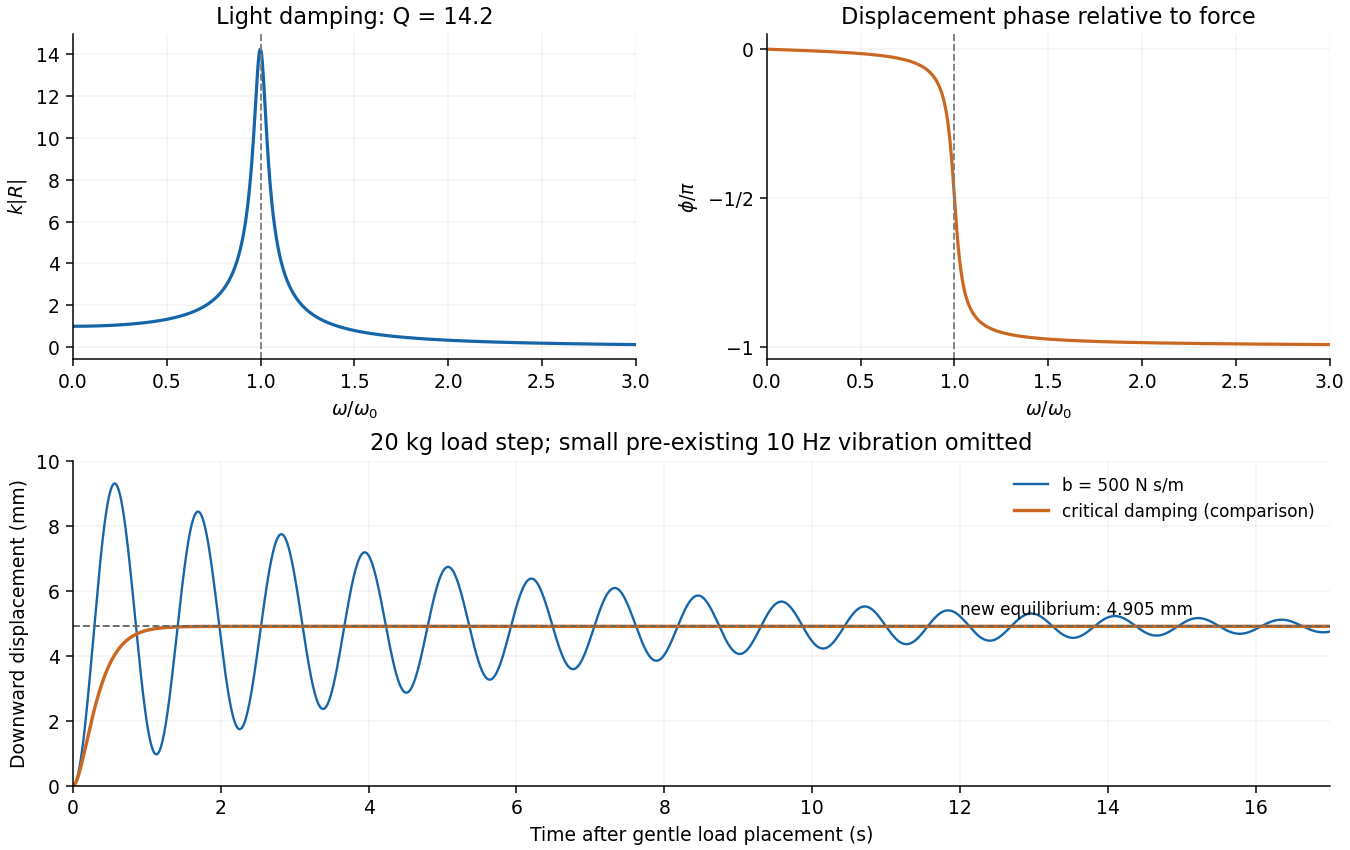
Lightly damped response amplitude and phase, followed by the table's load-step displacement and a critically damped comparison
. Details. To settle quickly after loading, critical damping is preferable to the supplied weak damper:Using the strict-bound mass instead changes this by less than . This eliminates free ringing while avoiding the slow tail of severe overdamping. In the stipulated external-force model, greater damping also reduces the steady forced amplitude; there is no finite optimum based solely on that amplitude. A critical or near-critical value is a practical compromise for rapid settling. If the disturbance were specified as floor displacement transmitted through the legs, damping would introduce an additional transmission tradeoff, but that is a different forcing model.
Superpose two nearby harmonic waves. The identityseparates a rapid carrier from a slow beat envelope. A constant point of the envelope moves at , which tends toas the components approach one another. Equivalently, expand a narrow wave packet spectrum around : . Factoring the carrier out of its Fourier transform representation leaves an envelope depending on . This interpretation requires a narrow spectrum and little attenuation or distortion; higher derivatives of the dispersion relation can change the envelope shape. The carrier phase velocity is and need not equal .
For the wavelength in the medium, , differentiate :The distinction in group velocity in material and vacuum wavelength coordinates is essential for the numerical data. For incident vacuum wavelength , differentiation of instead givesThus the printed derivative identity is valid, but its wavelength coordinate cannot be carried unchanged into data specified before refraction.
The wavelengths specified for incidence from vacuum are . With fixed incident angle , Snell's law gives and . At the central wavelength,Use a central difference, converting the angle change to radians:The group index from refracted-angle dispersion isDirectly inserting the incident vacuum wavelengths into would instead give . That is a plausible intended rough answer, but it mixes wavelength coordinates; the boxed result consistently uses the incident data. The two agree only to first order in a sufficiently small dimensionless dispersion correction.
Taking as the distance travelled in the medium, the narrowband group delay isIf denotes a slab thickness measured normal to the interface instead, the central ray travels , giving about . The coordinate-mixed velocity above would give for a path; it should not replace the consistent calculation silently.
The pulse envelope travels at the local group velocity, while individual carrier crests move at the phase velocity. In general, variation of group velocity across the pulse spectrum produces different delays, temporal broadening and chirp. Absorption can reshape the spectrum and envelope as well. The refraction data also show wavelength-dependent angles, so a finite-width incident beam acquires spatial separation of its spectral components. The supplied first derivative determines the central delay but does not specify a pulse duration, absorption spectrum or reliable second derivative of the dispersion relation; it therefore does not determine a numerical broadening, or its sign. If propagation phase is effectively linear across a sufficiently narrow spectrum, the leading approximation is a delayed pulse with unchanged shape.
Use Fourier transform convention . The convolution theorem givesA finite array of very narrow slits at , , has transmission proportional to . It can be constructed by multiplying an infinite Dirac comb by a finite window. The infinite comb transforms to a reciprocal comb; the finite window convolves each reciprocal peak with a narrow sinc-shaped amplitude. Thus increasing the illuminated length narrows each Fraunhofer diffraction peak.
The exact finite sum makes the argument quantitative:Its normalized intensity is . Principal maxima occur at ; their first zeros are displaced by . Replacing the ideal narrow slit by a finite slit function convolves the array in real space, multiplying this field by the single-slit Fourier transform. Field amplitudes are transformed and combined before their squared modulus is taken.
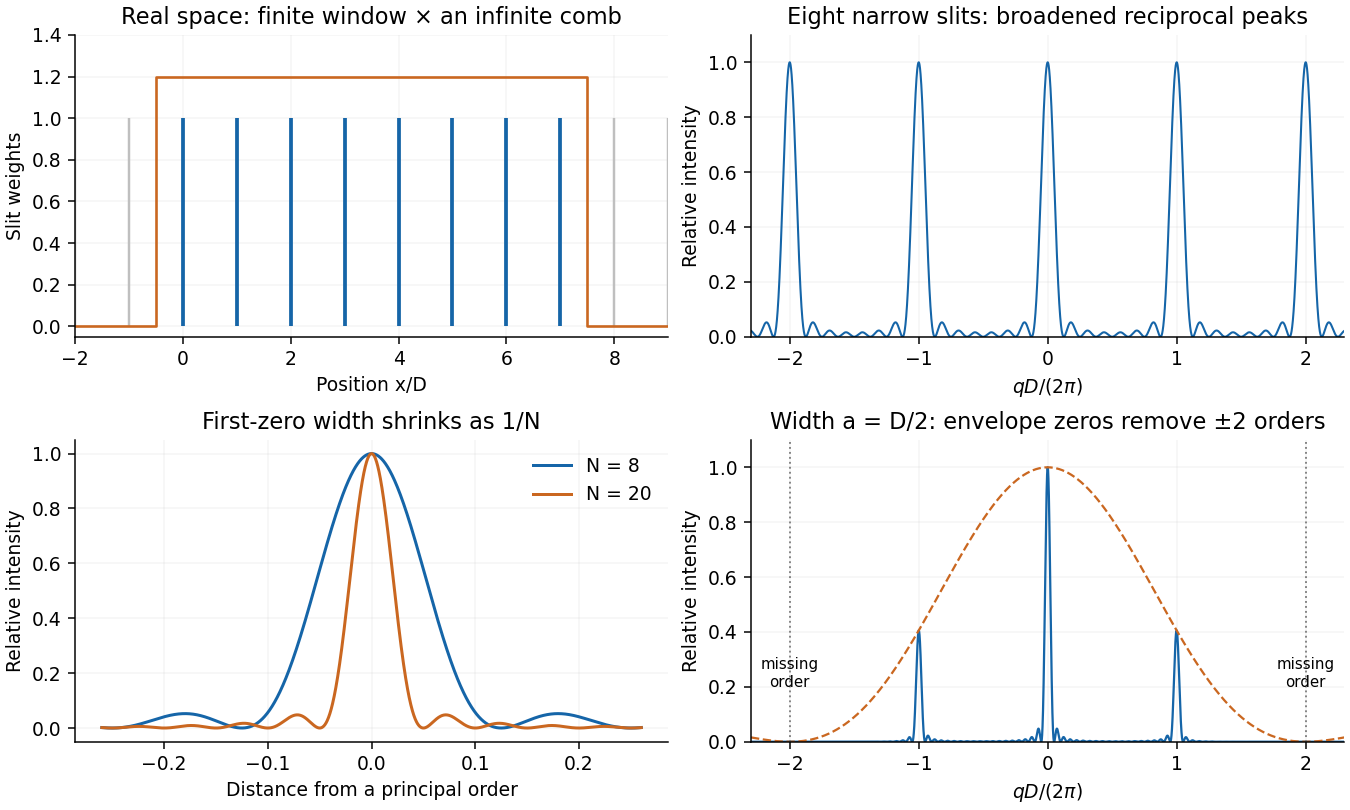
A finite narrow-slit array and its Fourier intensity, showing how the principal peaks narrow with slit count
. Details. The pitch corresponding to is . The normal-incidence diffraction grating equation givesThis locates the array-factor maximum; the single-slit envelope must also be nonzero for an observable peak.
Near order , the first angular zero from a principal maximum is . Two wavelengths have peak separation . Equating them applies the Rayleigh criterion and gives the resolving power of a diffraction grating,Here the required resolving power is , so in second order . The illuminated width is thereforeWhether one counts the full illuminated window or the first-to-last slit-centre distance changes the width by one pitch and is immaterial at this precision. The result assumes negligible aberrations and adequate slit illumination and coherence.
The angular dispersion at the chosen order isFor a collecting lens with its axis directed along the selected second-order beam, the local focal-plane separation isA basic one-pixel separation criterion is therefore . A more reliable two-pixels-per-resolution-interval choice is . Finite pixels integrate the pattern, so sampling and pixel response should not degrade the grating's optical resolution.
This pixel sampling of a grating spectrum depends on the layout and criterion, neither of which is fully specified. If the detector is instead described by relative to the incident-axis coordinate, the derivative contains an additional and gives separation, or about for two-pixel sampling. The more approximate paraxial mapping gives . These are stated alternatives rather than one falsely precise universal pixel width.
For a slit of width , the single-slit diffraction amplitude is proportional to . At a grating maximum, , so the envelope factor isThe specified gives at . ThusThe grating maximum coincides exactly with the first single-slit minimum for each wavelength. The preceding width and detector calculations describe the ideal array factor, but this particular rectangular-aperture grating cannot deliver the assumed second-order signal. Pixel refinement cannot repair the missing optical peak. One must change the aperture duty cycle or grating profile, or use an available order and recalculate its resolving power.
Let the first ray reflect at the upper surface and the second traverse the film, reflect below, and emerge at a laterally displaced point. Its internal round-trip geometric length is , but the external path to a common outgoing wavefront must also be included. The lateral separation is , whose projection along the external ray is . The net optical path difference is thereforeusing Snell's law . Multiplying by the vacuum wavenumber givesFor the usual index ordering , including the stated later value , both reflections are towards higher refractive index and both reverse the electric-field sign. Their relative reflection phase is therefore zero; is also their total relative phase modulo . A different index ordering or polarization-dependent reflection phase would require that additional term.
At the same output in air, use incident intensity . The two specified output amplitudes, including their common reflection sign, give the thin-film interference resultThe output is a cosine with mean , period , and extremaThe unequal amplitudes prevent a dark minimum; their interference visibility is . This is the stipulated two-beam model: the supplied amplitudes already include propagation and transmission factors, and internal re-reflections are excluded by the stated assumption. They need not be recomputed from the later index value.
Eliminate the internal angle using Snell's law:Neighbouring bright fringes differ in phase by . The local angular fringe spacing of a transparent film therefore givesWith , , and ,The data specify a local spacing near , so differentiating is appropriate; choosing particular neighbouring fringe angles slightly shifts this approximate result. The phase decreases as incidence angle increases.
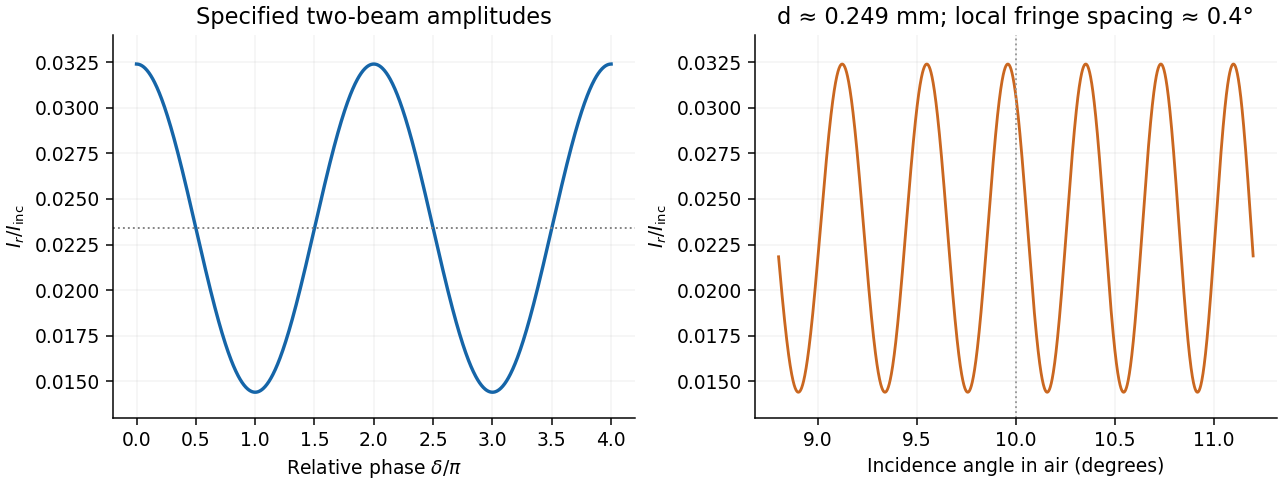
Two-beam reflected intensity versus phase and angular fringes for the inferred film thickness
. Details. At normal incidence, the propagation phase is . Different film thicknesses therefore produce bright and dark contours of equal thickness, with adjacent same-type fringes differing by . Under monochromatic illumination these are intensity variations of the incident colour, rather than a rainbow.
For the usual case , reflection at air-oil reverses phase while reflection at oil-water does not. The additional relative makes reflected minima occur at and maxima at . If the oil index were below the water index, the phase-reversal pattern would change and these conditions would interchange. The thinnest regions need not be completely dark because the two reflected amplitudes need not match; at vanishing thickness the residual reflection approaches that of the air-water boundary. Surface motion changes the thickness contours and moves the fringes.
A phonon is one quantum of a crystal's vibrational normal modes. In the harmonic approximation, each mode is a quantum harmonic oscillator with energy levels . A phonon carries excitation energy and crystal momentum modulo a reciprocal lattice vector. It is a collective lattice excitation, not one atom travelling along the chain. Phonons obey Bose-Einstein statistics; their number need not be conserved in thermal equilibrium.
Put type-A atoms at and type-B atoms at . Their displacements obey Newton's second law,Choose normal modes and . Substitution givesA nonzero displacement vector requires zero determinant:Solving this quadratic in gives the diatomic-chain dispersion relation with equal springs,The primitive unit cell has length , so the first Brillouin zone is .
The minus solution is the acoustic phonon branch. As , tends to zero and : adjacent atoms move together in a long-wavelength compression. The plus solution is the optical phonon branch, with nonzero zone-centre frequency and : the two sublattices move against one another with fixed cell centre of mass. For oppositely charged ions, this relative displacement can couple to an electric field, motivating the optical name.
At the zone boundary the frequencies are and . Different masses produce a gap; equal masses make the two branches meet, recovering a folded monatomic dispersion.
Put and use . Expanding the square root givesThus, to leading nonzero orders,The absolute value ensures a nonnegative angular frequency for either direction. The speed of sound is the initial acoustic slope .
The vertical axis of the original figure is angular frequency, in , not ordinary frequency. Its zone-centre optical intercept is approximately . Convert the relative atomic masses using :The long-wavelength inference of diatomic-chain parameters then givesNo factor is needed because the graph already plots .
Reading near the origin, an acoustic point is approximately . The initial slope therefore estimatesCombining the slope with the inferred spring constant givesThis is the model's adjacent Na-plane to Cl-plane spacing; its cell length is . The slope is a graphical estimate, so values around – and spacings near are consistent with the reading precision. A real ionic crystal has interactions beyond the scalar nearest-neighbour model; an intercept-and-slope fit need not reproduce the entire measured dispersion or independently measured structural spacing exactly.
A semiconductor has a filled valence band and an empty conduction band at zero temperature in the intrinsic idealisation, separated by a modest band gap. Thermal excitation or deliberately introduced impurities can create mobile Electrons and electron holes. Its conductivity is consequently very sensitive to temperature and doping. A metal has available electronic states at the occupied energy boundary, through a partly filled band or overlapping bands, and need not thermally excite carriers across a gap.
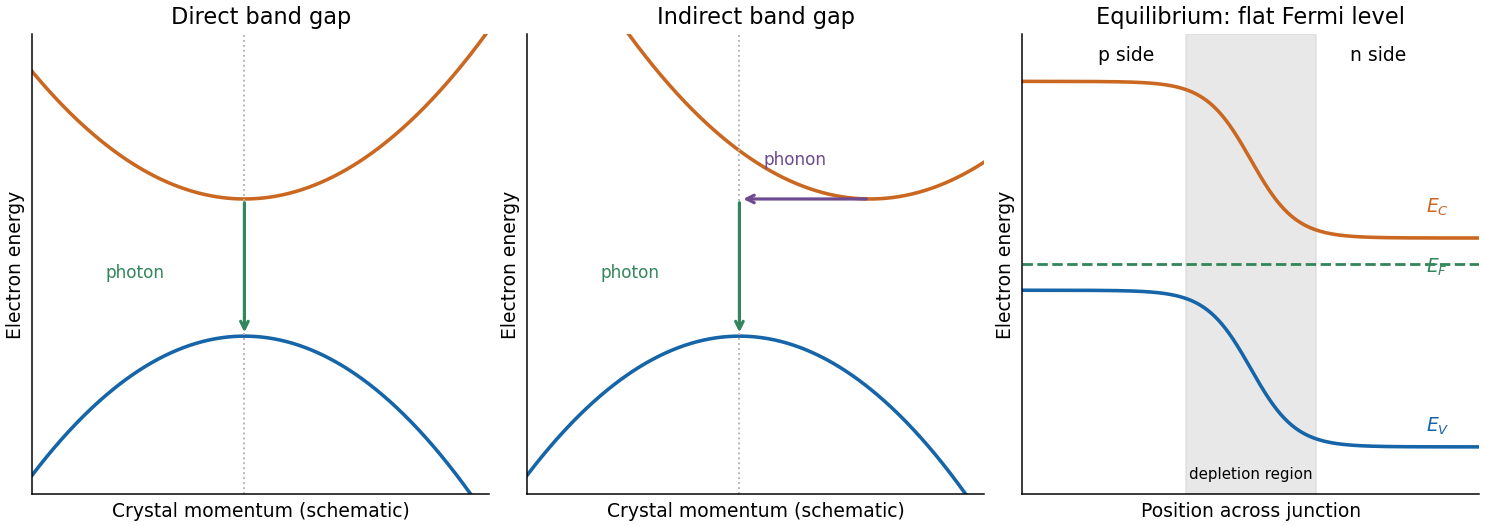
For a direct band gap, the conduction-band minimum and valence-band maximum occur at the same crystal momentum. An Electron can recombine with a hole near these extrema and emit a photon while conserving crystal momentum, since optical photon momentum is small on the lattice scale. For an indirect band gap, the extrema lie at different crystal momenta. A band-edge radiative transition then ordinarily needs a phonon as well, making it less probable and allowing nonradiative processes to compete more effectively.
gallium arsenide has a direct fundamental gap, while silicon has an indirect one. This makes efficient band-edge emission and hence a light-emitting diode easier to obtain from gallium arsenide. It does not mean silicon has no optical transitions or that every direct-gap sample emits efficiently: defects, surfaces and carrier confinement also matter.
Semiconductor doping introduces impurities with levels close to the band edges. A donor impurity can release an Electron to the conduction band, leaving a fixed positive ion; an n-type semiconductor has Electrons as majority carriers. An acceptor impurity can take an Electron from the valence band, leaving a mobile hole and fixed negative ion; a p-type semiconductor has holes as majority carriers. The opposite species remains as a minority carrier population, and a neutral bulk sample balances the ionised dopants with mobile carriers.
At a p-n junction, concentration gradients initially drive Electrons and holes across the join. Their removal near the join exposes negative acceptor ions on the p side and positive donor ions on the n side, forming a depletion region. Its electric field opposes further majority-carrier diffusion. Equilibrium has a flat Fermi level, no net current and spatially bent band edges. With p on the left and n on the right, the Electron band edges fall towards the n side; the difference is the equilibrium barrier in Electron energy. A flat Fermi level does not mean flat conduction and valence edges.
For a hydrogenic donor state, replace the bare Electron mass by and the Coulomb permittivity by with . Rescaling the Bohr model gives the positive ground-state binding magnitudeThe radius isusing the Bohr radius . The supplied positive hydrogen “energy” formula should be interpreted as a binding magnitude; the bound level's energy relative to the conduction-band edge is .
At , , about five times the binding energy. Thus a substantial fraction, ordinarily most of the shallow donors in the dilute nondegenerate regime, will be ionised. An exact fraction also depends on the Fermi level, donor concentration and degeneracies; comparing with alone does not determine it exactly. The large radius explains why a weakly bound donor extends across many unit cells.
The atomic number density isOne fully ionised single-electron donor per million atoms givesThe usual simplified answer treats conductivity as proportional to Electron concentration and assumes unchanged electron mobility, giving about times the undoped conductivity. There is a qualification: the conductivity ratio of doped and intrinsic semiconductors is not fixed by Electron counts alone. Intrinsic material also has , whereas the heavily n-type sample has and . ThereforeWith unchanged Electron mobility and negligible intrinsic hole conductivity this reduces to ; with equal, unchanged Electron and hole mobilities it is about . The problem supplies no mobilities, so the density-ratio estimate requires its stated approximation. Ionised impurities may additionally reduce mobility.
Use a Hall effect measurement. Pass a known current through a thin rectangular specimen, apply a perpendicular magnetic field , and measure the transverse Hall voltage . For a uniform single-carrier sample of thickness ,The Hall-voltage sign identifies the carrier sign. Reverse and the current to separate the field-odd Hall signal from voltage-probe misalignment and offsets, and measure the specimen thickness accurately. The extraction assumes a one-carrier Hall factor near one. In intrinsic or mixed-carrier material, the two-carrier Hall coefficient is mobility weighted, so Hall voltage and conductivity need a two-carrier interpretation rather than this simple inverse formula.
For donor number density , the mean separation is of order . A donor-state overlap estimate sets this scale comparable with the effective radius:Relative to the atomic density, this is , about parts per million. If “start to overlap” is defined geometrically by centre separation , the estimate is instead , about parts per million. Thus the geometric estimate is of order –. Real donor wavefunctions have tails, not hard orbit edges, so this does not define a sharp threshold or by itself locate a metal-insulator transition.
Circular apertures and circular obstructions illustrate both the usefulness and the limits of geometric shadow arguments. In scalar diffraction theory, each point of a transmitted wavefront contributes a complex secondary field. Their coherent sum, described by the Huygens-Fresnel principle, determines the intensity. Circular symmetry simplifies the integral, but the answer depends on whether propagation is in the Fraunhofer diffraction or Fresnel diffraction regime.
For aperture radius and axial propagation distance , the Fresnel number measures the importance of quadratic phase across the aperture. The far-field condition is ; a lens can produce the same angular spectrum in its back focal plane. Fresnel propagation retains that quadratic phase. For an axial point source a distance before the object and an observer a distance after it, the phase uses the effective distance , because both incident and outgoing spherical paths contribute curvature. Scalar, paraxial propagation and an opening large compared with wavelength are assumed throughout.
A circular hole in the far field gives an Airy pattern. For uniform plane illumination the field is the two-dimensional Fourier transform of the aperture. In polar coordinates, let ; the angular integral gives the Bessel function :ThusThe limiting central value is one because near zero. A bright central Airy disk is surrounded by progressively weaker concentric rings. The first dark ring has , or with diameter . This scale gives the Rayleigh criterion for a circular optical instrument. Larger apertures narrow the angular pattern; a lens of focal length maps the first dark ring to radius in its focal plane.
In the Fresnel regime, the axial intensity oscillates as aperture size or distance changes. Fresnel half-period zones have boundaries at path excesses and approximately opposite phases in successive zones. For a plane wave, their radii obey . A circular opening can therefore expose alternating constructive and cancelling zone contributions. More precisely, Fresnel diffraction by a circular aperture gives, normalized by the unobstructed field,An odd integer number of zones gives a bright axial point with ideal intensity ; an even number gives an axial zero. Intensity can locally exceed the unobstructed value because interference redistributes energy; total transmitted power still obeys conservation of energy. The relative normalisation here differs from the Airy expression, which normalises each far-field pattern by its own central intensity.
Off axis, the circular Fresnel field isIts concentric structure evolves with and includes fringes near the geometrical edge. The axial zone argument does not determine the complete off-axis pattern.
Complementary holes and opaque disks are related at the field level. Babinet's principle states for complementary aperture and disk transmissions under the same illumination. In the Fraunhofer region away from the direct transmitted beam, the background field is absent and the diffracted fields are opposite in sign. Their scattered intensity profiles therefore have the same Airy angular dependence. Exactly in the forward direction the unobstructed field must be retained; subtracting intensities is incorrect. Finite incident beams also give a finite-width direct beam rather than an ideal angular delta function.
For Fresnel diffraction by an opaque disk, the axial complement is particularly striking:The ideal circular disk has an Arago spot at the centre of its geometric shadow. Circular edge contributions reach the axial point with the same phase. This does not mean the whole shadow is illuminated: off-axis cancellation produces the surrounding shadow and rings, and the axial spot becomes narrower for larger obstruction or shorter propagation distance. An aperture's axial intensity oscillates, while its complementary disk's axial intensity stays constant in this ideal paraxial model.
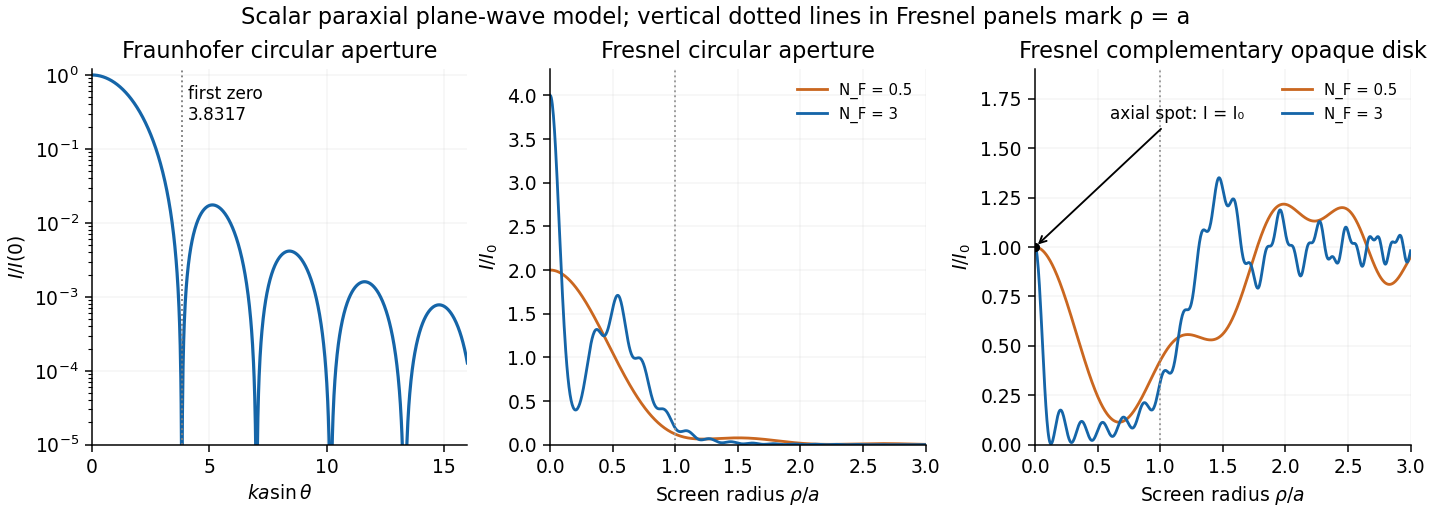
Original computed circular diffraction profiles: Airy far field and Fresnel aperture and complementary-disk intensities
. Details. A practical observation uses a compact coherent source, an accurately circular hole or disk, and an aligned screen or camera. Varying the propagation distance or aperture radius reveals the transition between regimes. A point source, or spatial filtering, prevents different source positions from washing out the fine structure. Finite source size, incomplete coherence, edge roughness, misalignment, vector effects for wavelength-sized objects and lens aberrations reduce the ideal contrast. These experimental limitations explain why a geometrically unexpected axial bright point requires a suitable setup even though its scalar derivation is simple.
The Debye model treats a solid's low-frequency lattice vibrations as acoustic phonons in an elastic continuum. There are three polarizations per wavevector, one longitudinal and two transverse, with approximately linear dispersion relations. A cutoff is chosen to preserve the total vibrational modes of atoms. The phonon number itself is not fixed; mode occupations follow the Bose-Einstein distribution with zero chemical potential.
For one polarization of speed , counting wavevector states in a spherical shell gives . Define an average Debye speed by . The total density of states can then be writtenThe Debye wavevector is , the Debye frequency is , and the Debye temperature is .
Omitting the temperature-independent zero-point energy, the vibrational energy and resulting Debye heat capacity areAt low temperature the upper limit can be extended to infinity. The integral is , givingOnly the long-wavelength acoustic modes are appreciably populated, explaining the Debye T-cubed test. At high temperature every mode contributes by equipartition theorem, so , the Dulong-Petit law.
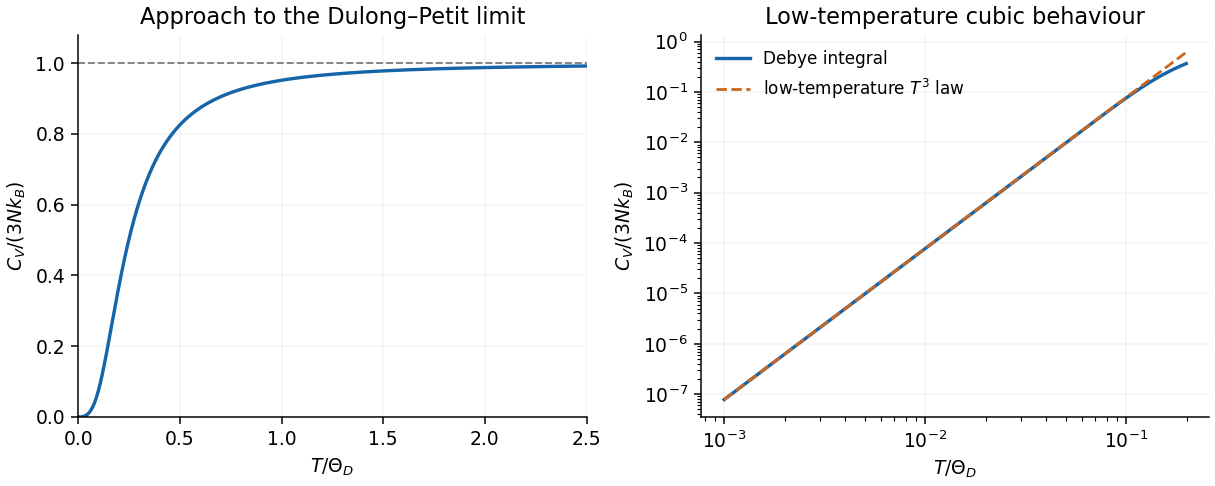
The model succeeds especially at low temperature, where long-wavelength elasticity is reliable. It replaces real anisotropic branches by a simple continuum and cannot reproduce detailed optical phonon branches or every intermediate-temperature feature. Metals also have an electronic heat capacity approximately proportional to ; defects, magnetic excitations or a phase transition can add other terms. Experiments often measure heat capacity at constant pressure, which need not equal the harmonic model's exactly.
A band effective mass describes the acceleration of an electronic wavepacket in a periodic lattice through the local band curvature. It incorporates the periodic lattice potential into a useful transport parameter without changing the bare Electron mass. For a Bloch state in an isolated band,Differentiation givesIn one dimension this becomes . A locally parabolic isotropic band minimum has with positive . A flatter band has a larger effective mass. At a band maximum the Electron curvature is negative, so the Electron accelerates oppositely to the applied force. Describing the missing Electron as a positive-charge electron hole with positive mass is often simpler.
In the scalar relaxation-time approximation, a conduction Electron in an electric field reaches . ThusFor a crystal with different directional curvatures, conductivity is a tensor and involves the occupied states and their scattering. Contributions from Electrons and holes add: in an isotropic two-carrier description. A filled band contributes no ordinary longitudinal current because opposite group velocities cancel; a partially filled band or holes permit a current response.
Effective mass therefore connects measured electrical transport to electronic band structure, but carrier density and momentum relaxation time matter as much as curvature. Ionised impurities and phonons alter . A smaller mass does not guarantee a higher conductivity if carrier population or scattering changes. Nor are all reported masses identical: density-of-states, cyclotron and conductivity masses weight anisotropic bands differently. The simple semiclassical formula assumes an isolated band, slowly varying weak fields and negligible interband transitions; near degeneracies or strong fields a single constant scalar mass is inadequate.
For a Bravais lattice with primitive translation vectors , define the reciprocal lattice by vectors satisfying for every direct-lattice translation . A convenient basis iswith cyclic formulas for . Then and for integers . The reciprocal primitive volume is .
These vectors are the spatial Fourier series frequencies of a periodic lattice potential or density. Elastic coherent crystal diffraction occurs when the scattering wavevector transfer equals a reciprocal lattice vector, with intensities additionally controlled by the basis crystal lattice structure factor. This is the reciprocal-space version of Bragg's law. A lattice of points and its basis should not be confused: a basis can make allowed reciprocal-lattice diffraction intensities vanish.
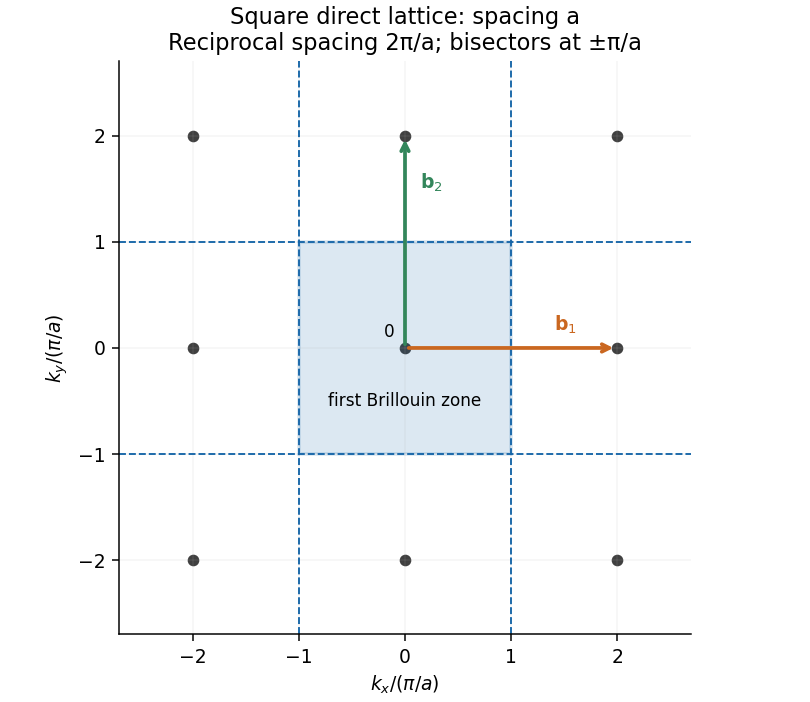
The first Brillouin zone is the Wigner-Seitz cell around the reciprocal origin: it consists of points closer to than to any other reciprocal point. Its faces lie on the perpendicular bisectorsTo see the condition, equate and . These are also free-electron Bragg-degeneracy planes, where a periodic potential can open a band gap. Higher zones classify regions beyond successive Bragg planes; the reduced-zone description folds them into the first zone while retaining a band label.
In one dimension with spacing , reciprocal points occur at , and the first zone is . A square lattice of spacing has reciprocal basis , and a square first zone with edges at .


The reciprocal of a face-centered cubic lattice is a body-centered cubic lattice and vice versa, with the scale fixed by the primitive-vector definition. In a Bloch state, wavevectors differing by describe equivalent crystal momenta modulo the lattice periodicity. A crystal with primitive cells has allowed wavevectors in one Brillouin zone, hence states in each band per spin. This state count links reciprocal geometry to band filling, metallic conduction and band insulating behaviour. Reciprocal space also labels phonons and makes conservation of crystal momentum modulo transparent.
Articles by others on the same topic
There are currently no matching articles.