In a normal metal, the electrical resistivity can often be approximated using Matthiessen's rule,Static impurities, defects and grain boundaries scatter conduction Electrons even as , giving the residual resistivity. Thermal lattice phonons add a temperature-dependent contribution through electron-phonon scattering. In a clean three-dimensional acoustic model, small-angle electron-phonon transport at low temperature gives at low ; once thermal phonon populations are approximately classical, the resistivity is approximately linear in . An electron-electron contribution proportional to can be relevant in some low-temperature ranges.
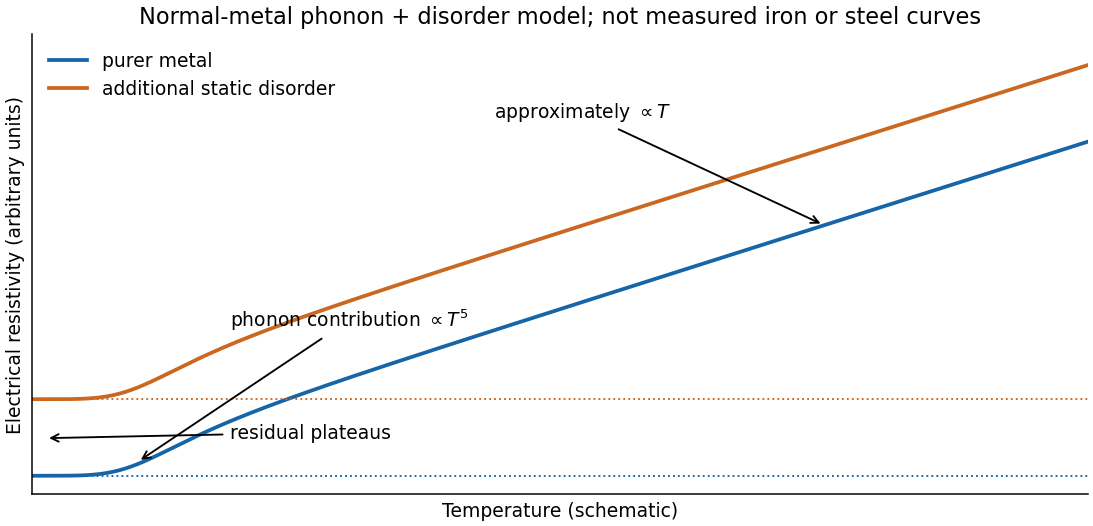
Schematic normal-metal resistivity with residual, low-temperature phonon and approximately linear high-temperature regimes
. Details. 
Carbon in mild steel, together with associated disorder, strain and microstructural changes, adds scattering and generally raises the residual resistivity relative to purer iron. Thus a dilute alloy may have a similar broad phonon-dependent rise but a larger baseline. The sketch is a generic phonon-plus-disorder model, not measured iron data. Iron's magnetic scattering and phase changes, and real steel's phases and processing history, can add structure; the simple sum is approximate rather than an exact material law. The expected explanation is greater Electron scattering from the added carbon and resulting disorder.
Articles by others on the same topic
There are currently no matching articles.