Specifying potential on the complete boundary gives a Dirichlet boundary condition and a unique harmonic solution. Specifying its normal derivative gives a Neumann boundary condition, with the zero-net-flux compatibility condition and an undetermined additive constant. Mixed conditions on complementary portions also give uniqueness when a potential reference is fixed. In an exterior domain, conditions at infinity are needed. These statements follow by applying Green's first identity to the difference of two solutions. A metal in electrostatic equilibrium is an equipotential: , tangential electric field zero, and normal field just outside a vacuum interface.
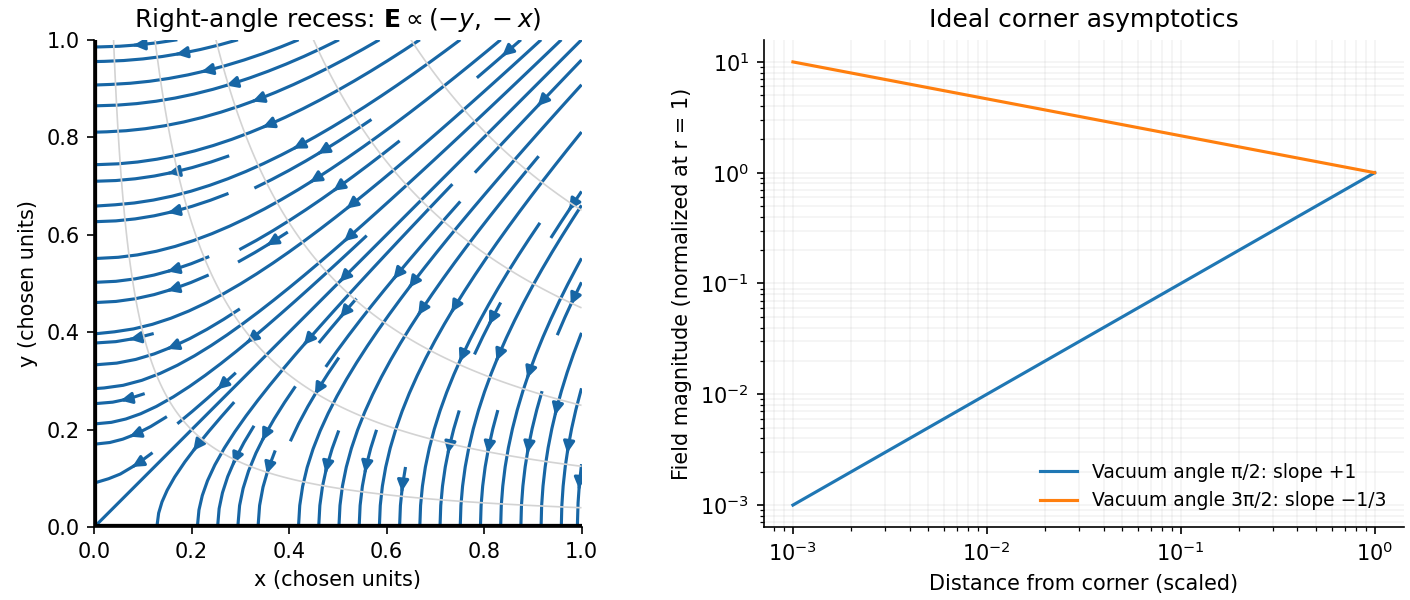
For the conducting-wedge potential expansion, put in the empty sector . For , Laplace's equation gives . Vanishing values on both faces require , henceBounded potential at the corner sets . The coefficients still require outer boundary data; the metal potential alone cannot select them. For a generic nonzero , put . Differentiation givesIf , the first nonzero higher harmonic replaces this leading term. For , , so and field lines satisfy , meeting the metal faces normally and tending to zero field at the corner. For , the electrostatic corner-field exponent is . A real tip's rounding cuts off this divergence; breakdown or field emission can limit the attainable field.

Articles by others on the same topic
There are currently no matching articles.