Original paper: Public original, physical PDF pages 156–163.
For rolling without slipping through height , conservation of energy givesA uniform solid sphere has , a solid cylinder , and a pipe . Thus the ball is fastest, then the solid cylinder, then the pipe. A smaller moment of inertia leaves more energy in translation. This assumes release from rest through the same height, adequate static friction and negligible rolling resistance; a thin pipe has .
The Maxwell speed distribution is proportional to . Setting its logarithmic derivative to zero gives the most probable speed:Use molecular oxygen, with , and .
For steady thin beams a distance apart, let be their laboratory charge per length. Their current magnitudes are , giving force magnitudes per lengthThe electric force is repulsive and the magnetic force attractive for the parallel electron velocities. The net force remains repulsive for .
For isotropic planar motion, the planar effusion flux gives an escape rate through a gap of width is , where is tray area. At fixed equilibrium kinetic energy, or fixed shape of the scaled speed distribution, . Hence halving the mass increases the rate by . This planar effusion result assumes the same spatial density and an unrestricted small opening. Strictly, average energy alone fixes , not ; an arbitrary change of distribution shape would need more information.
Assume uniform charge per unit length and the same angular speed . A charge element at distance has , so the Biot-Savart law gives the centre field of a rigidly rotating charged loop as . For one square side, with ,Using on each side givesThus : the circular field is larger by . This is a rigidly rotating charge distribution, not a current constrained to the sides of a stationary square.
Specifying potential on the complete boundary gives a Dirichlet boundary condition and a unique harmonic solution. Specifying its normal derivative gives a Neumann boundary condition, with the zero-net-flux compatibility condition and an undetermined additive constant. Mixed conditions on complementary portions also give uniqueness when a potential reference is fixed. In an exterior domain, conditions at infinity are needed. These statements follow by applying Green's first identity to the difference of two solutions. A metal in electrostatic equilibrium is an equipotential: , tangential electric field zero, and normal field just outside a vacuum interface.
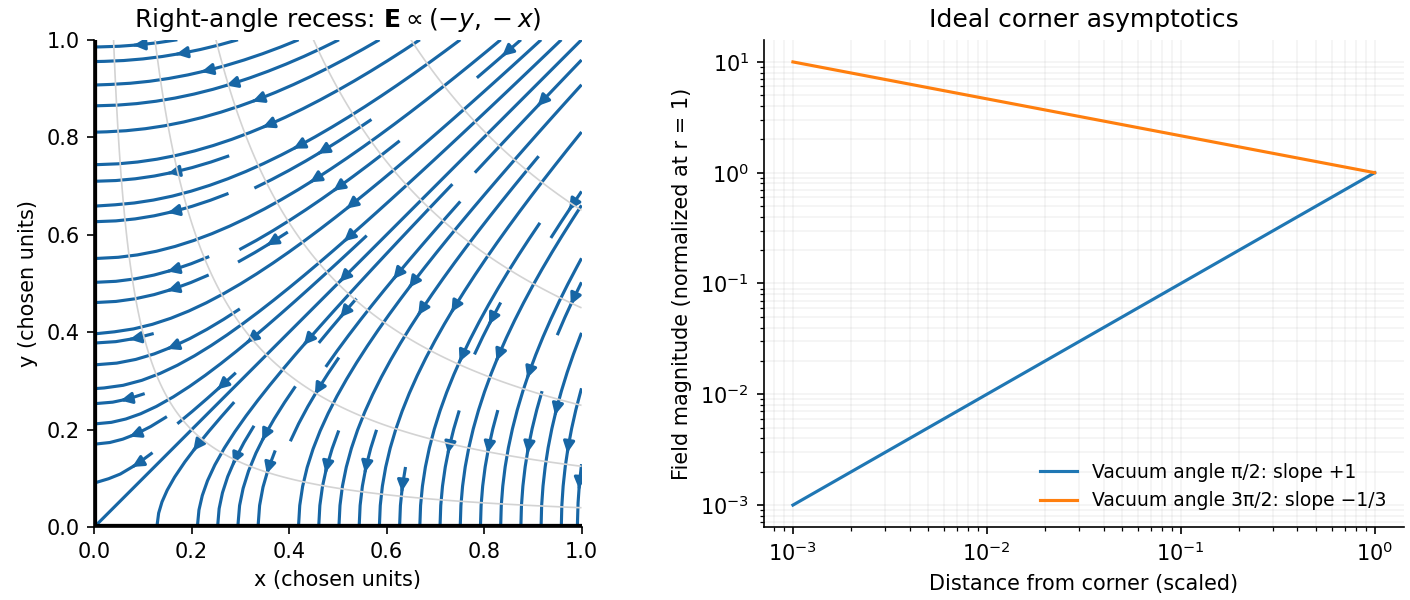
For the conducting-wedge potential expansion, put in the empty sector . For , Laplace's equation gives . Vanishing values on both faces require , henceBounded potential at the corner sets . The coefficients still require outer boundary data; the metal potential alone cannot select them. For a generic nonzero , put . Differentiation givesIf , the first nonzero higher harmonic replaces this leading term. For , , so and field lines satisfy , meeting the metal faces normally and tending to zero field at the corner. For , the electrostatic corner-field exponent is . A real tip's rounding cuts off this divergence; breakdown or field emission can limit the attainable field.
Applying Gauss's law for magnetism to a pillbox and Ampère's law to an interface-crossing rectangle givesHere points from material 1 to 2 and is free surface current. With no such current, and are continuous. For linear isotropic media, and . The magnetic fields need not have equal magnitudes on either side.
With negligible leakage, Gauss's law for magnetism makes each cross-section of a magnetic flux tube carry the same flux . High permeability guides it through the core; a short gap permits neglect of fringing. Flux conservation across these particular geometric sections is an approximation, not a consequence of zero divergence without controlling side leakage.
Let be the constant-radius arc marked in the figure, and . For each straight taper, the radius changes linearly from to , giving the reluctance of a conical magnetic poleSumming magnetic reluctances to find the gap field of a tapered electromagnet, and using givesIf is instead defined as the total magnetic-material length, replace the displayed uniform-arc length by . The comparison untapered core has uniform radius and material length , soThe original PDF specifies ; the TeX transcription reverses this inequality. In the printed limit the taper reluctances are small relative to that of the broad arc. The gain is approximately , approaching if the gap reluctance is also negligible. If the gap dominates, both fields instead approach and the gain approaches one. magnetic saturation near the small poles, gap fringing, leakage and winding heating limit practical enhancement.
The macroscopic Maxwell equations, with free charge and current, areInside this body and . The wave magnetic field lies along ; its sign follows the local wave component. Faraday's and Ampère's laws giveStatic background fields are excluded from this wave solution. The magnetic force density is along , with . For a steady periodic state, . ThereforeThe result gives radiation-force density without Ohm's law. Integrating through the body gives its pressure as the boundary value of the averaged electromagnetic energy density minus its value deep inside. In both limiting cases below the latter is zero. Take as the incident electric field's peak amplitude and write .
With no reflected field, and at the entrance. ThusComplete absorption transfers the incident normal momentum flux to the body.
At a perfect conductor, the reflected electric field cancels the incident tangential field, while their magnetic fields add. Thus and has peak amplitude . Taking the zero-penetration limit, including its surface force, givesReversal of the normal momentum doubles the pressure compared with absorption at the same incident Poynting flux.
is the terminating load impedance, the line's characteristic impedance, and the propagation wave number; is its length. In the lossless convention printed, an open circuit gives , a short circuit gives , and a matched load gives for every length. The divergent or zero limits at isolated electrical lengths are understood continuously.
Put , , . The voltage/current matrix of one section isFor a pair beginning with , write . Its entries are , , , and . The alternating-impedance transmission line has unchanged input , its Bloch impedance, obeying . Hence, away from the removable dividing zeros,For real positive , select the branch carrying energy into the line or decaying into it. A positive real part selects the pass-band root; infinitesimal passive loss resolves the stop-band branch. At the cell matrix is the identity, so the exact fixed-point condition alone does not determine ; at odd quarter-wave lengths the appropriate limiting impedance can be zero or infinite.
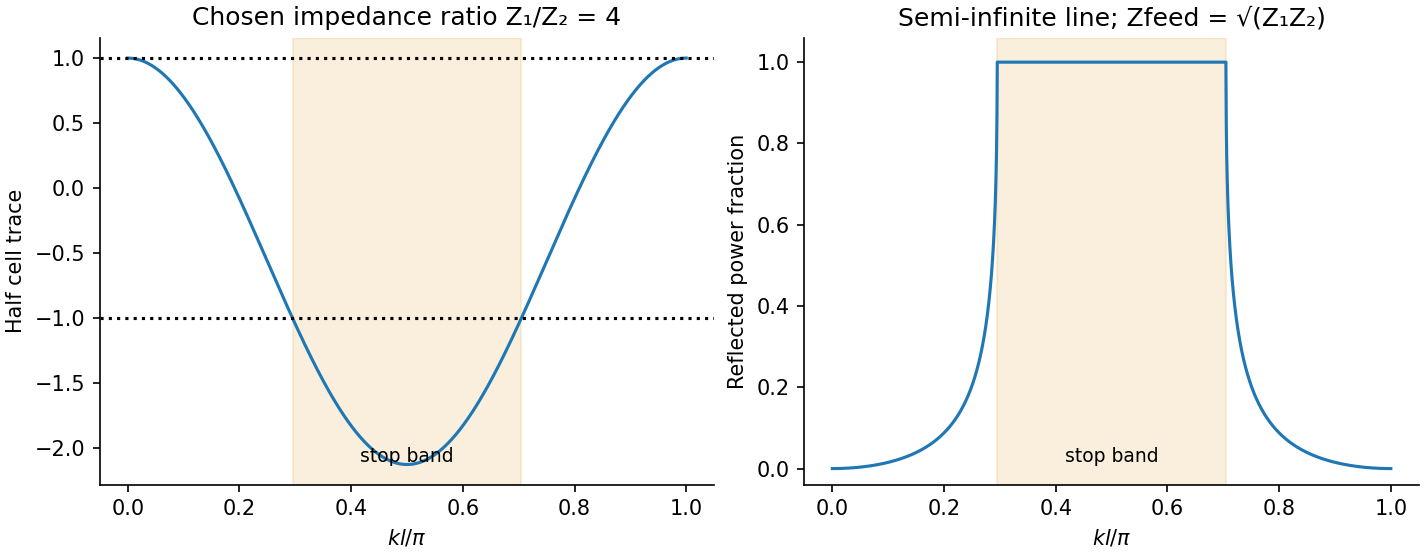
In a transmission-line stop band, a lossless semi-infinite ladder totally reflects because its physical input is reactive. Equivalently its cell hasThus, for nonzero contrast, the stop-band interiors satisfyWith , these are ; band-edge reflection follows by a limit. If , multiply the endpoints by for angular frequencies. Identical impedances have no stop band. A finite ladder can transmit by tunnelling, unlike the semi-infinite idealization.
A fictitious force accounts for acceleration of the chosen reference frame rather than an additional interaction. For axes rotating at constant , differentiating a vector uses . Twice applying this givesso moving the last two terms to the force side produces the Coriolis and centrifugal forces. Here is measured in rotating axes.
The rotating saddle trap has potential force . ThereforeThe trial solution givesBoth modes are bounded for arbitrary sufficiently small initial displacements and velocities precisely when . At equality there is a zero-frequency secular mode; the exactly stationary solution does not establish stability.
For rapidly rotating saddle confinement with , real mode ellipses can be writtenThey are nearly circular clockwise motions at rates . Rotating these axes back to the laboratory cancels the large angular rate: the leading laboratory motion is a slow approximately harmonic ellipse with frequency , plus small rapid micromotion. It results from the changing saddle force, not a static potential minimum. At next order the ellipse precesses prograde at . The rotating-potential model and this guiding-centre distinction are analysed in the primary work cited here.[ref]
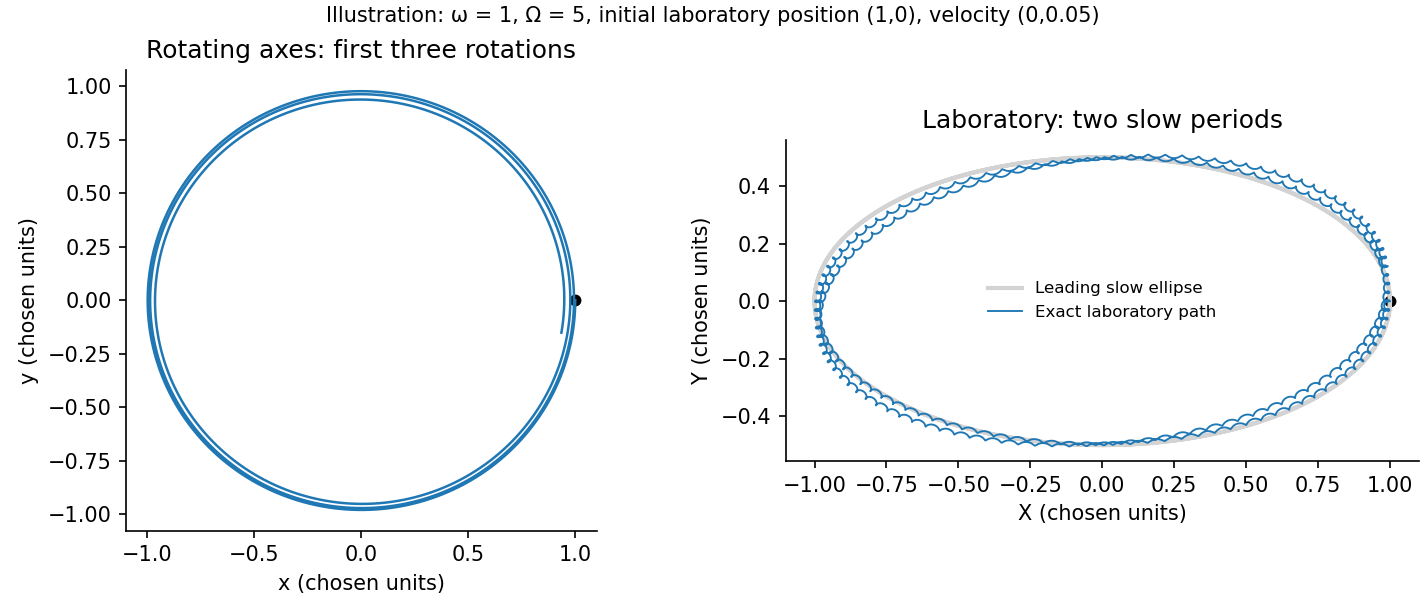
Original exact trajectories in rotating and laboratory coordinates for a chosen rapid saddle rotation
. Details. A normal mode is a small oscillation with fixed relative displacement amplitudes, all coordinates oscillating at one frequency. linearization gives , so mode shapes solve .
Write . force balance on an outer ion gives , henceA pair separated by has quadratic energy , equivalent to spring constant . The adjacent-pair constants are , and the outer-pair constant is . Adding the trap stiffness givesIn the three-ion axial normal modes, the translation mode leaves every separation unchanged. The antisymmetric breathing mode leaves the central ion fixed; the remaining vector is orthogonal to both. Direct multiplication yieldsFor breathing excitation after a trap-frequency quench, put and . The displacement from the new equilibrium is solely along the breathing vector and the initial velocity is zero. To first order in the fractional quench,The frequency shown is the linearized frequency about the new equilibrium. Nonlinear amplitude corrections are beyond this small-quench result.
At distance from the neutral axis, bending strain has magnitude and the corresponding stress is . Its moment is thereforeThe second moment of area is about the neutral bending axis and has units of length to the fourth power. This assumes a slender linear-elastic beam, small strains and plane sections remaining plane, not necessarily small deflections.
For horizontal compression , moment balance across a short arc gives . Since , the exact-angle Euler elastica equation and its first integral areThe first integral follows by multiplying by and integrating; no small-angle replacement has been made.
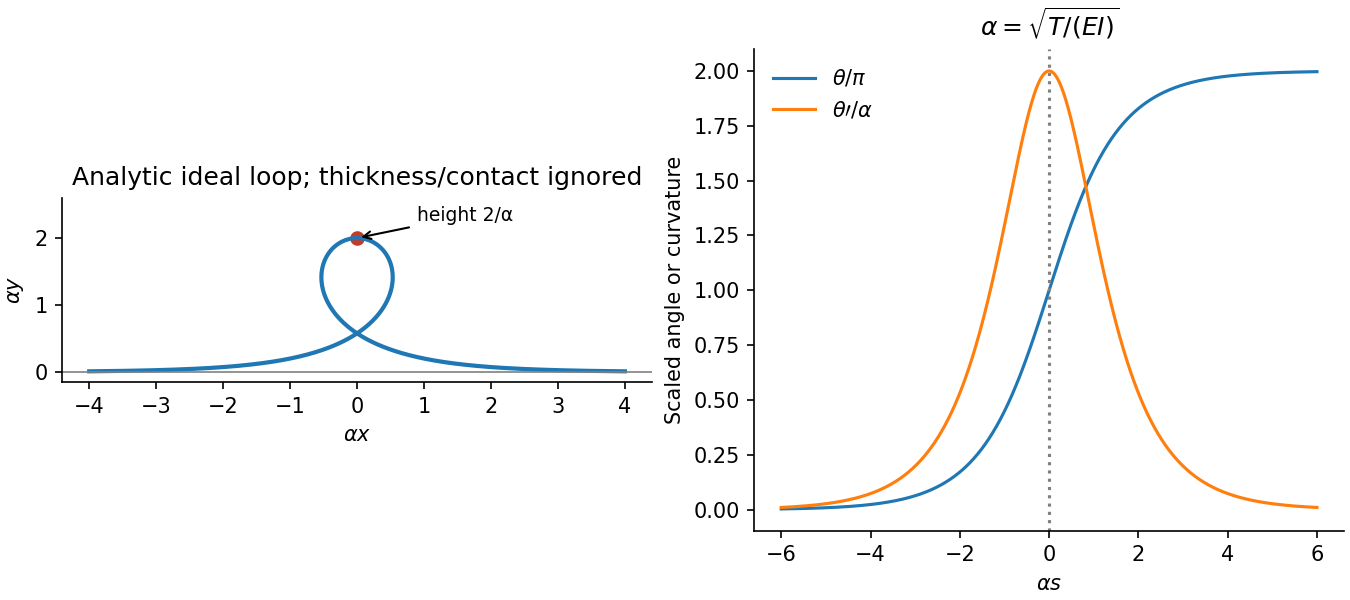
For tension set . The straight far-field ends give , so on the increasing-angle tensile elastica loop branchChoosing at givesThe terminal angles are and , the same physical tangent direction. At the top, and the bending moment is . The horizontal tensile force has lever arm , soIntegrating independently gives , , confirming the height. This ideal loop neglects self-contact and thickness at its crossing.


In irrotational flow, the velocity has a velocity potential locally, and globally in a simply connected flow domain. incompressibility then gives . For a sphere moving at speed along through fluid at rest far away, the potential of a translating sphere is a decaying axisymmetric dipole. Its solution and its impermeability condition giveThese are laboratory fluid velocities expressed relative to a moving origin. A velocity field measured in the sphere-rest frame instead requires adding to the potential.
The vector identity printed in the PDF has its signs reversed. The product rule gives the consistent identity . With outward normal of the exterior fluid equal to at the sphere, the divergence theorem yieldsThe integral at infinity vanishes. HenceThis added mass of a sphere is half the displaced fluid mass. For a spring of unchanged stiffness, buoyancy only shifts the static equilibrium. Its oscillation frequency with fluid added mass isFor a small-angle simple pendulum, buoyancy also reduces restoring torque from to , while the inertia is . ThusThe downward equilibrium is stable only for . The ideal results assume unbounded fluid, negligible viscosity, small excursions, and no important free-surface or container corrections.
Articles by others on the same topic
There are currently no matching articles.