The 2017 release includes selected final answers, rather than a complete set of worked solutions. Those papers are retained.
The transfer is a Hohmann transfer orbit. Write for the original circular Kepler orbit radius and for the transfer ellipse's semi-major axis. The diagram measures both radii from Earth's centre, giving , and henceThe Hohmann transfer time is half the transfer orbital period, taking the satellite to the opposite end of the elliptic orbit. By Kepler's third law, relative to the original geostationary orbit's orbital period ,Using one sidereal day, , gives ; the usual approximation gives . The arrival impulse changes the velocity into that of the new circular Kepler orbit without adding coast time in the impulsive model.
There is a real discrepancy between the wording and the diagram: an increase in altitude above Earth's surface is different from the radius increase drawn. If altitude is interpreted literally, let be Earth's radius. Thenusing and . Thus answers the explicitly labelled geometry; answers the literal altitude wording.
To find the two-mass three-spring normal modes, choose both displacements positive to the right, measured from mechanical equilibrium. The middle spring's extension changes by . Hooke's law and Newton's second law therefore giveIn a normal mode both displacements have the same angular frequency: take . A nonzero amplitude vector exists when the determinant vanishes:Writing , the two angular frequencies areThe corresponding eigenvectors can be specified bySince for positive masses, the lower normal mode has : both bodies move in the same direction at any instant. The higher normal mode has : they move in opposite directions. Their amplitudes are generally unequal. For the useful check , these reduce to with , and with . Each angular frequency has units .
An Electron has electric charge , so its gain of kinetic energy through an accelerating electric potential difference of magnitude is . Starting from rest, conservation of energy givesWith , electron mass , and ,This is a speed; the velocity points along the accelerating path, opposite the electric field. Here , where is the speed of light, so the classical kinetic energy approximation is accurate. As a check, special relativity gives and , agreeing to the quoted precision.
The quoted capacitance is that of the filled parallel-plate capacitor, . Disconnecting the source imposes charge conservation on the isolated plates:On removing the dielectric, the capacitance falls by its relative permittivity, so . The capacitor energy at fixed electric charge is . ThereforeandThe increase is supplied by the external work needed to withdraw the dielectric against its attraction into the electric field, in the lossless quasistatic limit. The final electric potential difference is , not the original charging value.
For the propagating mode of an air-filled or evacuated rectangular electromagnetic waveguide, the longitudinal dispersion relation isThe phase velocity and group velocity along the guide are consequentlyWith waveguide cutoff frequency and carrier frequency , . ThusThe pulse envelope travels at the group velocity for a sufficiently narrow range of frequencies. The phase velocity exceeding the speed of light does not describe superluminal signal transport. The check follows directly from the dispersion relation. A different uniform filling medium would require replacing by its electromagnetic propagation speed; the stated numerical answer uses the usual empty-guide assumption.
Use orthonormal basis vectors fixed in the rotating reference frame, and expand the angular momentum as . Over time , the basis undergoes infinitesimal rotation , soThe product rule gives the rotating-frame derivative formula:Since the applied couple is the rate of change of angular momentum in the inertial frame,The second term accounts for the changing basis, even when the components of angular momentum are constant in the rotating reference frame.
One application is the slow steady precession of a rapidly spinning gyroscope supported at one point. Let its centre of mass be a distance from the pivot along its spin axis, at angle to the upward vertical. Write for its dominant spin angular momentum. In a reference frame precessing steadily about the vertical with angular velocity , the spin angular momentum is approximately stationary, soThe gravitational torque has magnitude . The cross product on the right has magnitude , giving, for a nonvertical axis,Its direction follows from the torque equation. This is the slow precession approximation: the additional angular momentum associated with precession is small compared with the spin contribution.
For this gyrocompass, let be local north, west and upward unit vectors, forming a right-handed basis. Earth's rotation has local componentsLet the spin axis point along , and write its dominant angular momentum as , where . In mechanical equilibrium relative to Earth, this leading angular momentum is fixed in the terrestrial rotating reference frame. The bearings can exert horizontal torques to keep the axle horizontal, but free rotation about the vertical implies . The vertical component of the rotating-frame derivative formula therefore requiresAway from either geographical pole, , henceThis is a necessary equilibrium condition; the next part distinguishes its stable and unstable spin orientations. The rapid-spin approximation neglects angular momentum terms of order compared with . At either pole the horizontal component of Earth's rotation vanishes, and this north-seeking mechanism gives no preferred horizontal direction. The paper explicitly excludes ; if latitude is signed, must likewise be excluded.
For the gyrocompass oscillation, use the same local basis and define about the stable orientation, with spin angular momentum directed north at . Because the vertical is perpendicular to the horizontal axle, the extra vertical angular momentum from the slow azimuthal motion is . To leading order in Earth's small angular velocity,A constant vertical contribution from Earth's rotation has zero terrestrial time derivative; the transverse terrestrial contributions affect the following equation only at order . Taking the vertical component of the torque equation givesThe terrestrial derivative of is horizontal, as is , so neither contributes to this component. Thus the small angle satisfies, using the small-angle approximation ,This is simple harmonic motion, , with positive squared angular frequency away from the poles. The approximation requires rapid spin, small angular displacement and negligible bearing friction. Near the opposite orientation, putting instead yields , which is unstable. Consequently, the paper's oscillation claim applies to the stable equilibrium, not both north--south spin directions. Without damping the ideal gyrocompass continues to oscillate rather than settling.
For a thin gyrocompass flywheel with rotational symmetry, the perpendicular axis theorem gives . This does not require the mass to be concentrated at the rim. Convert the specified spin to angular velocity and use one sidereal day for Earth's rotation:At the given latitude,The associated oscillation period is . This uses the stated neglect of the support assembly's contribution to the moment of inertia; a substantial additional vertical moment of inertia would lengthen the oscillation period.
The bending moment is the internal torque transmitted across a cut through an elastic beam, about the transverse bending axis. It balances the moments of the external forces on the isolated portion on one side of the cut. Its sign depends on the chosen convention, and its units are .
The relevant “moment of area” is the second moment of area of the cross-section about its neutral axis:where is perpendicular distance from that axis within the section. It has units and is a geometrical quantity, unlike a mass moment of inertia. For a homogeneous beam under pure bending, the neutral axis passes through the section's centroid, and its longitudinal strain is zero.
Assume a slender homogeneous elastic beam obeying linear elasticity, with plane sections remaining plane and no resultant longitudinal force. A length element of its neutral axis subtending a small angle has length . A neighbouring fibre at distance from that axis has a length change of magnitude , giving longitudinal strain with signs chosen consistently for tensile and compressed fibres. By Hooke's law, its longitudinal stress is .
The torque of these longitudinal forces about the neutral axis is thereforeHere is Young's modulus and the second moment of area. The displayed relation uses a signed radius and bending moment; an unsigned geometrical radius is . For consistency with the negative bending moments in the later parts, take the deflection positive downward and the signed curvature as . Then the small-slope Euler-Bernoulli beam equation reads . Reversing the vertical coordinate reverses the corresponding sign relation but leaves the physical deflection unchanged.
By vertical force balance and reflection symmetry, each support exerts an upward force . Use the paper's convention in which the sagging bending moment is negative. For a cut at , the left support's moment about that cut givesFor , include the central downward force when taking moments of all loads to the left:ThusThe bending moment is continuous at the load, with , and vanishes at both freely rotating supports. The jump is in its first derivative, reflecting the concentrated transverse force.
The uniform weight per unit length is , where is the mass density and the gravitational acceleration. The total weight is , so each support provides an upward force . The weight on the portion from to is acting at that portion's midpoint, a distance from the cut. In the same bending moment convention as part (c),The units are . Its greatest magnitude occurs at , where .
Take downward deflection positive, with the support level . The rectangular section second moment of area about the horizontal neutral axis isFor small slopes the curvature relation from part (b), with the stated sign convention, isIntegrating twice givesThe support boundary conditions give and . HenceThis is a downward displacement; its upward component is . As checks, reflection symmetry gives , and the maximum downward deflection isThe units are length: has units . The width cancels because both weight and bending resistance scale with it. The small-slope approximation requires ; shear strain is also neglected, as appropriate for a slender elastic beam.
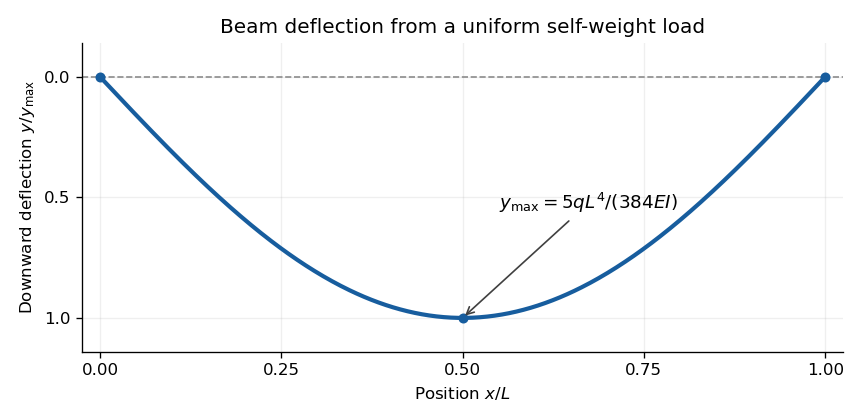
Calculated deflection of a simply supported beam under its own weight; downward displacement is positive
. Details. The Poynting vector is the local electromagnetic energy flux density:Here is the electric field and the magnetic field intensity. For an oriented area element , is the electromagnetic power crossing that element in its positive normal direction. Thus is outward power through a closed surface, in watts. The Poynting vector has units , and its direction describes local electromagnetic energy transport.
The unit relative permittivity and vacuum-valued magnetic permeability imply and . The electromagnetic energy per unit volume isThe two contributions are the stored electric and magnetic energies. Although called in this paper, this quantity is an energy density; the total electromagnetic energy is .
Use the divergence identity for a cross product, followed by Faraday's law of induction and the Ampère-Maxwell equation:With the electromagnetic energy density of part (b), these giveIntegrate over a fixed volume and apply the divergence theorem, choosing outward:This is Poynting's theorem. The outward electromagnetic energy flux equals minus the power transferred to matter and minus the rate at which electromagnetic energy accumulates inside. For the dissipative electrical conductor in this question, the matter term is Ohmic heating.
Take the electric current along , and use cylindrical coordinates. A uniform current in a straight homogeneous wire hasThe local Ohm's law gives the longitudinal electric fieldFor a circular Amperian loop of radius , the enclosed electric current is . The magnetostatic Ampère law gives , henceSince , the Poynting vector isIt is zero at the centre and points radially inward elsewhere. Its units are . These are the interior fields in the long-wire approximation, neglecting end and contact effects.
The Ohmic heating per unit volume is , uniform in this wire. Multiplying by its volume gives the dissipated powerwhere the electrical resistance is . The result is in watts; over a time interval the dissipated energy is .
On the curved wire surface, the outward normal is and the Poynting vector has the constant radial value . Its outward flux isThe Poynting vector is radial, so it has zero normal component on the two end faces in this approximation. This is therefore also the outward flux through the complete wire surface. Equivalently, positive electromagnetic power flows inward.
The fields are steady, so the stored electromagnetic energy does not change. Poynting's theorem consequently requires the incoming power to equal the Ohmic heating in part (e), exactly as found. The energy reaches the wire through the surrounding electromagnetic field. A local check is .
Let the unit normal point from material 1 to material 2, and let their relative magnetic permeabilities be , so for linear isotropic media. Apply Gauss's law for magnetism to an infinitesimal Gaussian pillbox straddling the interface. The side contribution vanishes as its height tends to zero, leavingThe normal magnetic flux density is continuous.
Next use a narrow rectangular Amperian loop crossing the interface. The two short-side contributions vanish in the zero-height limit. The magnetostatic Ampère law for magnetic field intensity giveswhere is any free surface current density. Thus, if there is no free surface current density on the interface, the tangential magnetic field intensity is continuous. In that case the component relations areThe distinction between free and bound electric currents matters: bound currents due to magnetization are already incorporated in the definition of magnetic field intensity. A change of magnetic permeability alone does not make the tangential magnetic flux density continuous.
The starting point is Gauss's law for magnetism, : a flux tube carries the same magnetic flux through successive transverse sections. To identify that tube approximately with the physical core, one must also make a negligible-leakage approximation. The large core magnetic permeability makes the core route much less reluctant than competing paths through the surrounding air; the small gap further reduces the incentive for a long external return path. The gentle taper, , lets the field follow the changing section with only small transverse corrections.
For two cuts and the intervening lateral surface, the divergence theorem gives . Neglecting lateral leakage givesThe normal magnetic flux density is continuous at each core–air interface by part (a), so this same magnetic flux crosses the gap. To use the gap's geometrical area in the later formulas, the magnetic fringing must also be negligible, normally requiring . This is the small-gap interpretation of the paper's approximation. Large magnetic permeability alone does not eliminate leakage or magnetic fringing for arbitrary gap geometry.
For the closed untapered torus, apply the magnetostatic Ampère law to a circular path through the core. It links all turns, each carrying electric current :Since , variation of the path length and of the tangential magnetic field intensity across the section is negligible. Thus , giving, within this thin-torus approximation,The units are . The core magnetic flux density is in the linear material model.
With uniform section and negligible magnetic fringing, constant magnetic flux gives equal magnetic flux densities in the core and gap:Here is the core arc length and the additional gap length. Applying the magnetostatic Ampère law around the complete magnetic circuit,Consequently,This tends to when the gap dominates the magnetic reluctance, , and reduces to the no-gap result as . The gap magnetic flux density is .
Let the approximately conserved magnetic flux be . ThenThe length shown in the original diagram is the untapered core arc; the two tapers are separate lengths each. In the untapered core, flux conservation givesFor one taper use distance from its narrow end. The straight taper in the diagram has local radiusand magnetic field intensityIts contribution to the line integral in the magnetostatic Ampère law is found explicitly:Adding the gap, the untapered arc and both tapers givesThereforeThis uses a linear radius profile, approximately uniform magnetic flux density over each section, a linear constant magnetic permeability, and negligible leakage and magnetic fringing. For a non-linear taper profile the honest generalization isThus an arbitrary smooth taper with the same end radii and length need not give the printed formula; the straight-sided geometry supplies the additional information.
Set . Comparing with the untapered expression in part (d), using the same and large radius ,The stated limit makes , soThe taper concentrates magnetic flux into a smaller pole-face area, increasing the gap magnetic field intensity and magnetic flux density for the same winding electric current. If , the enhancement approaches . If instead , the gap dominates the magnetic reluctance and the enhancement approaches unity: both fields approach .
The benefit is therefore strongest when the untapered core's contribution is significant, while the taper lengths contribute little. The same-core-length convention is the comparison defined by parts (d) and (e); if one instead fixes the full iron path length, the untapered comparator has length , a difference negligible in the stated limit. A smaller gap area can increase the field even though the total magnetic flux need not increase. Magnetic saturation and magnetic fringing, excluded from this model, limit the ideal concentration.
Interpret the applied pressure as a uniform increase of external hydrostatic pressure on all six faces, and approximate the rock by an isotropic material obeying linear elasticity. Taking tensile stress as positive, . By Hooke's law, the strain along any one axis isTo first order in the small strain, the fractional volume change is the sum of the three axial strains:Thus the bulk modulus is . Using the specified Young's modulus, Poisson's ratio, and givesThe sign indicates contraction. This is the change relative to the unloaded reference state; simply maintaining a specimen already equilibrated at this same pressure would produce no further change.
Use the pipe-diameter convention for the Reynolds number, with mean velocity , density and dynamic viscosity :The Reynolds number compares inertial and viscous effects in the fluid flow. A conventional estimate for the onset of turbulence in a pipe is , givingHence the usual onset estimate is . Using the also common transition criterion gives , whereas , used for established turbulence, gives . There is no universal sharp minimum: inlet disturbances and pipe conditions affect the transition from laminar flow, so the threshold convention must accompany the answer.
(a) Treat the lake as a heat bath at fixed temperature and the block's heat capacity as constant. Its initial temperature is , and . Although the cooling is irreversible, entropy is a state function, so evaluate the block's change along an imagined reversible thermodynamic process:The lake receives heat , and thereforeAdding the two contributions givesThe positive result is consistent with the Second law of thermodynamics for heat transfer across a finite temperature difference. The calculation uses exactly as printed in both the original PDF and the transcription; it does not replace the supplied value by a tabulated value for lead.
(b) The block starts and eventually finishes at the lake's temperature, so its net entropy change is approximately zero. Neglecting buoyancy, air resistance and the final immersion depth, the lost gravitational potential energy becomes internal energy in the lake after the motion and waves have dissipated. The lake remains at , givingTemporary heating of the block or temporary storage in kinetic energy does not change this final energy and entropy balance once thermal equilibrium is restored.
For a fixed amount of a simple compressible system, write the internal energy as . Its exact differential isAssuming the thermodynamic potential has continuous second partial derivatives, equality of its mixed partial derivatives yields the first Maxwell relation:For the second Maxwell relation, use the Legendre transform , the enthalpy. Its natural variables are sinceThus and . Equality of the mixed partial derivatives now gives
Let be the upper- and lower-level populations and their degeneracy factors. At thermal equilibrium, the Boltzmann distribution givesNo degeneracy factors are supplied, so the numerical answers use equal degeneracy factors. Stating the ratio as upper population divided by lower population removes an otherwise arbitrary inversion.
(a) At ,The two populations are nearly equal because the level separation is much smaller than the thermal energy .
(b) At ,Almost every atom occupies the lower level. If the levels have unequal degeneracy factors, each boxed ratio must be multiplied by ; their individual values cannot be inferred from the paper.
Newton's second law takes its familiar form in an inertial frame. Axes fixed to a turning apparatus or to the Earth form a rotating reference frame. Extra inertial forces account for the acceleration of these coordinates. Their values depend on the chosen reference frame; physical interactions such as gravity, tension and contact forces must still be included separately.
Let the rotating origin have inertial acceleration , and let its axes have angular velocity . For any vector , the rotating-frame derivative formula isEach rotating basis vector changes by , which proves this rule by expanding in that basis. Apply it twice to the position relative to the moving origin. With and measured in the rotating axes,Consequently the equation in the rotating reference frame isThe additional terms are the translational inertial force, Coriolis force, Euler force and centrifugal force, respectively. The last two simplify when the angular velocity is constant: the Euler force vanishes, while the other rotation terms remain.
The centrifugal force points away from the rotation axis. If is the perpendicular displacement from that axis, thenFor uniform rotation it has potential energyA mass at rest relative to a turntable can therefore be described as having an inward tension or friction balancing its outward centrifugal force. In an inertial frame, the inward physical force instead produces the required centripetal acceleration. These are two descriptions of the same motion; one must not insert the rotating-frame outward term into the inertial equation as an additional physical interaction.
A rotating liquid gives a useful quantitative example. For a liquid in hydrostatic equilibrium relative to a vessel rotating uniformly about the vertical axis,Along the free surface the pressure is constant, so andThe surface is a elliptic paraboloid. This is the balance of gravity and the centrifugal force in the rotating description. On the Earth, the same outward acceleration reduces effective gravity, most strongly at the equator, and contributes to the planet's equatorial bulge.
The Coriolis force depends on relative motion:It is perpendicular to both and , vanishes for motion along the rotation axis, and reverses when the relative velocity reverses. The dot product givesThus the Coriolis force does no work in the rotating reference frame: it changes the direction of motion rather than directly changing the rotating-frame kinetic energy. For example, on a horizontal turntable rotating anticlockwise as viewed from above, an outward-moving slider has a clockwise Coriolis acceleration, whereas an inward-moving slider has an anticlockwise one. The deflection can be observed by comparing a laboratory camera with a camera rotating with the table.
For slow horizontal motion on the Earth at latitude , keep the vertical component of its angular velocity. In east-north coordinates the horizontal Coriolis acceleration isIt deflects motion to the right in the northern hemisphere and to the left in the southern hemisphere. In large-scale atmospheric and oceanic motion it can balance a horizontal pressure gradient, giving geostrophic balance. With upward, the steady horizontal equation without friction isThe resulting velocity runs along lines of equal pressure. This approximation requires rotation to dominate local inertial changes; it is inappropriate close to the equator where tends to zero.
The Foucault pendulum gives another terrestrial example. In the small-angle approximation, its horizontal coordinates satisfyTo first order in the small ratio , the oscillation plane precesses relative to the ground at angular rate : clockwise in the northern hemisphere, zero at the equator, and one revolution per sidereal day at a pole. The Coriolis force explains this changing orientation without requiring energy input. Together these examples show why inertial forces are useful whenever the apparatus or environment supplies naturally rotating coordinates.
The examination asks for three notes. All four options are worked below so that each topic has a complete study answer.
The method of images solves certain electrostatics problems by replacing a conductor by fictitious electric charges outside the region where the solution is required. The replacement must satisfy the actual boundary values of the electric potential as well as the prescribed sources. The uniqueness of Poisson equation then establishes that the constructed electric potential equals the physical one in that region. The image locations are mathematical devices; they are not real charges inside the metal.
For a point charge at above an infinite grounded conducting plane , put an image charge at . In a cylindrical coordinate system with coordinates the potential in the physical region isThis vanishes at , has the required singularity at the real charge, and tends to zero at infinity. With electric field , the induced surface charge density follows from the normal field immediately above the conductor:The force on is the field of the image evaluated at the real charge:The electrostatic energy relative to infinite separation is . The factor accounts for the fact that the induced charge changes as the real charge is assembled; treating the image as an independently fixed physical charge would give the wrong energy.
A second standard geometry is a grounded conducting sphere of radius with a charge a distance from its centre. Its exterior field is generated by an image at distance from the centre on the line towards the real charge. On the sphere the distances to the real and image charges are in the ratio , making their potentials cancel. For an isolated neutral sphere, an additional central image makes the total induced charge zero and leaves the surface an equipotential. The construction is powerful for suitable symmetric boundaries, but arbitrary boundaries do not in general admit a finite image system.
An electrical insulator has no freely conducting bulk charge in the ideal static description, but an applied electric field can displace bound positive and negative charge relative to one another. The resulting electric dipole moments per unit volume define the polarization density . Distortion of electronic charge clouds, relative displacement of ions, and partial alignment of permanent molecular electric dipoles can all contribute. Thermal agitation opposes the last mechanism.
For a weak field in a linear isotropic dielectric, the constitutive law isHere is the electric susceptibility, is the permittivity, and is the electric displacement field. In an anisotropic material, is a tensor and need not be parallel to . These response laws describe the macroscopic field, not necessarily the microscopic field acting on one molecule.
Spatial variation and surface termination of the polarization density give bound charge and bound current through the bound charge densitieswhere is outward from the material. Thus uniform polarization density has no bulk bound charge, but generally has opposite bound charges on opposing surfaces. Gauss's law can be rewritten asWith no free surface charge, the normal component of is continuous across an interface; the tangential electric field is continuous in electrostatics.
For example, fill a parallel-plate capacitor of plate area and gap with a uniform dielectric, neglecting fringing. At fixed free plate charge , , soThe induced bound surface charges oppose the original field, reducing the electric field and potential difference at fixed . At fixed applied potential difference, the field remains and the battery instead supplies more free charge. The electric displacement field separates these free-charge and bound-charge roles.
Because the magnetic field obeys , it can be represented locally as the curl of a magnetic vector potential:This automatically enforces the absence of magnetic monopoles. It is also a global representation throughout ordinary all-space problems without monopole singularities. It is not unique: the gauge transformationleaves unchanged because the curl of a gradient vanishes. In a time-dependent problem,makes the same transformation leave both physical fields unchanged and automatically satisfies Faraday's law.
In vacuum magnetostatics, choose the Coulomb gauge . Substitution into Ampère's law and the identity givesfor a localized steady electric current density and a potential vanishing at infinity. Taking the curl recovers the Biot-Savart law. The magnetic vector potential converts a constrained vector field problem into componentwise Poisson equations once a gauge is chosen.
For a uniform magnetic field, is a convenient choice. For a localized magnetic dipole moment , the leading far-field potential isAnother useful relation is Stokes theorem, which relates a closed-path integral to the magnetic flux through a spanning surface:The units of are , equivalently .
An incident electromagnetic wave generally produces reflected and transmitted waves because the two media have different electromagnetic response. Consider a flat interface between homogeneous, linear, lossless media with permittivities and magnetic permeabilities . Their wave speeds and wave impedances areFor each plane electromagnetic wave, . With no free surface charge or current, the interface conditions for electromagnetic fields require continuous tangential and normal . Equality of the phase at every point on the boundary gives equal angular frequencies and tangential wavevectors. Hence the reflection angle equals the incidence angle and Snell's law iswhere and each angle is measured from the normal.
At normal incidence use the same tangential axis for all electric amplitudes. The two independent boundary equations areSolving gives the amplitude Fresnel equationsFor nonmagnetic media, these become and . Reflection into a medium of larger refractive index therefore reverses the electric amplitude's sign at normal incidence.
The normal Poynting vector determines the reflected and transmitted fractions of incident power. At normal incidence,It is the power fractions, rather than the squared electric amplitudes alone, that add to unity.
At oblique incidence separate transverse electric polarization (, electric field perpendicular to the incidence plane) from transverse magnetic polarization (, electric field in that plane). For nonmagnetic media, writing and , the Fresnel equations areHere choose a common direction and, for each ray, the direction as . This makes the reflected basis reverse its tangential direction at normal incidence, explaining why the displayed then has the opposite sign to . Physical reflectance is independent of this sign convention. For either polarization with propagating transmission,For polarization, zero reflection occurs at the Brewster angle . If , incidence above the critical angle for total internal reflection produces an evanescent field in total internal reflection and for an isolated lossless interface. A lossy second medium requires complex response coefficients and an absorption term in the energy balance.
Use an ideal gas to illustrate the Carnot cycle, with hot and cold heat baths at and . The four processes are all reversible thermodynamic processes. Lettered states below belong only to this illustration; the engine later in the question uses numbered states.
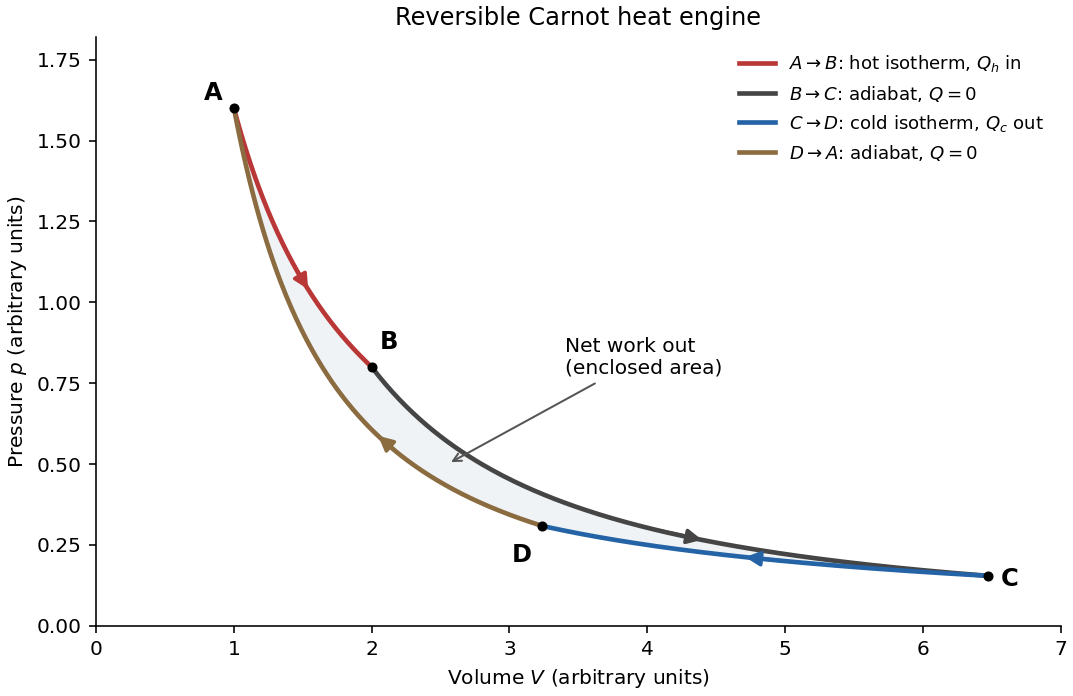
Starting at , perform the following four stages:
- : isothermal expansion at . The gas absorbs heat from the hot heat bath and does work. Its internal energy is unchanged, so .
- : reversible ideal-gas adiabat during expansion. Insulation prevents heat transfer; work done by the gas reduces its internal energy and lowers its temperature from to .
- : isothermal compression at . Work done on the gas is rejected as heat to the cold heat bath, with .
- : insulated adiabatic compression, performed reversibly, raises the temperature back to and closes the cycle.
Because the working substance returns to its original thermodynamic state, its net entropy change is zero. There is no entropy change on either reversible ideal-gas adiabat; on each isothermal process the entropy transfer is the exchanged heat divided by the bath's absolute temperature. HenceThe first law of thermodynamics over a complete cycle gives . The thermal efficiency is thereforeThe use of kelvins is essential. This result does not depend on the working substance. For the ideal gas illustration, the two reversible ideal-gas adiabats imply , so ; the explicit heat expressions in (a) give the same ratio.
The complete cycle must be a reversible thermodynamic process: no friction, viscous dissipation, unrestrained expansion, or other source of entropy. Each moving boundary must be arbitrarily close to mechanical equilibrium. Heat transfer to or from a bath must occur across an infinitesimal temperature difference, and the insulated stages must be genuinely adiabatic processes. There must also be no direct heat leak between the heat baths.
For an engine exchanging heat only with these two heat baths, the Second law of thermodynamics givesand thusPractical engines generate entropy through finite temperature differences, friction and other dissipative effects. They therefore fall below the Carnot cycle limit. Approaching reversible heat exchange generally requires vanishingly slow operation for a finite heat-transfer apparatus, limiting useful power.
For the numbered engine, denote the low and high pressures by and . Let denote the molar gas constant. The ideal gas law makes the constant-pressure branches straight rays in a temperature-volume diagram:The high-pressure ray is steeper. For a constant heat capacity ratio , each reversible ideal-gas adiabat obeysConsequently curves upward and left during compression; goes upward and right along the steeper ray; curves downward and right during expansion; and goes downward and left along the shallower ray.
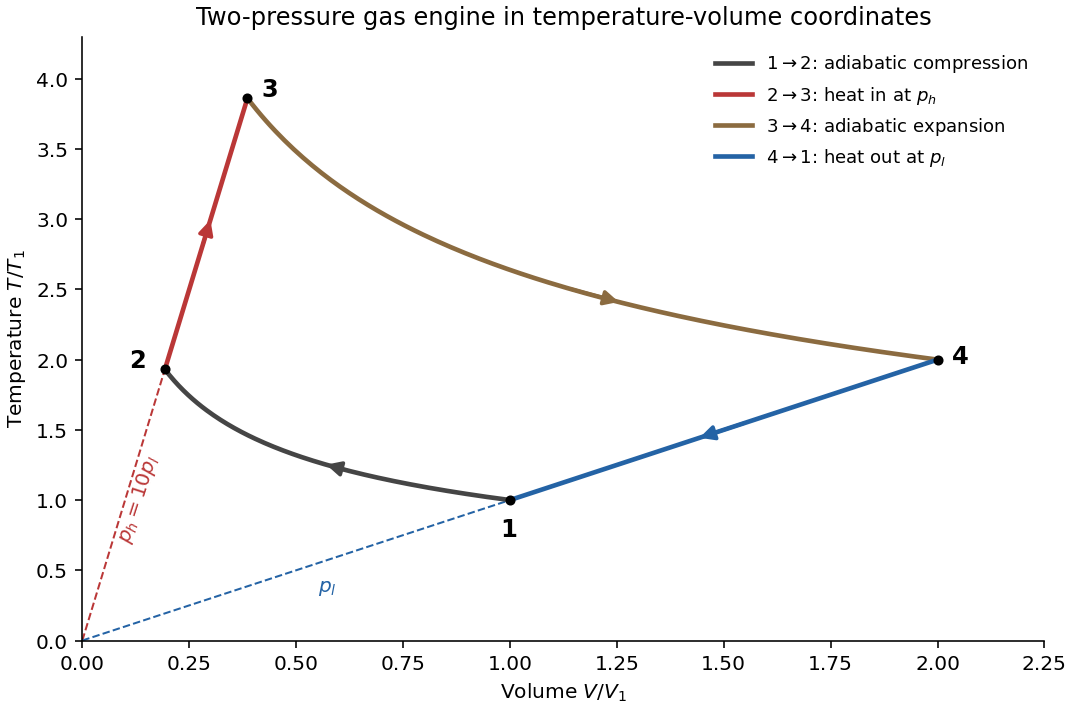


The plot is an original calculation for , and ; its state directions follow the original paper. The dashed extensions identify the two constant-pressure rays, not additional stages of the cycle.
This is the Brayton cycle. Assume fixed gas amount, constant heat capacities, and internally reversible adiabatic processes, as intended by the ideal engine model. Put andCombining with the ideal gas law gives along either reversible ideal-gas adiabat. ThereforeDuring a constant-pressure process the heat supplied equals the enthalpy increase. If is the molar heat capacity at constant pressure, the positive heat input and output areThe insulated branches exchange no heat, so the first law of thermodynamics gives . HenceAn adiabatic process alone need not be an isentropic process; the relations used here also require internal reversibility. Dissipative compression or expansion would require extra information and would not, in general, obey this efficiency formula.
Articles were limited to the first 100 out of 531 total.
Articles by others on the same topic
There are currently no matching articles.