For two equal lenses with a virtual intermediate object, use positive distances for real objects on a lens's incident side and real images on its outgoing side. The first lens gives , hence . At the second lens these rays are already converging toward a point to its right: its object distance is therefore .Thus the final image is real, to the right of lens 1. Its transverse magnification is : it is inverted. The intermediate focus is not a real object placed before lens 2.
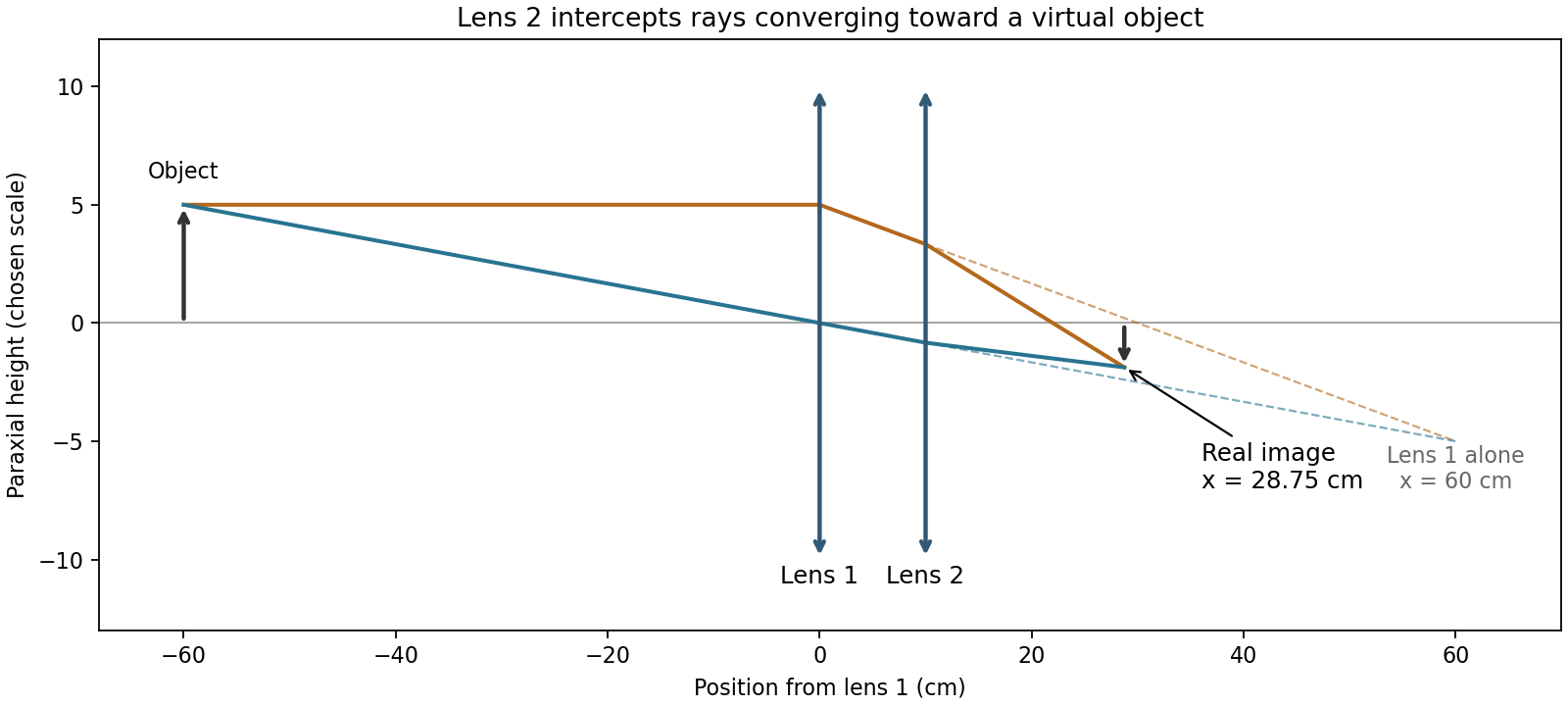
Two converging lenses and a real image
. Original paraxial ray construction with an arbitrary small object height. Two rays meet at the calculated inverted final image; dashed continuations show where lens 1 alone would have focused them. Details.
For prism sweep under different rotation conventions, let the apex angle be . Snell's law at both faces givesHere is measured from the second face's outward normal, whereas is the deviation from the incident direction. The two settings giveFor a fixed laser and rotating prism, the outgoing beam therefore sweepsIf instead the prism stays fixed and the input beam is steered, its exit-face normal stays fixed and the answer is . The source does not explicitly say which component moves, so the laboratory-angle convention matters. Both settings transmit through the second face; total internal reflection does not occur.
Apply Ampère's law on a concentric circle. Uniform current density is , so the enclosed current is inside and outside. With permeability ,The field circulates azimuthally by the right-hand rule. Its magnitude rises linearly from zero, is continuous and maximal at the surface, then falls as . End effects are neglected.
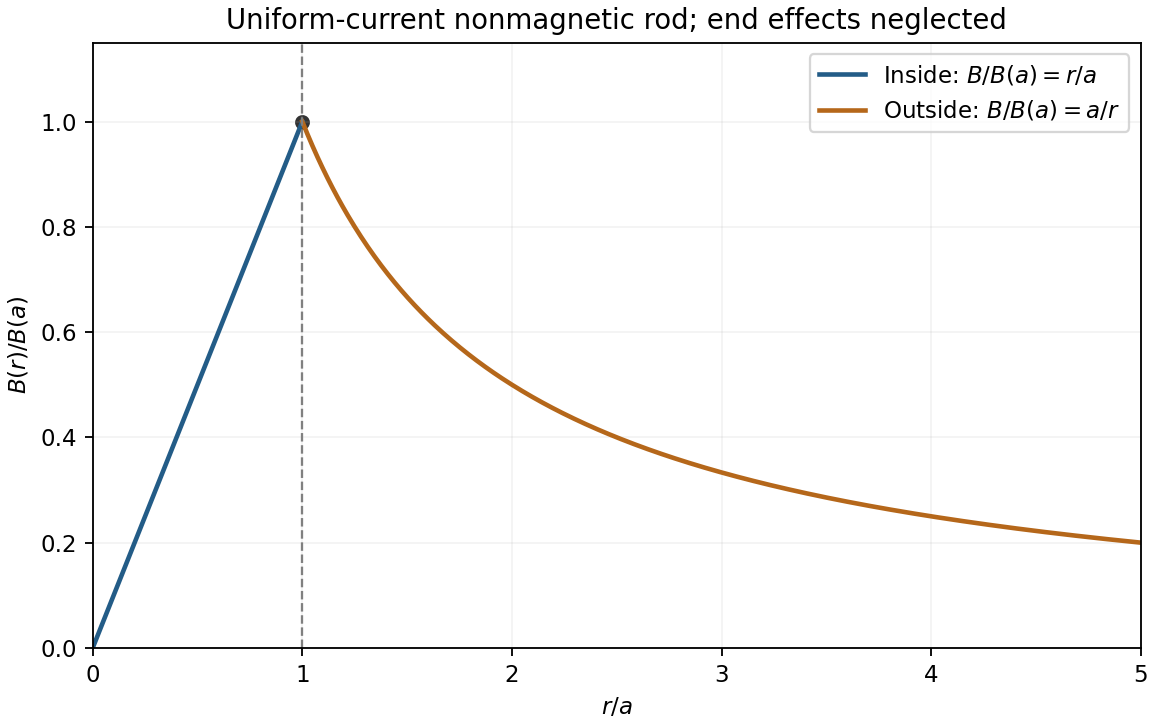
Magnetic field of a uniform-current rod
. Original dimensionless Ampere-law field curve: B divided by its surface value versus radius divided by rod radius, with the surface and the change of radial slope marked. Details.
In SI base dimensions,Equating current, time, mass and length powers respectively yieldsThusDimensional analysis cannot determine the dimensionless proportionality constant.
For a proper lifetime inferred from a delayed decay flash, the measured interval ends when the light returns to the detector, not when the muon decays. Put passage at in the detector frame. If decay occurs at , its distance is , and the backwards photon takes another to arrive. ThereforeThe muon's proper elapsed time isApplying time dilation directly to the 10 ns reception interval would transform the wrong pair of events.
For background-subtracted radiative temperature uncertainty, assume the two quoted precisions are independent standard uncertainties, and treat the radiative proportionality factor as known. Write and . Then , while both absolute input uncertainties equal . ConsequentlyThus the temperature precision is about , or . Subtraction amplifies fractional uncertainty even though itself is precise.
Independence is a measurement assumption, not a consequence of the two percentages. For correlation coefficient , the result is . If the percentages are strict error bounds combined pessimistically, the corresponding bound is . Unknown calibration correlations cannot be inferred from the source.
Articles by others on the same topic
There are currently no matching articles.