The displacement is along , transverse to propagation in the membrane's plane. Write ; then . Here is the displacement amplitude, the initial phase, the angular frequency and the wavevector normal to constant-phase lines. Its magnitude is , and its direction specifies phase propagation for the chosen sign convention.
For equal-phase two-wave membrane modes, two equal complex amplitudes with opposite sum toThe edge condition gives , hence , , for this even-in- family. Opposite relative phase gives the sine family; together they yield all Dirichlet transverse modes , . For the equal-phase family,The lowest mode has . ThereforeIt approaches for and diverges as ; there is no real travelling-mode beyond the cutoff. This is an axial phase velocity, not the group velocity: . Here denotes the membrane wave speed, not the speed of light.
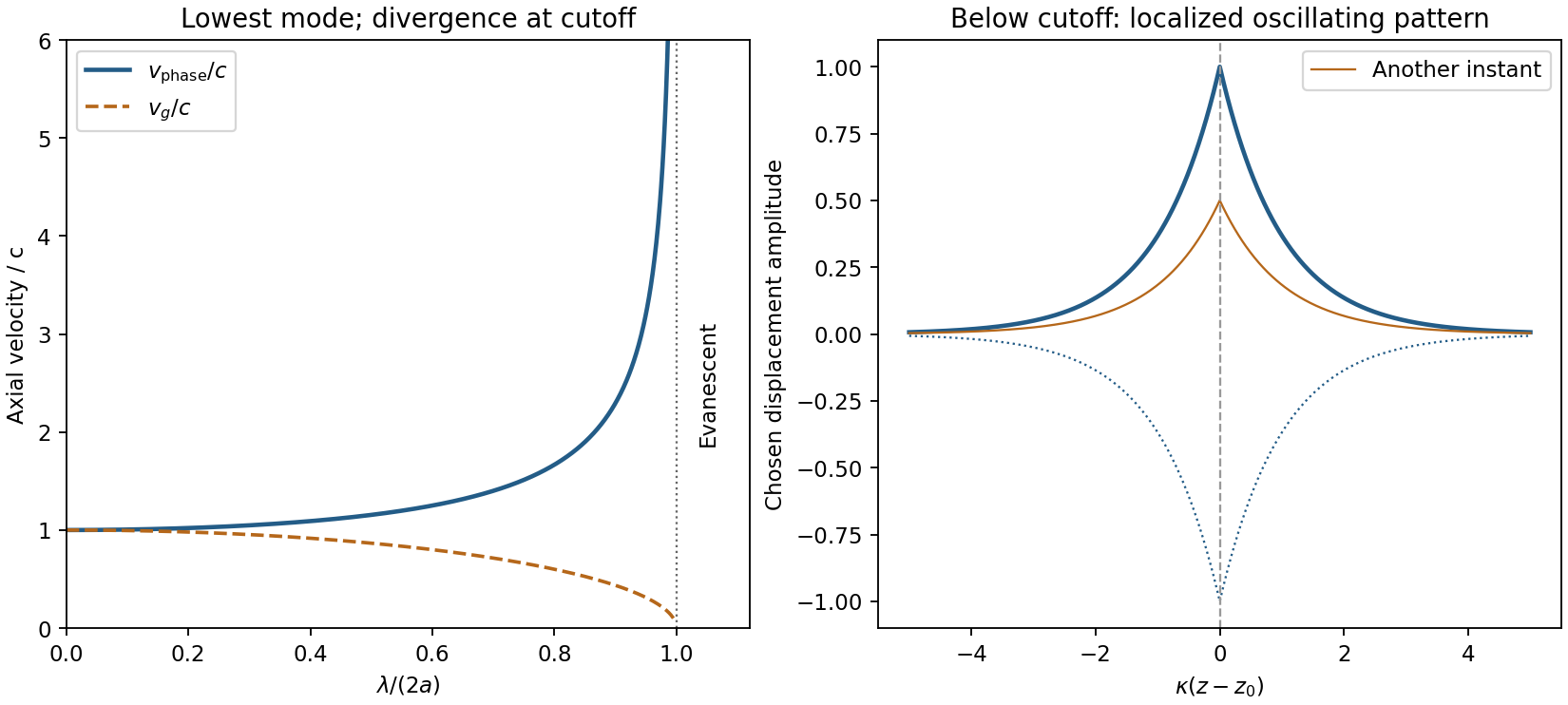
Membrane cutoff and evanescent response
. Original lowest-mode phase-velocity curve, with group velocity distinguished, and a schematic below-cutoff displacement envelope of exponential form. All lengths and amplitudes are dimensionless choices; no source apparatus drawing is copied. Details.
For the evanescent membrane response below cutoff, below , put for decay along positive , with . A localized central drive creates an evanescent, sinusoidally oscillating deformation decaying away in both axial directions. Far enough from the drive the leading profile is proportional to . Higher evanescent modes contribute near the point source. The pattern has no steadily advancing axial phase front or far-field propagating wave; decreasing frequency increases its spatial localization.
Direct differentiation gives . Inserting this into the Schrödinger equation and separately matching the and constant terms yieldsFor , and . The normalizable Gaussian has no nodes, as expected for the nondegenerate one-dimensional ground state of this confining potential.
The normalization integral is . Choose its irrelevant global phase so thatFor the oscillator ground-state density in a comparison wavelength, choose a free comparison particle with the same total energy. It has , hence comparison wavelength . ConsequentlyThe bound density is localized on scale , with standard deviation , rather than being spatially uniform like the density of a single free plane wave. The comparison does not assign constant free-particle momentum to the bound state; its total energy also includes potential energy.
Articles by others on the same topic
There are currently no matching articles.