For a small-slope string element, the transverse net tension is . Its mass is , so Newton's second law givesIts extra length is . Work against the approximately constant tension gives the elastic energy of a small-slope string, while transverse motion gives its kinetic energy:For a single travelling wave , , so pointwise to this order. A standing wave need not have pointwise or instantaneous kinetic–potential equality.
For a fixed-end string of length L, taking the stated note to be its fundamental gives . HenceIf98Hz were instead the nth harmonic, the required tension would be ; the usual fundamental interpretation is explicit.
For the specified standing wave, . Every allowed nonzero fixed-end mode has , yieldingAt this instant the ideal mode's elastic energy is zero; at maximum displacement all its energy is elastic. [ref]
University Physics Volume 1 by William Moebs and others. Chapter16, transverse-string wave speed, wave energy and fixed-end normal modes
In the time-independent Schrödinger equation, is the kinetic-energy operator acting on the state, its potential-energy contribution and the energy-eigenvalue term. The complex wave function is a probability amplitude: the Born rule assigns density for a normalized single-particle state. A plane-wave beam uses an incident-amplitude or flux normalization instead of a unit-integral wavefunction.
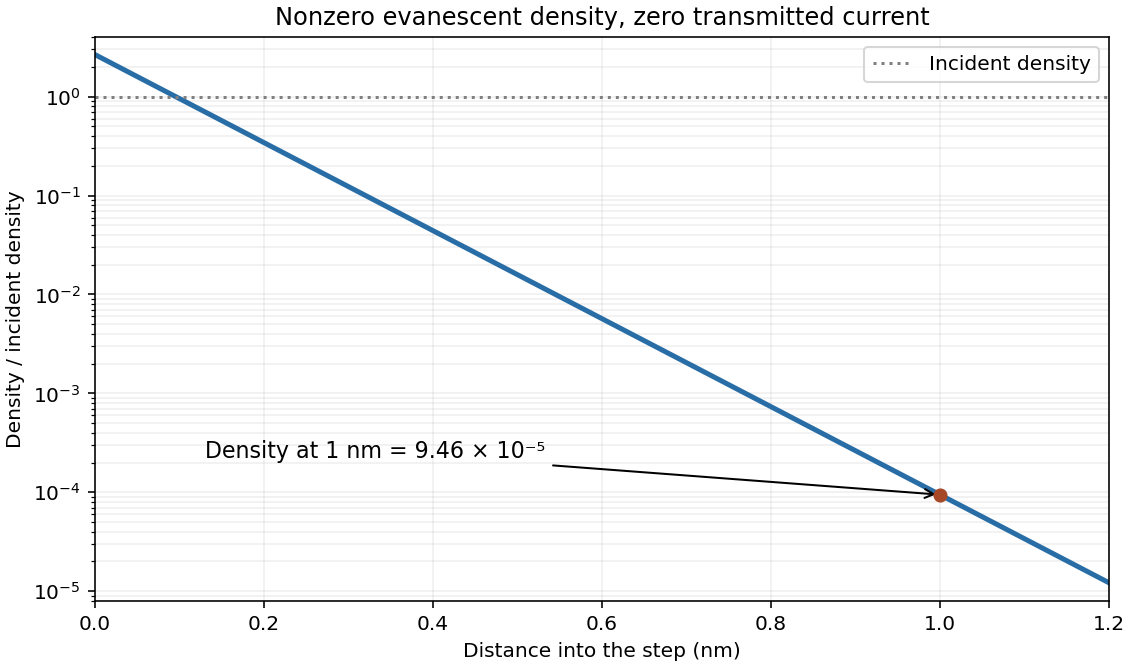
For a free plane wave, , so and its time factor obeys . Above the upward potential step, the bounded subthreshold solution has decay constantFor the PDF's unit incident amplitude, write on the left and on the right, omitting their common time phase. Continuity of both and at this finite step givesConsequentlyThe evanescent amplitude versus transmitted current distinction matters: the second quantity is a squared amplitude, not a transmitted-flux probability. The decaying tail has zero probability current, despite nonzero density and the possible value .
Using and the electron mass and elementary charge specified above, the energy difference1eV gives . Thus at the stated positionThis is relative to the unit incident density in the source figure, not an absolute normalized probability per metre. [ref]

Articles by others on the same topic
There are currently no matching articles.