For the gravitational-electrostatic balance of equal charged spheres, the shell theorem and Coulomb's law give and for well-separated spherical particles. Their separation cancels at balance. Since ,The two charges have the same sign, so electrostatic repulsion opposes gravitational attraction. A zero charge gives no nontrivial force balance. Spherical symmetry of the external charge distribution, or the leading far-field monopole approximation, is understood.
By symmetry, the two grounded plates take equal induced surface charge and the electric field has magnitude between either plate and the sheet. The grounded-plate potential of a central charged sheet is thereforeAn electron released at zero potential gains kinetic energy . ThusThe planar infinite-sheet approximation neglects edge effects. Here denotes charge magnitude; the electron's negative charge makes it accelerate toward the positive sheet. Relativistic corrections are below0.1%. Numerical constants use rounded CODATA values, not a claim about the historical handbook: , and . [ref]
In the initial centre-of-mass frame, equal fragments acquire opposite velocities by conservation of momentum. The released energy isThe equal-mass fragmentation energy budget needs merely to match the other ship, costing . To close an existing gap requires a little more than this. Using the full reserve givesThe reserve is sufficient to overtake. The rear half moves at , preserving momentum. The kinetic-energy increase is the same in any inertial frame because total momentum is unchanged. Subsequent capture or braking would require additional interaction details; no target mass is needed for the interception test.
The PDF's apex angle is , so each contacted face makes with the vertical. Let N be the inward normal force per face. Its vertical component is downward, ; limiting upward static friction contributes . Symmetric contacts cancel horizontal forces and torque. Incipient lift consequently requiresThis is the usual normal gripping force convention, using . Friction can lift the prism only if , which is satisfied here.
If “force applied” means the magnitude of the entire finger-contact resultant, including its tangential component, the normal versus resultant force in a frictional pinch givesThe optimal resultant lies at the limiting friction angle from the inward normal. Stating which force is being measured avoids confusing these two legitimate quantities.
For the double-slit experiment with oblique incidence, the optical path difference has an unknown incident contribution plus in the outgoing direction. It cancels between adjacent angular features. From a minimum to the next maximum, the path difference changes by :This incidence-independent adjacent-fringe wavelength uses the statement that intensity rises directly from the stated zero to the following peak. No absolute interference order or incidence angle is needed; nonadjacent extrema would require the number of intervening fringes.
The central estimate is . With independent input standard errors, the ratio-minus-one uncertainty from first-order uncertainty propagation isThe four independent reported results cluster near1.21, within about one quoted standard error of this estimate, so they are consistent at this precision. Their tight clustering is not evidence that this measurement has the same precision. If the measurements of a and b were correlated, a covariance term would be needed. [ref]
For a steady uniform jet, the mass flow rate is . The transported momentum flux and kinetic energy flux of a uniform jet areIncompressibility gives piston speed . Equating piston power to the jet's kinetic power givesThis ideal result neglects losses and the kinetic energy of fluid moving slowly inside the large cylinder. Retaining an inlet speed correction would multiply the pressure expression by .
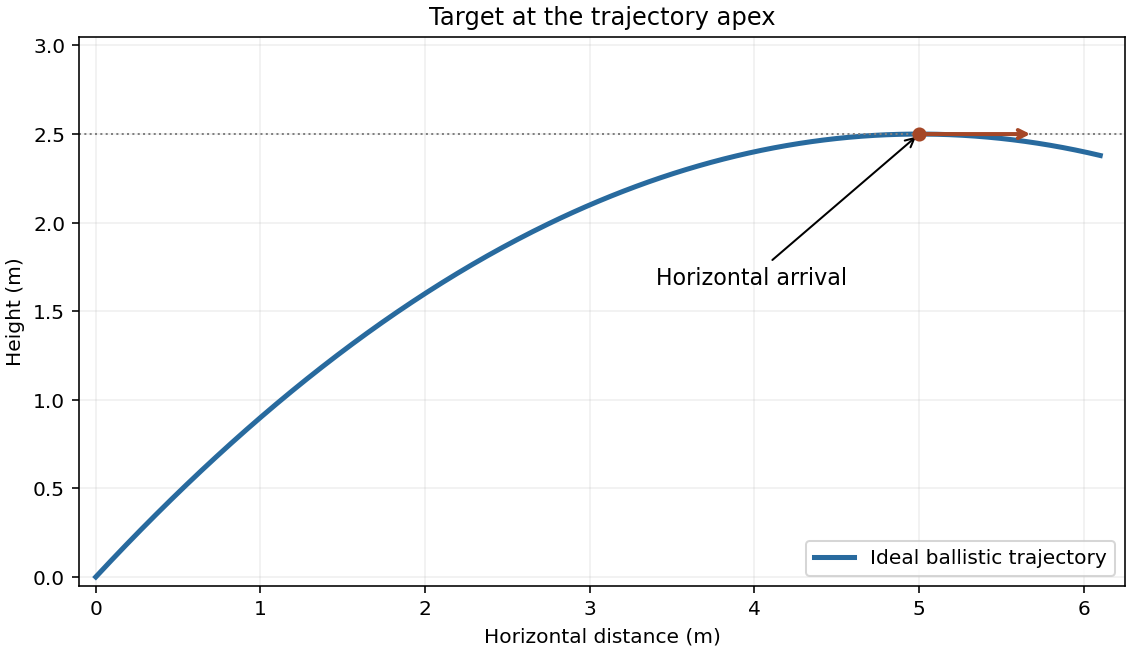
A horizontal impact occurs at the projectile apex. Write and . At its height h, and the flight time is , soHere and . The apex-target condition for a ballistic jet fixes both launch speed and angle.
If the target stops the horizontal momentum of the arriving water, the force isThis exceeds the limiting friction, so the target can be dislodged in the ideal stopping-impact model. The jet-area adjustment during ballistic slowing matters: the nozzle area sets ; replacing u by in that mass-flow factor would incorrectly assume unchanged jet area during deceleration. Reflection or a specified deflection would change the transferred momentum. Air drag, breakup and splash losses are excluded from the ballistic estimate.
The work-energy theorem gives for a point particle. For a conservative force, and its work is . Force is not generally a scalar derivative of total energy without specifying the displacement and the relevant energy.
The instantaneous mechanical power supplied by a force iswhere v is the velocity of its point of application in the chosen frame.
Power is the rate of energy transfer:Net mechanical power equals the rate of kinetic-energy change in the work–energy description.
The moment of inertia about an axis is . The parallel axis theorem states , where a is the perpendicular separation from a parallel axis through the centre of mass, and M is total mass.
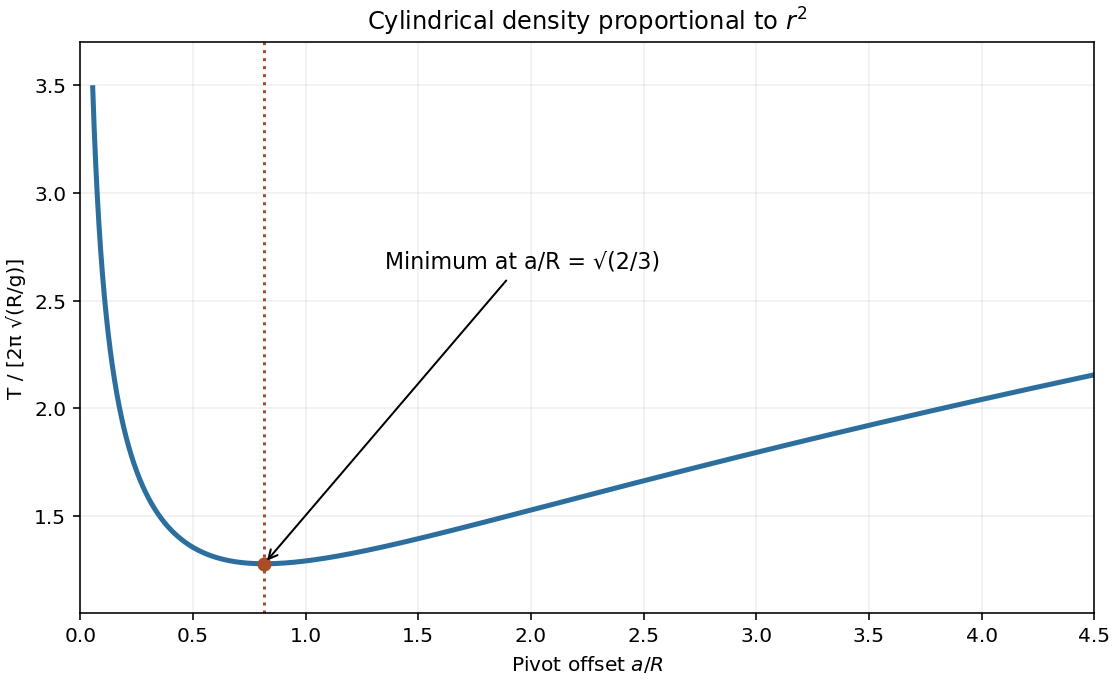
Since , the density coefficient has units . The density-power cylindrical moment of inertia follows from cylindrical shells:For an offset pivot, the physical pendulum equation is . At small amplitude,For the minimum-period offset of a physical pendulum, minimizing is equivalent to minimizing . Its derivative vanishes atThe second derivative is positive. The period diverges as near zero and grows as for large offset, giving one minimum. This assumes the stated ideal pivot can pass inside the body; an externally constrained pivot would restrict the allowable a. [ref]
For the stated standard configuration, the Lorentz transformation isDifferentiate along the moving object's worldline and divide by to obtain the velocity-addition formula:For a receding source, two emissions separated by proper time occur apart in S. The second signal travels an additional distance , so its reception interval is . Hence the longitudinal relativistic Doppler effect isThe inverse velocity transformation for the forward throw givesThe ball approaches the stationary receiver, so its forward light is blueshifted. The received wavelength is , in the ultraviolet. The stated monochromatic emission is outside the visible band. Other reflected or emitted frequencies have not been specified. [ref]
University Physics Volume 3 by Samuel J. Ling and others. §5.7, longitudinal light Doppler shift and approach/recession signs
For sinusoidal steady state with the convention, complex impedance is the phasor ratio , encoding both amplitude ratio and phase. From , an ideal inductor has ; from , a capacitor has .
The original diagram has in series, and in parallel. ThusWith the right supply node as the reference, the two unloaded voltage divider outputs are and . Subtracting givesThe series-RL parallel-RC bridge balance is . Equating its real and imaginary coefficients givesThese ideal components balance the bridge at any frequency, not just the test frequency.
At , the current amplitude through is . Using peak rather than RMS supply amplitude,In the DC steady state the inductor is a short and the capacitor is open. Both dividers have equal resistors, so each midpoint is at2.5V and the bridge stays balanced. The upper-branch current is0.100A, giving .
For the high-input-resistance voltmeter, hold the other components fixed. At the DC balance,The DC bridge resistance resolution is a local readout resolution, or0.08% of , not a total uncertainty allowing for supply, component calibration or voltmeter loading. [ref]
TODO: user-deferred biological application. The entire organism-specific question, including all unlabelled requests and both requested response cases, is preserved without solving or biological research.
For a small-slope string element, the transverse net tension is . Its mass is , so Newton's second law givesIts extra length is . Work against the approximately constant tension gives the elastic energy of a small-slope string, while transverse motion gives its kinetic energy:For a single travelling wave , , so pointwise to this order. A standing wave need not have pointwise or instantaneous kinetic–potential equality.
For a fixed-end string of length L, taking the stated note to be its fundamental gives . HenceIf98Hz were instead the nth harmonic, the required tension would be ; the usual fundamental interpretation is explicit.
For the specified standing wave, . Every allowed nonzero fixed-end mode has , yieldingAt this instant the ideal mode's elastic energy is zero; at maximum displacement all its energy is elastic. [ref]
University Physics Volume 1 by William Moebs and others. Chapter16, transverse-string wave speed, wave energy and fixed-end normal modes
In the time-independent Schrödinger equation, is the kinetic-energy operator acting on the state, its potential-energy contribution and the energy-eigenvalue term. The complex wave function is a probability amplitude: the Born rule assigns density for a normalized single-particle state. A plane-wave beam uses an incident-amplitude or flux normalization instead of a unit-integral wavefunction.
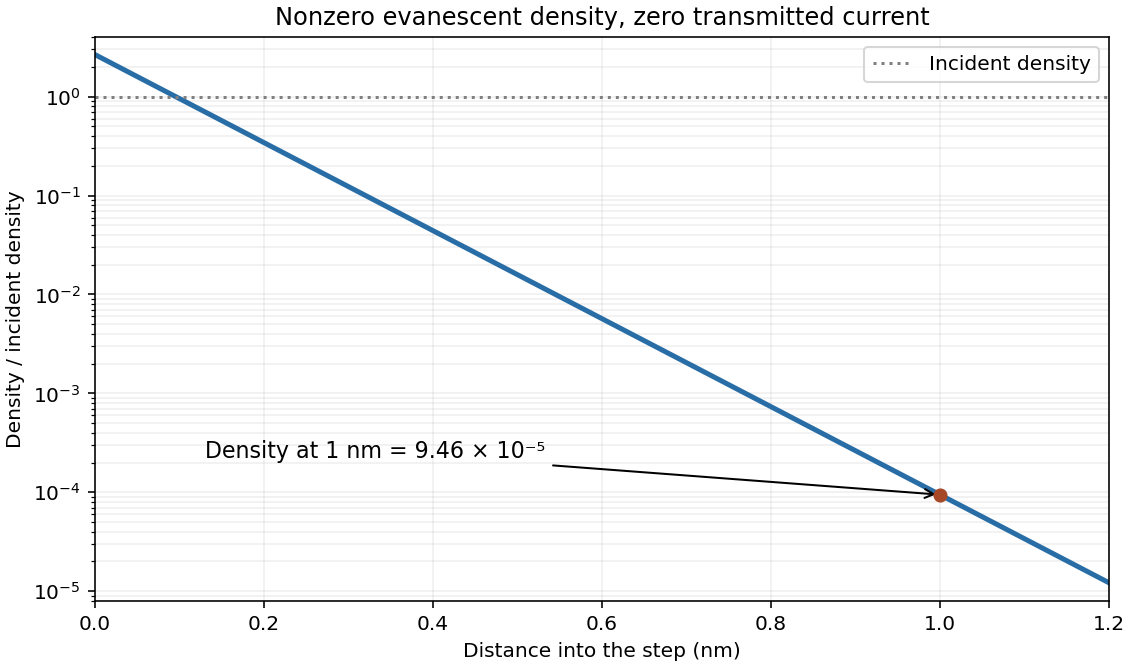
For a free plane wave, , so and its time factor obeys . Above the upward potential step, the bounded subthreshold solution has decay constantFor the PDF's unit incident amplitude, write on the left and on the right, omitting their common time phase. Continuity of both and at this finite step givesConsequentlyThe evanescent amplitude versus transmitted current distinction matters: the second quantity is a squared amplitude, not a transmitted-flux probability. The decaying tail has zero probability current, despite nonzero density and the possible value .
Using and the electron mass and elementary charge specified above, the energy difference1eV gives . Thus at the stated positionThis is relative to the unit incident density in the source figure, not an absolute normalized probability per metre. [ref]


Gauss's law statesThe surface is closed and oriented outward, and includes all enclosed charge. The integral law follows from the local form through the divergence theorem. It is universally valid in classical electromagnetism, but calculating the field directly from the flux requires enough symmetry.
For spherical charge symmetry, . A uniform infinite line gives from a coaxial cylinder. An infinite sheet gives on either side from a pillbox, with the direction set by charge sign. The normal field jump is ; the electrostatic field inside a conductor is zero. Zero enclosed charge implies zero net flux, not generally zero field. [ref]
University Physics Volume 2 by Samuel J. Ling and others. Chapter6, Gaussian surfaces and symmetry applications
For a steady thin-wire current in vacuum, the Biot-Savart law isThe line element follows conventional current direction. More generally replace with . The cross product gives the circulating field direction and superposition allows contributions from separate wire segments to be added.
Integration gives around a long straight wire. On the axis of a circular loop of radius a, , including the centre value . Coil turns multiply the field when their geometries coincide; distributed coils and solenoids follow by integration. This is a magnetostatic or quasistatic calculation: rapidly changing currents require retarded electrodynamics and appropriate displacement-current effects, not an instantaneous wire formula. [ref]
University Physics Volume 2 by Samuel J. Ling and others. Chapter12, steady-current fields and Biot–Savart applications
For a stationary closed circuit, Faraday's law of induction isThe loop orientation and magnetic-flux normal obey the right-hand convention. For a moving material circuit, the emf is instead , with the same negative derivative of the flux through the moving circuit. The additional magnetic force term accounts for motional emf.
Lenz's law expresses the minus sign physically: an induced current opposes the change in flux that produces it. It does not always oppose the field itself. Increasing positive flux drives a current producing negative flux; decreasing it reverses that response. A straight conducting rod of length l moving across a perpendicular uniform field has emf magnitude Blv. A resistive return circuit then develops a magnetic braking force, and the supplied mechanical power equals Joule heating in the ideal steady limit. This connects induction with conservation of energy. [ref]
University Physics Volume 2 by Samuel J. Ling and others. Chapter13, Faraday induction, Lenz direction and motional emf
A conservative force has work depending only on the endpoints, so it can be writtenThe arbitrary additive constant in potential energy has no effect on force. A smooth curl-free force is conservative on a simply connected domain; a hole or excluded singularity requires checking global circulation as well.
Uniform gravity has , central gravity has with zero at infinity, and a linear spring has relative to equilibrium. If the potential is time independent and no other force does work, is conserved by the work-energy theorem. A time-dependent potential or nonconservative work can change mechanical energy; having an instantaneous gradient force alone is not sufficient for energy conservation. [ref]
University Physics Volume 1 by William Moebs and others. Chapter8, conservative forces, potential energy and mechanical-energy conservation
Treat Earth as a stationary spherical source, with , and neglect drag and other bodies. The conserved quantities are total mechanical energy and the angular momentum vector, implying a fixed orbital plane and constant areal velocity. The Kepler problem additionally conserves the Laplace-Runge-Lenz vector. The orbiting object's linear momentum is not constant because gravity exerts a force.
For a circular orbit, , so . HenceAt the closest approach of a noncircular orbit, the velocity is tangential and . Its energy and specific angular momentum areThe pericentre-speed qualification of Kepler orbit classes requires when is genuinely the closest approach. For an ellipse, conservation of h gives . Equating energies at the two turning points and writing givesThe distinct apocentre root is thereforeFor an unbound orbit, decreases toward infinity. The asymptotic minimum speed of an unbound Kepler orbit isIt is the limiting infimum, reached only asymptotically: positive for a hyperbola and zero for a parabola. The turning-point interpretation of is essential; if , the same instantaneous energy describes a bound orbit whose is the apocentre instead. [ref]
University Physics Volume 1 by William Moebs and others. Chapter13, gravitational energy, escape and Kepler orbits
The orbit is circular for . The speed equals and radial acceleration balances the changing direction of the velocity.
A noncircular ellipse with at pericentre has . Its energy is negative. Merely specifying would make the stated closest-approach point an apocentre, so it is excluded by the geometry; the circular case is listed separately.
The orbit is unbound for : parabolic at equality and hyperbolic above it. The pericentre speed has reached or exceeded the local escape velocity.
Articles by others on the same topic
There are currently no matching articles.