For an infinite straight wire in vacuum, Ampère's circuital law around a circle of radius gives . ThereforeHere is the vacuum permeability and the azimuthal direction follows the right-hand rule around the electric current. The magnetic field is measured in .
Choose the electric current counterclockwise as viewed from ; reversing it reverses the magnetic field. Parameterize the circular wire byThe cross product in the Biot-Savart law isConsequently the transverse terms integrate to zero over , while the axial term is constant:ThusThe direction is on both halves of the axis for this electric current orientation, including ; it is not “away from the plane” on both sides. The right-hand rule gives the same direction.
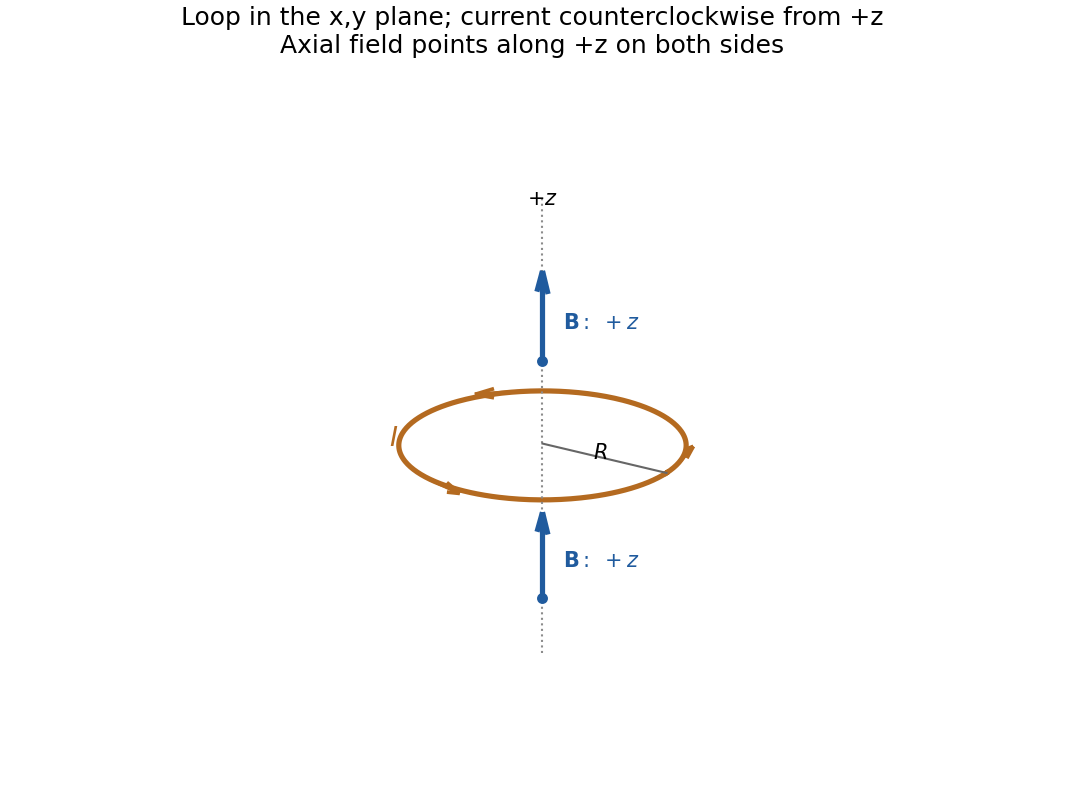
Direction of the axial magnetic field of a circular current loop, with counterclockwise electric current viewed from
. Details. 
Read the original diagram as a clockwise arc carrying electric current from its upper endpoint to its lower endpoint, with tangent semi-infinite leads extending to the right. Their crossing is insulated, so there is no extra junction. Choose out of the page. At the centre the arc produces a negative axial magnetic field, and each straight lead a positive one, by the right-hand rule.
For the arc, every element is at distance , with perpendicular to its displacement to the centre. The Biot-Savart law therefore givesFor each straight lead, write for distance along the tangent measured from its endpoint. Its perpendicular distance from the centre is , soThe integral equals because an antiderivative is . Adding both leads and the arc,Using the full infinite-wire magnetic field for either lead would incorrectly double its contribution.
To calculate magnetic-field cancellation of an arc and tangent leads away from the plane, put . Each point on the arc is distance from , and the axial component of still has magnitude . Thus its axial magnetic field isFor either tangent lead the axial numerator remains , while the cubed distance is . HenceAdding both leads givesFor , a binomial series yieldsThe exact condition for cancellation of the axial component isFor example, keeping would leave a small positive axial magnetic field proportional to . Both contributions weaken with height, but the arc factor is whereas the lead factor is . The arc therefore loses a greater fraction of its axial magnetic field. Increasing its angle compensates for this loss. Physically, the arc is all at the same finite radius, whereas distant elements of the semi-infinite leads undergo a smaller fractional change in distance on moving a little out of the plane.
Articles by others on the same topic
There are currently no matching articles.