is the particle's potential energy as a function of position, and is its total energy eigenvalue in this time-independent Schrödinger equation. Solving it with the boundary conditions determines the allowed stationary states and energy levels.
The wavefunction is a probability amplitude: the Born rule gives position probability density , normalized to unit integral for one particle. itself need not be real or positive and is not a classical matter-density profile. The full stationary-state time dependence is , leaving time independent.
For a nonzero integer mode, normalize the wavefunction:Thus . Choosing an arbitrary overall phase makes real and positive. The physical modes are conventionally indexed ; would be the zero function and cannot be normalized.
Substitution into the Schrödinger equation gives . For the stated electron well,The transition emits the energy difference, , soUsing the full excited-state energy as the photon energy would neglect the nonzero ground-state energy.
The position probability density isand zero outside. It has zeros at and equal maxima at . The two lobes have equal integrated probability. The vertical axis is a density with units of inverse length, not a dimensionless probability at a point.
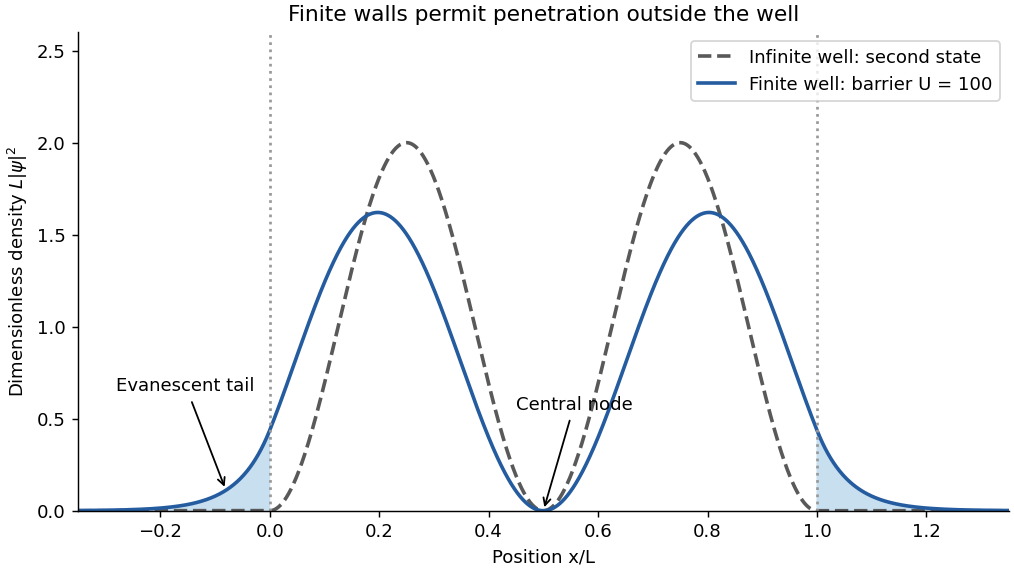
Second-state position densities for an infinite well and an illustrative finite well, including evanescent tails
. Details. 
Use the dimensionless coordinate :ThereforeThe central interval surrounds a node, which explains why the probability is much smaller than its ten-percent share of the well's length.
The density is symmetric about : . Denote the expectation by . Substitution givesThus . An expectation need not coincide with a high-density position: the centre is a node of this particular state, but the two equally weighted lobes balance about it.
For a symmetric finite well supporting this excited bound state, the wavefunction and its derivative match continuously at each finite potential step. Outside, where , the solution decays exponentially withThe density therefore extends into the classically forbidden region instead of dropping to zero at the walls. Its interior lobes and normalization change, and the energy is lower than for the corresponding infinite-wall state at the same well bottom. Symmetry preserves the central node for the first excited state. The diagram shows an explicitly illustrative barrier height, not an extra numerical value supplied by the question.
Articles by others on the same topic
There are currently no matching articles.