Three experimental tests probe different consequences of special relativity. The Michelson-Morley experiment compares light round trips along perpendicular interferometer arms while changing the apparatus orientation. Its small observed orientation-dependent fringe shift contradicts the simple stationary-aether prediction and supports orientation-independent round-trip light speed. It does not, alone, exclude every alternative theory.[ref]
On the Relative Motion of the Earth and the Luminiferous Ether by Albert Abraham Michelson and Edward W. Morley. 1887 apparatus and fringe-shift comparison
In the muon storage-ring time-dilation experiment, fast circulating muons live longer in laboratory time than muons at rest. Measuring decay counts versus elapsed laboratory time and independently determining the beam Lorentz factor tests . Circular motion includes acceleration, so this also tests the applicability of accumulated proper time along the stored trajectory.[ref]
Measurements of relativistic time dilatation for positive and negative muons in a circular orbit by J. Bailey and others. storage-ring lifetime measurements and comparison with the relativistic factor
Bertozzi's electron speed-energy experiment measures electron time of flight and deposited kinetic energy independently. An electrostatic accelerator and a linear accelerator increase the energy while the measured speed approaches the light-speed limit. Calorimetry checks that the additional beam energy is real, rather than inferring it only from an assumed voltage-to-speed relation. The result supports relativistic rather than extending to arbitrarily large speeds.[ref]
Speed and Kinetic Energy of Relativistic Electrons by William Bertozzi. 1964 abstract: time-of-flight measurements over 0.5–15 MeV and independent calorimetry
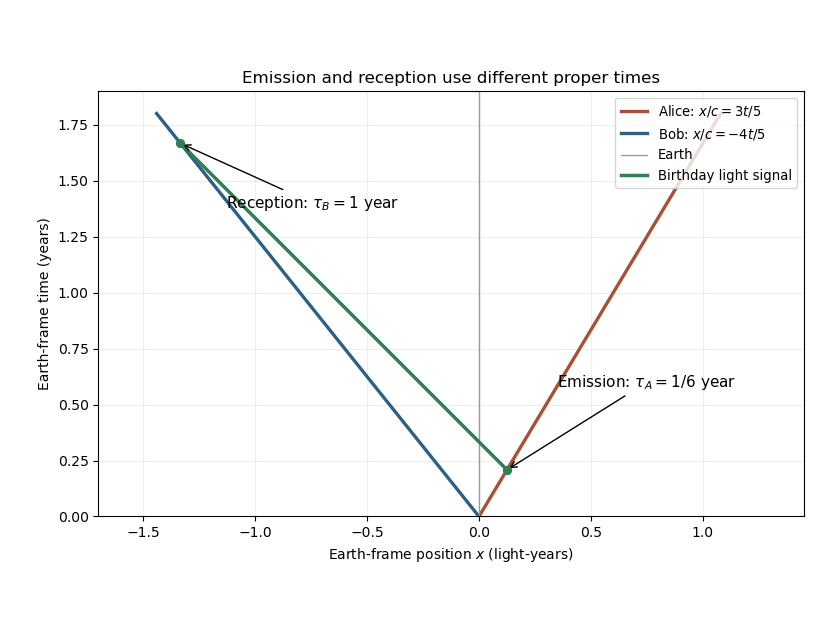
For the two ships, set launch time to zero and measure Earth time in years. Their Lorentz factors are and . Bob's thirtieth birthday occurs after one year of his proper time, so its Earth coordinates areIf Alice sends at Earth time , her position is . The left-going light signal obeys . Intersection with Bob givesAlice's elapsed proper time is thereforeShe sends two months after her twenty-ninth birthday. This compares the emission and reception events; the captains' clocks need only be synchronized at launch, not kept numerically synchronized afterward.

Articles by others on the same topic
There are currently no matching articles.