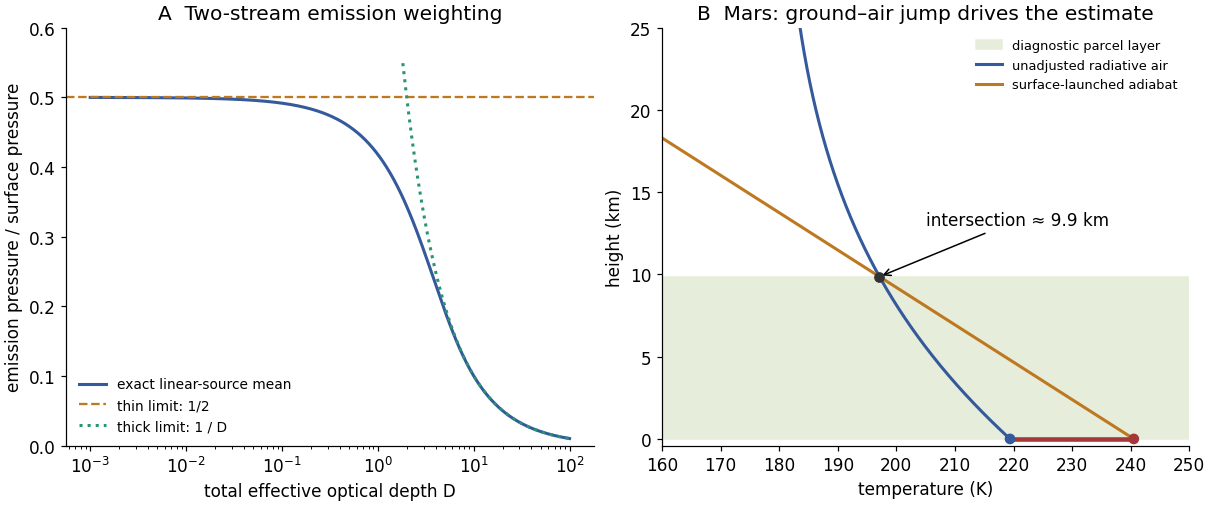
The global mean absorbed solar flux is . Using givesFor the requested graphical parcel estimate, start a dry adiabat at the warm ground, with in km, and intersect it with the radiative atmospheric profile . Solving givesThe original diagram below shows the intersection and the initial ground–air temperature discontinuity. A parcel heated towards the ground temperature remains buoyant until nearly one scale height in this model.
The atmospheric radiative lapse rate itself is only about at the bottom and decreases with height, smaller than the stated adiabatic . Thus the interior radiative atmosphere is statically stable; the driver of this particular estimate is the hotter ground and discontinuity at the lower boundary, not a radiative lapse rate everywhere steeper than adiabatic. Convection would smooth that discontinuity and redistribute energy.
This is a diagnostic depth using the unadjusted radiative ground and atmospheric temperatures, not a fully energy-conserving radiative–convective equilibrium after adjustment. A self-consistent adjustment changes the surface temperature, infrared fluxes and boundary height. Mars also has spectral CO absorption, dust, day–night variation, seasonal changes and geographically uneven heating; a gray, horizontally averaged, constant-scale-height column with fixed lapse rate captures none of those details. The calculation indicates the possible importance of a deep surface-driven mixed layer under the stated assumptions, not a universal Martian boundary-layer measurement.

Articles by others on the same topic
There are currently no matching articles.