and are the positive upward and downward hemispherically integrated infrared fluxes, in , rather than directional specific intensities. The source is the blackbody hemispheric flux . Absorption removes a fraction proportional to the flux along a ray, and thermal emission replaces it according to Kirchhoff's law. Local thermodynamic equilibrium sets that emission source to the local Planck function.
A plane-parallel, non-scattering, gray atmosphere with a two-stream/angular closure reduces the angle- and frequency-dependent transfer equation to these two flux equations. The angular path factors are absorbed into the effective optical depth. Since the supplied coordinate increases upwards, the upward flux loses while gaining in moving upward; the downward ray traverses the coordinate in the opposite direction, reversing the differential signs in its equation. The equations therefore encode emission as well as absorption and are consistent with an isothermal source approaching thermal radiation in an optically thick medium. The source's use of “radiance” for these integrated quantities should not introduce an extra factor of .
Assume the atmosphere is transparent to incoming shortwave radiation, as required for the stated infrared-only radiative-equilibrium model. Global energy balance givesPut and . Radiative equilibrium requires , hence the two equations imply . Substitution gives . At the top there is no incident infrared flux, , and . ThereforeThe black ground supplies . ThusThe ground also satisfies , showing explicitly that its outgoing flux balances absorbed sunlight plus downward atmospheric radiation. In pure radiative equilibrium the air just above the ground need not have the ground's temperature: , whereas . That discontinuity is relevant to surface-driven convection in part (d).
Adding the two flux solutions givesThe supplied pressure–optical-depth law gives . With the exponential pressure model ,It approaches the finite atmospheric top temperature and has the lowermost-air value . Its lapse rate isThe stated approximate sign is appropriate physically: a nonisothermal ideal gas does not have an exactly constant hydrostatic scale height . Treating as a representative constant is an additional vertical-coordinate approximation. Algebraically the displayed profile is exact for the prescribed exponential pressure and two-stream equations.
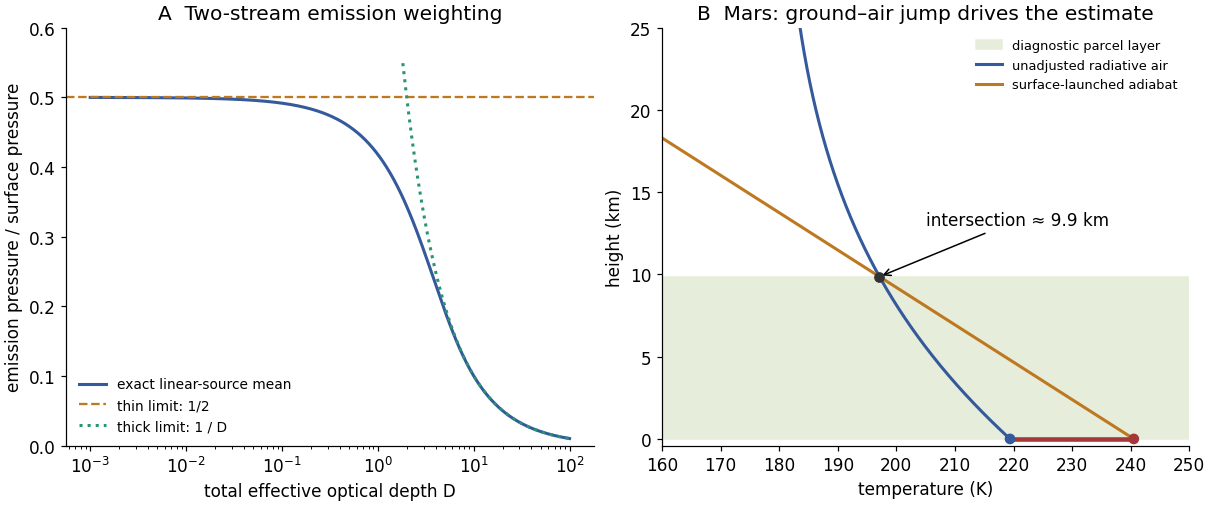
The global mean absorbed solar flux is . Using givesFor the requested graphical parcel estimate, start a dry adiabat at the warm ground, with in km, and intersect it with the radiative atmospheric profile . Solving givesThe original diagram below shows the intersection and the initial ground–air temperature discontinuity. A parcel heated towards the ground temperature remains buoyant until nearly one scale height in this model.
The atmospheric radiative lapse rate itself is only about at the bottom and decreases with height, smaller than the stated adiabatic . Thus the interior radiative atmosphere is statically stable; the driver of this particular estimate is the hotter ground and discontinuity at the lower boundary, not a radiative lapse rate everywhere steeper than adiabatic. Convection would smooth that discontinuity and redistribute energy.
This is a diagnostic depth using the unadjusted radiative ground and atmospheric temperatures, not a fully energy-conserving radiative–convective equilibrium after adjustment. A self-consistent adjustment changes the surface temperature, infrared fluxes and boundary height. Mars also has spectral CO absorption, dust, day–night variation, seasonal changes and geographically uneven heating; a gray, horizontally averaged, constant-scale-height column with fixed lapse rate captures none of those details. The calculation indicates the possible importance of a deep surface-driven mixed layer under the stated assumptions, not a universal Martian boundary-layer measurement.

Articles by others on the same topic
There are currently no matching articles.