Take a Northern-Hemisphere cyclonic vortex, with positive relative vorticity. For a fixed-depth incompressible layer, conservation of absolute vorticity givesThe anticlockwise flow on the east side moves parcels northward, increasing their planetary vorticity and creating negative relative vorticity anomalies. On the west side it moves parcels southward and creates positive relative vorticity anomalies. Initially,so the positive anomaly grows on the western flank while the eastern flank loses positive vorticity. The cyclonic pattern consequently shifts westward. The induced anomalies themselves drive meridional flow and further relative vorticity anomalies, transmitting a Rossby wave pattern through the surrounding fluid. The restoring process is this exchange between planetary vorticity and relative vorticity, rather than a parcel executing a permanently westward translation.
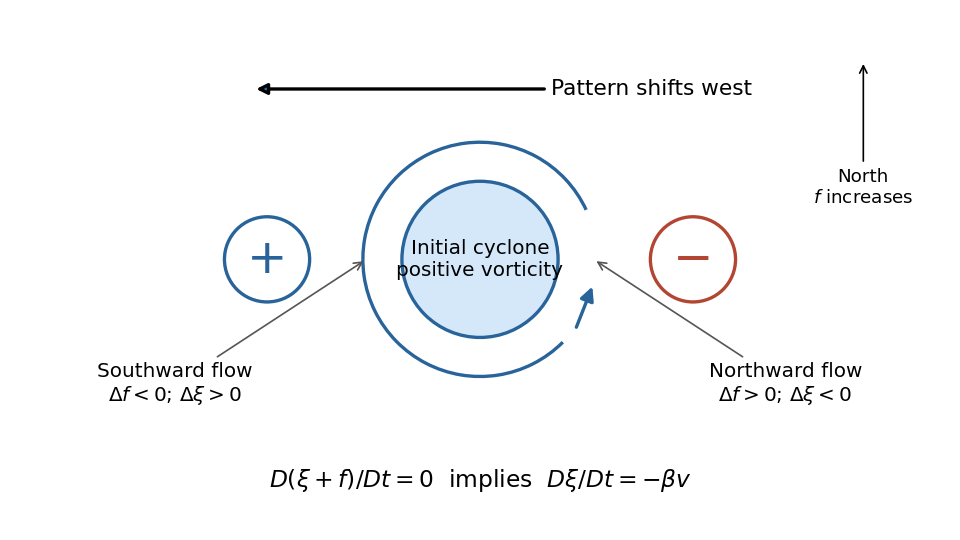

The sketch shows the initial tendency, with the generated signs separated from the initial positive core. An isolated disturbance contains many wavevectors and disperses; westward phase velocity does not imply that all its wave energy travels westward. A Southern-Hemisphere cyclonic vortex reverses the signs of the initial and generated relative vorticities, while the same beta plane mechanism remains.
Write , , and , with constant. Discarding products of perturbations in the vorticity equation givesIntroduce the streamfunction conventionIt enforces incompressibility identically. The linear partial differential equation isFor the plane wave , put . Substitution yieldsThe first term is the Doppler shift by the background flow; the second is the intrinsic Rossby wave frequency. The source's convention selects representatives of real waves, rather than making this expression nonnegative for arbitrary . For and , nonzero positive frequency requires ; the conjugate mode has opposite signs of and describes the same real field.
For and fixed , completing the square in the dispersion relation givesThese Rossby-wave isofrequency circles lie in the half-plane and touch the origin, where the dispersion relation is undefined. Their radii decrease as frequency increases. The zero-frequency line is .
The group velocity is normal to the constant-frequency curves, toward increasing frequency:At , the group velocity is eastward; close to it is westward. For the positive-frequency circles its arrows point inward toward the circle centre. Its meridional component is southward in and northward in .
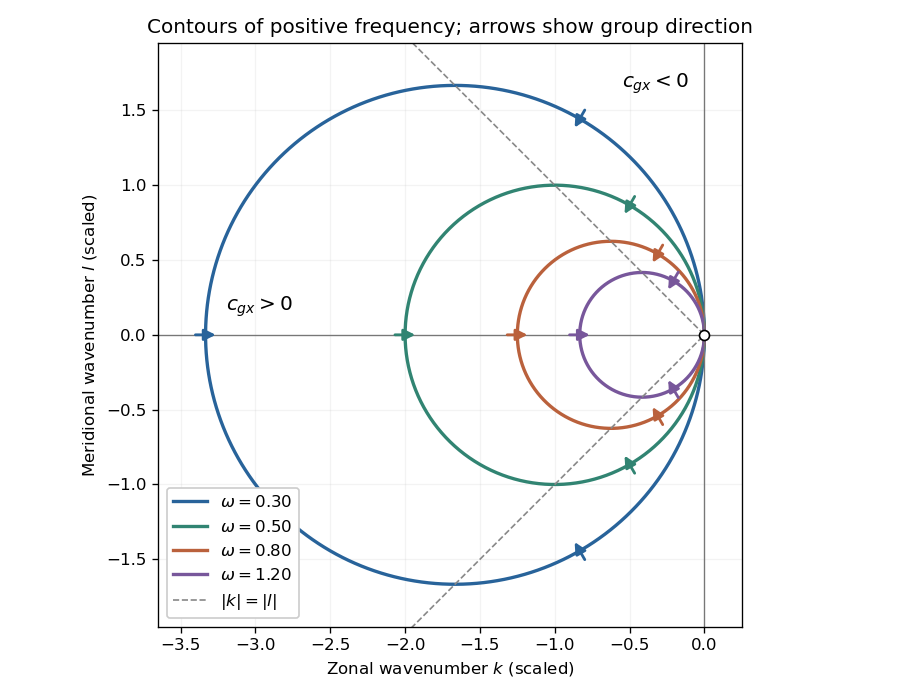
Positive-frequency Rossby-wave isofrequency circles and group velocity directions in dimensionless wavenumber coordinates
. Details. 
For , the zonal phase velocity, meaning propagation at fixed , isIt is westward everywhere it is defined. The zonal group velocity is eastward for , westward for , and zero on . There is no region of eastward zonal phase velocity. At , is undefined, though its continuous limiting expression is westward and . Using instead the normal-to-wavecrest phase velocity vector gives ; its zonal component is also westward for , but is not the same scalar as .
For a nonzero zonal wavenumber , stationarity requiresA real propagating solution therefore requires a westerly . For there are two meridional wavenumbers:The source's assertion of two stationary solutions needs these qualifications: at they coincide, and at there is no real meridionally propagating solution. For example gives . Modes with are a separate zonally invariant degeneracy and do not have a defined zonal phase velocity.
Adding to the zonal group velocity and imposing stationarity givesThus a localized midlatitude disturbance radiates stationary Rossby wave activity downstream, along one poleward and one equatorward branch. For in the Northern Hemisphere, gives the northeastward branch and the southeastward branch. With strictly constant , these wave rays are straight. Changing latitude cannot bend them within that constant-coefficient model.
To discuss a planet, extend it locally to slowly varying and possibly . The conserved zonal wavenumber in a locally zonally uniform medium then hasFor constant and northward propagation in the Northern Hemisphere, decreasing reduces until : the wave ray becomes zonal at a turning latitude and can refract equatorward. The equatorward branch initially encounters larger allowed and becomes more meridional. This local midlatitude description eventually needs replacement near the equator or wherever the background varies rapidly.
Orographic forcing by a mountain range or persistent spatially localized heating can supply such a disturbance. Its steady forcing selects the ground-stationary part of the response. The corresponding local total wavelength isFor fixed it increases toward the pole as decreases. Locally the zonal integer scale has upper bound , so fewer planetary-scale zonal waves fit around higher-latitude circles. This is not an unconditional trend in actual weather: changing , its curvature, stratification and the forcing spectrum can change the dominant Rossby wave wavelengths.
Articles by others on the same topic
There are currently no matching articles.