Transverse confinement in a short clean channel gives subband dispersionsA gate varies the subband thresholds and channel width. If elastic backscattering is negligible and spin is degenerate, the two-terminal linear conductance isA fully open subband has , producing conductance steps in units . Magnetic spin splitting can resolve steps. A finite two-terminal resistance remains in a perfect ballistic channel because reservoirs supply and absorb a finite number of transport modes; it does not prove momentum-randomizing scattering inside the constriction.
At finite source-drain bias the two reservoir distributions differ over an energy window rather than at one Fermi energy. Choose and take positive current from source to drain. For spin-degenerate channels,At zero temperature with a rigid transmission spectrum, . For symmetric bias and neglecting an explicit bias response of ,If the two window edges lie above different numbers of subbands, the differential conductance can lie at half-integer values in units . For example, two open subbands at one edge and one at the other give . This is a bias-window effect, not fractional charge or a fractional Hall state.
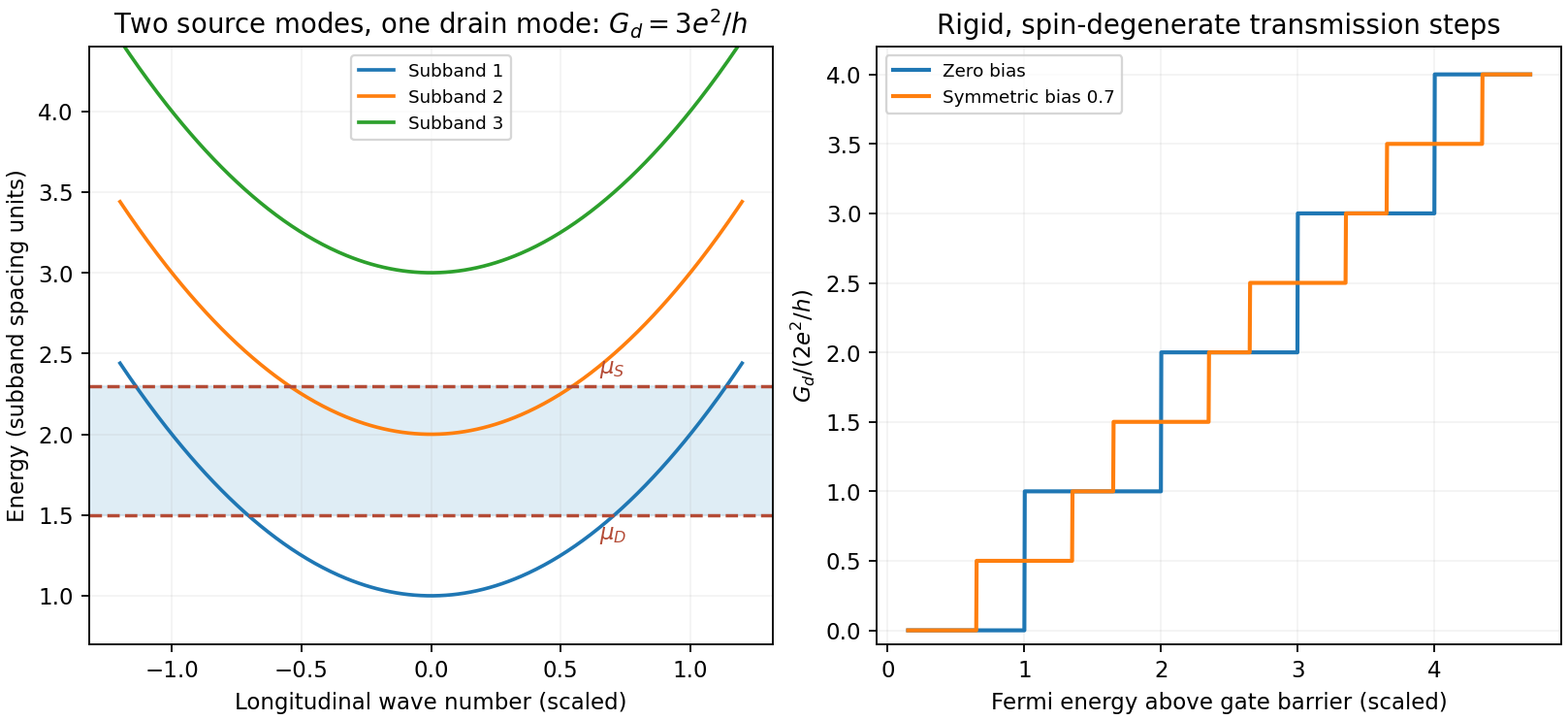
Original ideal one-dimensional subbands sampled by a symmetric bias window, with integer and half-integer differential-conductance plateaus
. Details. 
Mapping transconductance versus gate voltage and source-drain bias reveals boundaries where a reservoir chemical potential crosses a subband bottom, enabling energy-spacing spectroscopy under a specified lever arm and bias division. Finite temperature rounds thresholds over ; reflection, disorder, series resistance and a saddle-shaped barrier reduce or smooth plateaus. Large bias can alter the electrostatic potential, heat carriers or produce inelastic scattering, so the rigid-transmission differential formula is not generally valid without its assumptions. One-dimensional interaction effects can add anomalies beyond this independent-channel model.
Articles by others on the same topic
There are currently no matching articles.