2016 paper: Public original PDF, physical page 832. Student-answer availability for this paper remains unverified.
All three questions and all alternatives in Question 3 are covered. Questions 1 and 2 contain unlabelled requests, retained within their respective question Solutions.
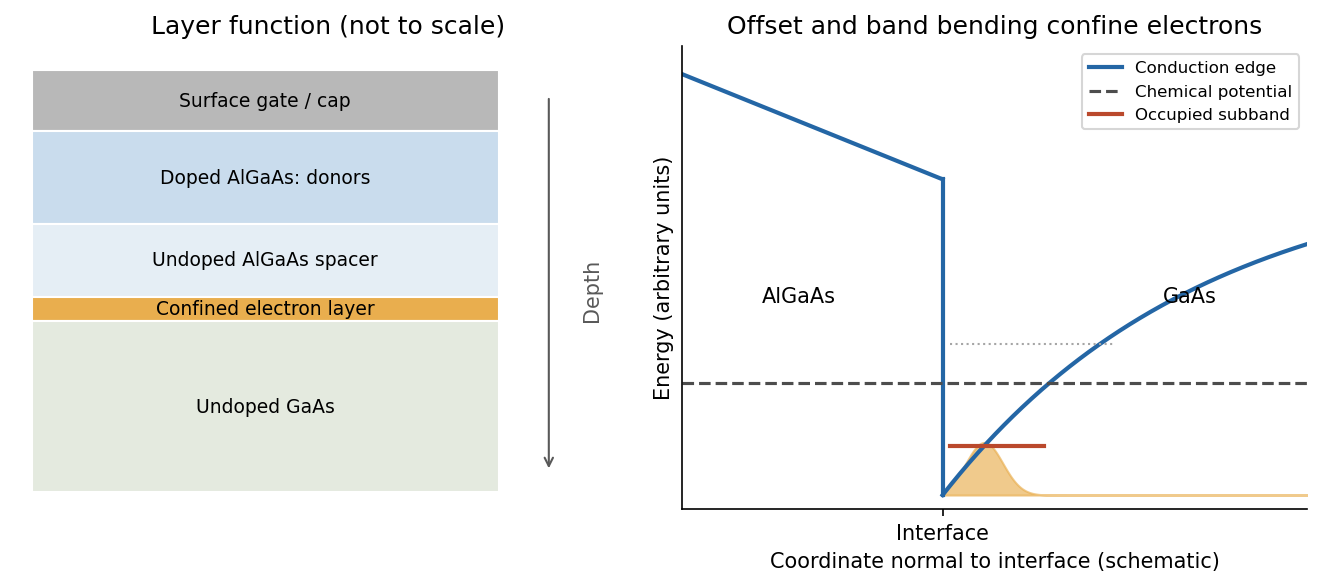
A high-mobility modulation-doped GaAs-AlGaAs electron gas is grown by molecular beam epitaxy as a clean layered semiconductor heterostructure. An undoped gallium arsenide region is followed by an undoped aluminium gallium arsenide spacer and a donor-doped barrier region, commonly with a protective cap. The closely matched crystal structures allow a high-quality heterojunction. The spacer supplies a crucial separation: the mobile electrons reside away from the ionized donors, reducing impurity scattering compared with putting the donors directly in the conducting layer.
The larger conduction band energy on the aluminium gallium arsenide side permits donor electrons to transfer into gallium arsenide. The resulting charge separation creates band bending; together with the band offset, it forms a roughly triangular quantum well at the interface. The normal-direction wavefunction is confined, while motion parallel to the interface remains approximately free:When only the lowest confinement subband is occupied, this is a two-dimensional electron gas. It is the quantized normal motion, not a physically zero layer thickness, that makes the low-energy system two-dimensional.
At zero magnetic field, one occupied spin-degenerate parabolic subband has constant density of states per area per energy, above its edge. A perpendicular field quantizes the in-plane orbital motion into Landau levels:Here is the material's effective spin factor and is the positive elementary charge; no free-electron assumption is made for this semiconductor. Each resolved spin branch contains states per unit area. The ideal density of states becomeswith Landau-level broadening in a real sample. The Landau filling factorcounts the carrier density in units of one spin-resolved level's degeneracy. Two unresolved spin branches have twice that degeneracy; resolved branches must not each be counted twice.
Disorder localizes states in the broadened level tails, while extended states occur near level centres. As varies, occupation of localized states can change without changing the number of current-carrying edge channels. This produces a finite-width quantum Hall plateau, rather than quantization only at isolated fields. In a mobility gap, longitudinal resistivity approaches zero and the Hall magnitude is for occupied transmitting branches. When the chemical potential passes through extended states, longitudinal dissipation peaks and the Hall value changes to another plateau. A spectral density of states can remain nonzero where transport is localized. Very strong disorder can destroy the resolved quantum Hall regime; the statement is not that any amount of disorder improves it.
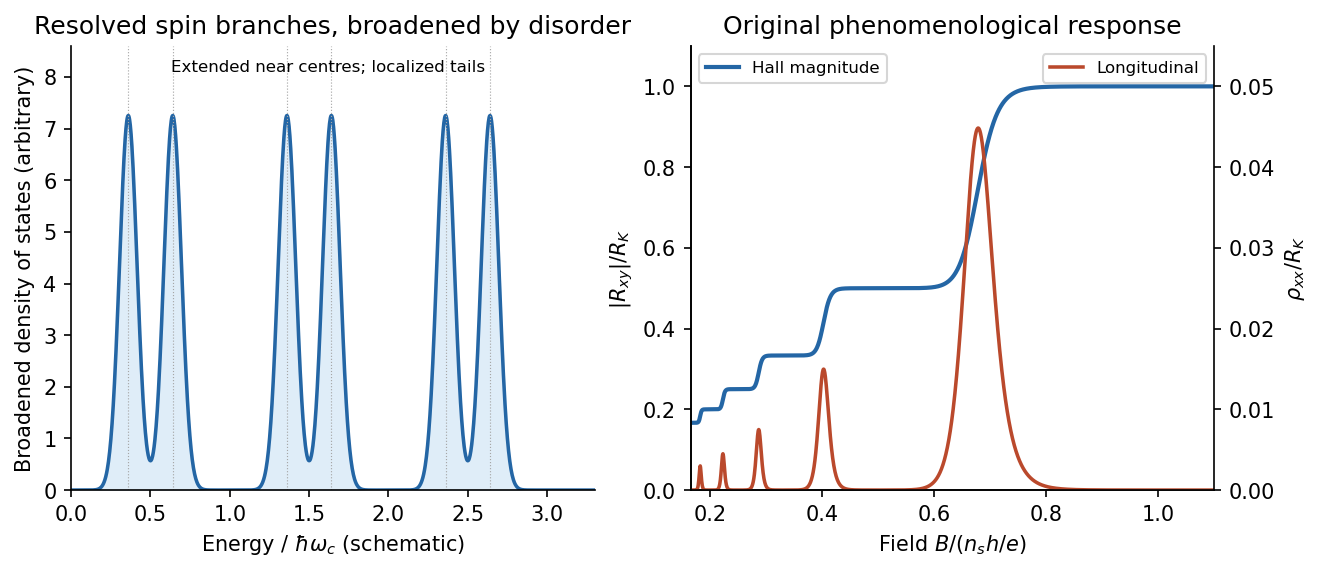
Broadened Landau levels and an illustrative integer Hall staircase with longitudinal peaks
. Details. The original plot is schematic, not fitted data. At fixed sheet density, increasing decreases Landau filling factor, so the Hall magnitude climbs through plateaus while longitudinal peaks separate the plateaus. The signed Hall voltage depends on carrier and probe conventions.
For the gate calculation, the target sheet density is fixed by the desired Landau filling factor:Use top-gate density tuning in the parallel-plate approximation. The geometric capacitance per unit area isThereforeThe gate must become more negative relative to the electron gas, reducing its density. The voltage is the change from the gate setting associated with the stated initial density; if that setting is defined as zero, it is the required gate voltage. Work-function offsets, trapped charge and quantum capacitance are neglected. An absolute voltage referenced to some other uncalibrated potential cannot be inferred from geometry alone. Numerical values use exact SI and , and .[ref]
For the subsequently specified five-channel plateau, the chemical potential between the fifth and sixth resolved branches means , not ten. The physical contact order in the PDF is along one side of the mesa. Use ideal equilibrating Ohmic contacts and the Landauer-Büttiker formula, rather than inferring a longitudinal measurement merely from the contacts being drawn on one edge.
Choose one field polarity so the chiral order is . With ,Contacts 2 and 4 are voltage probes, so . With , this gives , , and . Hencefor this circulation. Reversing the field reverses the contact order and gives with the same voltage ordering. The resistance magnitude is ; it is not zero. Contact 2 samples the outgoing source potential and contact 4 the outgoing drain potential for the chosen chirality.
The antidot is a depleted island supporting closed quantum Hall edge states. Tunnelling between those states and opposite propagating edges can produce resonant backscattering and resistance peaks as varies. One electronic Aharonov-Bohm phase winds by when flux through a fixed effective orbit area changes by . Using the supplied area as that effective area,With the two spin-split branches of the lowest orbital level occupied, the common Coulomb-dominated antidot oscillation model has two charge rearrangements per added flux. Both branches contribute to charge buildup; screening and their capacitive coupling can make tunnelling through the outer edge occur twice during the cycle. It then givesThis is two electron-tunnelling resonances per flux cycle, not evidence that the mobile particles have charge . The primary charging model specifically addresses this two-spin regime.[ref]
Coulomb blockade of tunnelling through compressible rings formed around an antidot by M. Kataoka and others. Primary abstract: two spins of the lowest Landau level and two outer-spin resonances per h/e period
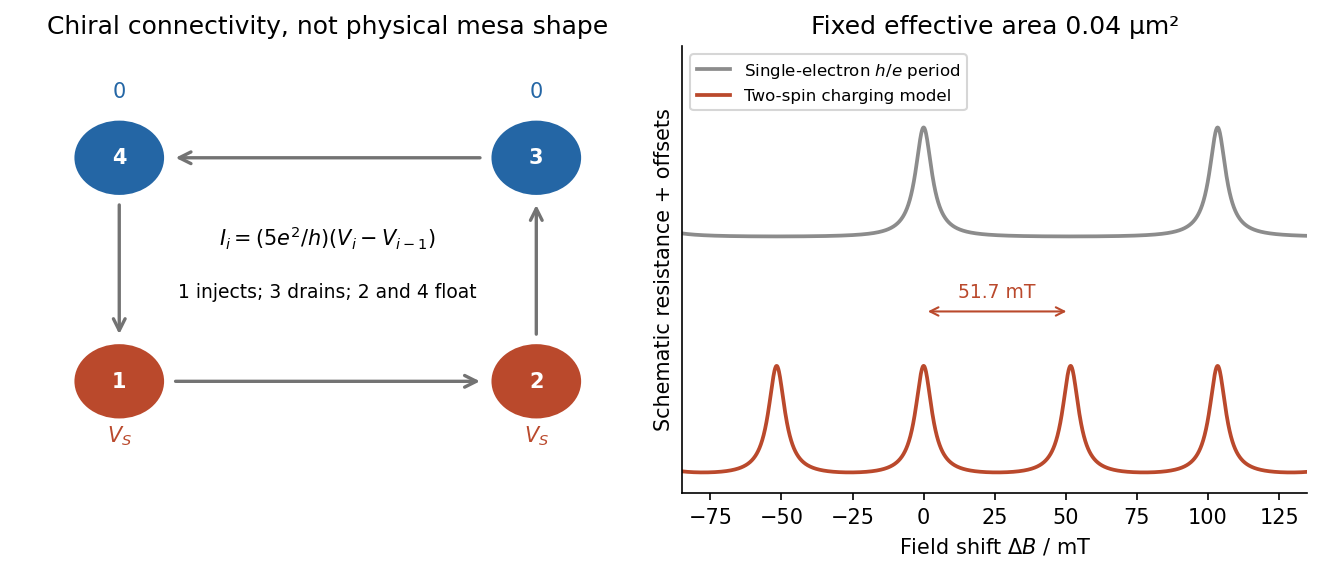
Chiral reservoir potentials and the distinction between flux period and two-spin charging resonances
. Details. The sketch shows resistance peaks in a weak-backscattering configuration, with arbitrary height and linewidth because tunnel couplings and temperature are unspecified. A two-spin count alone does not force two independent noninteracting resonance series to be exactly half a flux period apart: their relative positions also depend on spin splitting and confinement. Thus describes the stated charging-model interpretation; is the single-electron fixed-area flux period. The actual enclosed edge-orbit area can differ from the geometrically depleted area.
For bulk filling two and total forward transmission in spin-resolved units, ideal chiral probes give the longitudinal four-terminal resistanceResonant loss of transmission therefore gives peaks. Their size, background and detailed shape cannot be calculated from the supplied area and bulk filling alone. If the gates instead make a tunnelling path that enhances forward transmission, the resonant contrast can be reversed; the plotted peak convention is explicitly the backscattering one.
Use two collinear quantum point contacts in a clean two-dimensional electron gas. Surface split gates deplete the electron gas beneath them, leaving two short constrictions facing one another across an open region. The first injects a directional beam from a biased reservoir; the second collects carriers into a downstream reservoir, with electric current flowing in the same spatial direction through both constrictions. Additional surrounding contacts can absorb carriers that miss the collector. A direct collector signal at zero magnetic field, sensitive to alignment and to obstruction of the intervening path, demonstrates ballistic electron transport across the separation.
An illustrative GaAs device uses gate gaps of a few hundred nanometres and electrically tunable constriction widths of tens to a few hundred nanometres, with injector–collector separation of a few micrometres. These are typical design scales, not dimensions supplied for a particular chip in the question. The electrical width can be much smaller than the lithographic gap because depletion extends laterally. A one-mode opening has width comparable to roughly half a Fermi wavelength; it is not simply any opening below one micrometre. Low-temperature operation suppresses inelastic scattering and resolves transverse modes. The direct trajectory length should be comfortably below the relevant transport mean free path.
Collimation is provided by the smooth exit from a constriction. In adiabatic electron collimation, transverse mode action is approximately conserved, giving . As the channel opens from width to , . At the same time the bottom of the electrostatic potential falls, increasing longitudinal kinetic energy. Thusand the angular distribution narrows. The reciprocal collector selects this forward-directed set of trajectories. A narrow abrupt aperture by itself may diffract into a broad fan; the smooth funnel and its potential profile are important. Here “focusing” refers primarily to collimation and efficient injector–collector coupling, not a claim that every emitted trajectory converges to one exact geometric point.
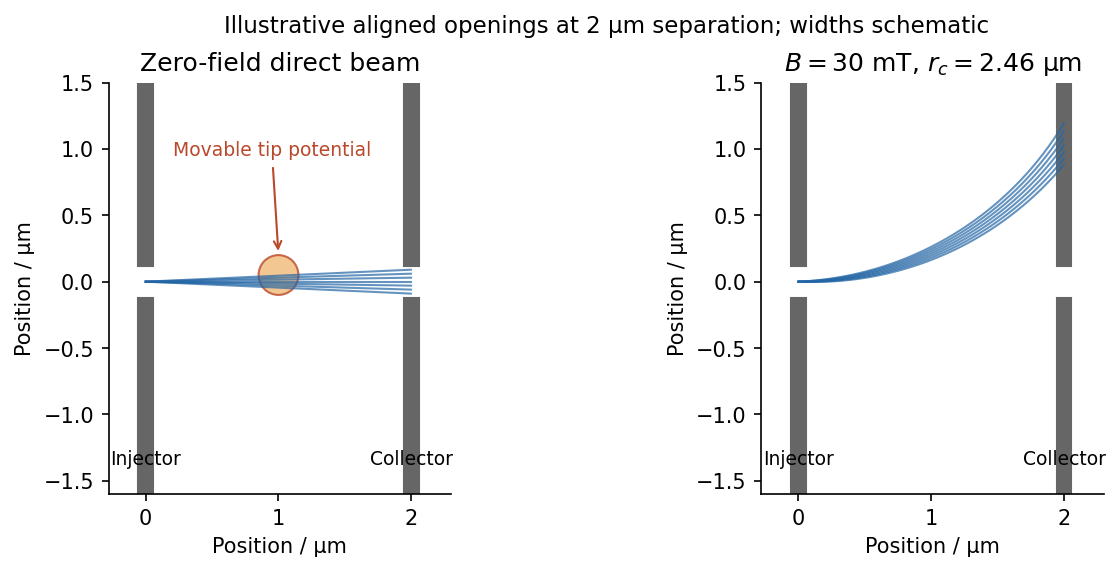
In scanning gate microscopy, a conducting tip biased sufficiently negatively creates a local repulsive potential and, when strong enough, a small depleted region in the electron gas beneath it. Raster the tip and record the collector current or differential conductance. Placing the perturbation on a strongly contributing path deflects or backscatters electrons and changes collection, producing spatial contrast. A primary scanning-probe experiment records conductance changes as a negatively charged tip depletes and backscatters the two-dimensional gas.[ref]
Imaging Coherent Electron Flow by B. J. LeRoy and others. 2002 author abstract: tip depletion, backscattering, conductance imaging and mode-dependent angular patterns
The resulting image is a map of transport sensitivity to the tip, not a literal nonperturbing photograph of an electron trajectory. Broad electrostatic gating of either constriction should be distinguished from local beam disruption. Weak smooth disorder can create branches even in a high-mobility sample. Where electron phase coherence is preserved, interference between alternative paths can add fringes, often with a scale comparable to half a Fermi wavelength for a round-trip path-length change. Ballistic motion and phase-coherent interference are related but distinct requirements.
A small perpendicular magnetic field curves the imaged paths through the Lorentz force, . Reversing reverses the bending, and a fixed aligned collector generally loses the initially straight beam unless a curved path connects it. For a circular orbit at the Fermi velocity,For one valley with two nearly equally occupied spin species at small field, state counting in the Fermi disc gives . HenceSpin polarization or extra valley degeneracy changes the density-to-wavevector relation; the stated low-field GaAs estimate uses the ordinary spin-degenerate case.
The electron mobility gives the momentum relaxation time in a parabolic-band Drude model, . ThereforeThe effective mass cancels from both and when expressed in terms of density and mobility. For the supplied density,With , , one also obtains and . The requested lengths areA useful independent ratio is . The standard constants used here are explicitly tabulated, rather than inferred from the sample.[ref]
Mobility measures momentum relaxation. Predominantly small-angle elastic scattering can occur more frequently than that transport time, and the phase-coherence time is different again. Thus the calculation supports a several-micrometre transport scale, without proving that every electron experiences literally no perturbation over that distance.
As temperature rises, the directed ballistic collector signal decreases. Increased electron-phonon scattering and other inelastic processes reduce survival of the directed beam; thermal averaging broadens the mode and angular selection, and interference contrast also diminishes. A diffuse background current can remain, so disappearance of beam contrast need not mean all current through the device vanishes.
The fractional quantum Hall effect occurs when interactions produce an incompressible correlated state within a partially occupied Landau level. The orbital kinetic energy is already quantized; the important degeneracy is among many possible arrangements of electrons within the level. Repulsion can lift that degeneracy and create a many-body excitation gap. The interaction scale is of order , where magnetic length ; it is not a gap predicted by independent-electron fractional occupation alone.
A composite fermion description incorporates strong correlations by attaching statistical flux quanta to each electron, with positive integer . The attachment is a representation of correlated wavefunction phases and zeros, not a literal solenoid attached to a particle. Attaching an even number preserves fermionic exchange character. In a mean-field approximation for positive applied field,The particles consequently experience a reduced effective field. Define the signed effective filling and electronic filling . Their relation isWhen effective levels are filled with the same field orientation, , giving . Reversed effective-field orientation has , giving . Thus the Jain sequence isFor , examples are , , on one branch and , on the reversed branch. Fractional electronic plateaus can be understood as integer effective Hall states of these composite objects. The original proposal explicitly makes this connection.[ref]
Composite-fermion approach for the fractional quantum Hall effect by J. K. Jain. 1989 publisher abstract: even flux attachment and integer Hall interpretation of fractional electronic states
At a gapped fractional state, longitudinal dissipation becomes very small and the Hall magnitude approachesDisorder can localize quasiparticles and allow the plateau to persist over a filling interval, provided it does not overwhelm the interaction gap. The Laughlin wavefunction at is a particularly simple correlated example; its charged excitations carry fractions of the electron charge. More generally the basic quasiparticle charge in the simple Jain sequence has magnitude . Such excitations are distinct from noninteracting bare electrons occupying a fraction of a level.
At , the mean effective field vanishes. This permits a compressible composite-fermion Fermi-sea description, rather than an ordinary integer effective-level gap. The external field remains large: cancellation is in the effective description. Not every fractional state is explained by the simplest integer composite fermion sequence, and the effective masses and gaps reflect interactions rather than simply the GaAs band mass. The utility of the construction is that it organizes many observed fractions and their nearby excitations into one understandable pattern.
A quantum point contact is made by using negative surface split gates to leave a short narrow channel in a clean two-dimensional electron gas. Its length should be smaller than the transport mean free path; transverse confinement should be strong enough that subband spacing exceeds thermal and lifetime broadening. Low-resistance Ohmic contacts connect large reservoirs. Apply a small source–drain bias, measure current and differential conductance, and sweep the gate to change the channel width or barrier height. Contact and wiring series resistance must be accounted for when comparing plateau values.
The Landauer formula explains the conductance without treating the short channel as a diffusive wire. For each propagating one-dimensional mode, the density of states and group velocity cancel in the incident flux, leaving per spin per energy interval. The reservoir occupation difference supplies the net current:The factor two assumes unresolved spin degeneracy. In zero-temperature linear response,A well-transmitted channel has , giving steps as modes open. A finite two-terminal resistance persists even for a perfectly ballistic channel because reservoirs inject only a finite number of modes; it is not evidence of resistive scattering inside the channel. Gate-controlled point-contact conductance quantization was demonstrated in a two-dimensional electron gas.[ref]
Quantized conductance of point contacts by B. J. van Wees and others. 1988, primary publication: gate-controlled quantized conductance of ballistic point contacts
The saddle-point model of a quantum point contact resolves how modes open. Near the bottleneck, choose the channel direction as and writeTransverse harmonic confinement gives barrier tops . Scattering through the inverted longitudinal harmonic barrier givesSmall longitudinal curvature makes a sharp transmission threshold compared with the transverse subband spacing; finite curvature rounds each conductance step. This is the explicit smooth-barrier model developed for a saddle constriction.[ref]
Quantized transmission of a saddle-point constriction by M. Büttiker. 1990, saddle potential and mode-resolved transmission
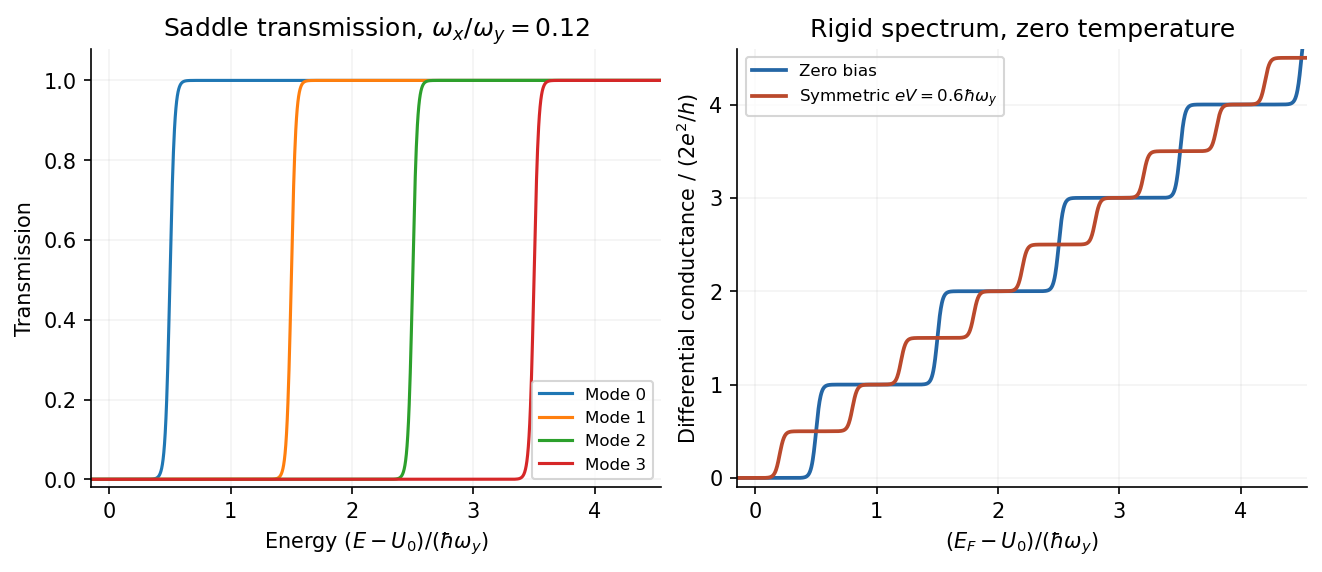
At larger source–drain bias, the current samples a finite energy window. For a rigid transmission spectrum at zero temperature,With symmetric bias, , the nonlinear conductance of a quantum point contact isIf both window edges sample open modes, the usual plateau remains. If one edge samples and the other , differential conductance approaches : a half-integer plateau relative to the zero-bias step. It is a bias-window effect, not half an electron spin degeneracy. Ridges in gate–bias transconductance occur when a reservoir chemical potential crosses a subband threshold; their separations can measure subband energies.
The half-plateau expression assumes symmetric bias and an approximately bias-independent barrier. An asymmetric voltage drop or self-consistent shift of changes the numerical relation. At still larger biases, heating and inelastic scattering can invalidate a rigid elastic saddle model. Thus the zero-bias quantization counts transmitted modes, while nonlinear spectroscopy compares mode counts at the two ends of the bias window.
An electrostatically defined quantum dot uses depletion gates to confine a small island laterally in a two-dimensional electron gas. Two narrow barriers allow weak tunnelling to source and drain; a plunger gate tunes the island's electrochemical levels, and additional gates can form a double quantum dot. Adjusting the gates resolves successive charge states and eventually reaches the single-electron regime. An electrical dot is defined by confinement and tunnel coupling, not simply by the drawn metal area.
In a constant interaction model,Here is gate-induced charge and total island capacitance. Successive additions cost , with spin, exchange and correlations modifying the orbital term. Coulomb blockade appears when no allowed charge transition lies in the source–drain energy window. Gate sweeps give charge steps and transport peaks; finite-bias Coulomb diamonds constrain charging and orbital energies under a stated bias convention. Resolved single-electron operation requires thermal and tunnel broadening smaller than the relevant addition energies.
Quantum-dot charge sensing avoids relying on a measurable current through a nearly isolated dot. A nearby quantum point contact biased on a sensitive conductance slope, or a single-electron transistor, responds capacitively when one electron enters or leaves the dot. A time trace of sensor current can therefore distinguish from and resolve individual tunnelling events. The sensor measures charge; a spin-dependent step is needed to measure spin.
For one electron, Zeeman splitting gives a lower and a higher spin level separated by . In energy-selective spin readout, initialize an empty dot and pulse both levels below the reservoir chemical potential to load one electron. Then move to a readout configurationAn electron in the higher state can tunnel out, temporarily leaving the dot empty, after which a lower-state electron can refill it. An electron initially in the lower state remains trapped. The charge sensor records a pulse for the first outcome and no escape pulse for the second. This is spin-to-charge conversion; it measures the spin projection along the field through a state-dependent tunnelling probability. A primary single-shot experiment uses this conversion with a quantum-point-contact charge detector.[ref]
Single-shot read-out of an individual electron spin in a quantum dot by J. M. Elzerman and others. 2004 author abstract: electrical single-electron spin readout, spin-to-charge conversion and nearby quantum point contact
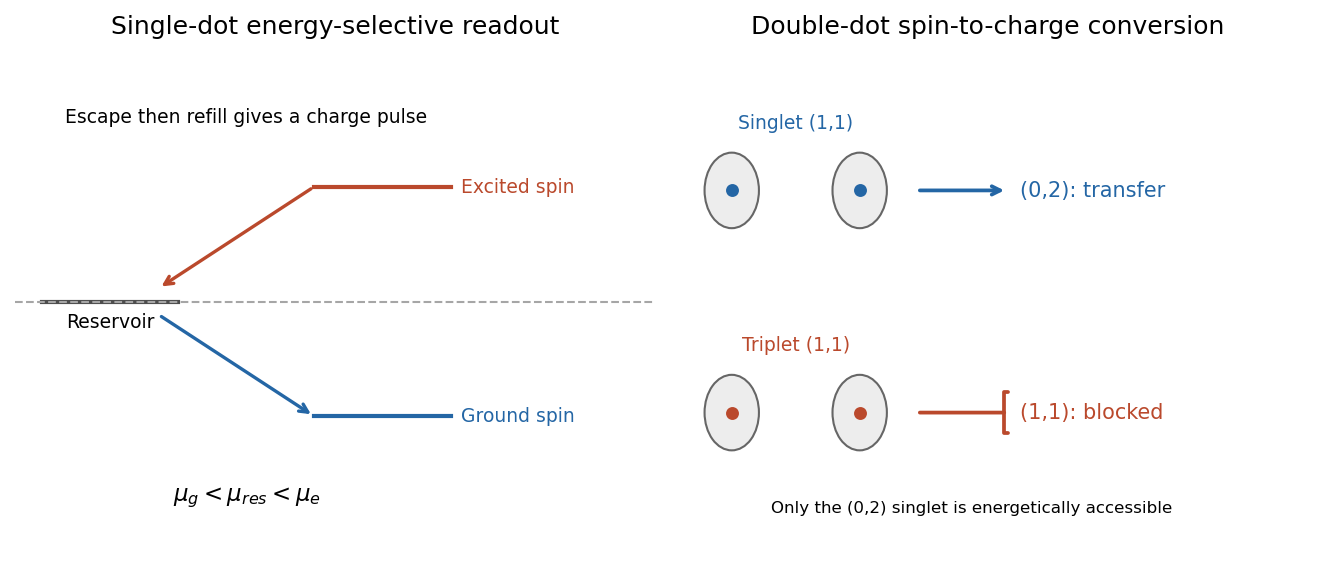
The readout window must be long enough to detect escape but short compared with excited-spin relaxation:Detector bandwidth must also resolve the empty-state dwell time before refilling. Thermal activation, relaxation before escape, missed fast events and sensor backaction cause errors. Since the excited electron can leave and be replaced, this simple sequence does not preserve an arbitrary initial spin state.
For coupled dots, label charge occupation by . Gate-controlled detuning can make and accessible. Two electrons in the lowest orbital of one dot must form a singlet state; a triplet state requires a different orbital or another higher-energy configuration. Choose a measurement window where the singlet is available but the triplet is not. Thenunder spin-conserving tunnelling. The second process is forbidden by spin symmetry and the Pauli exclusion principle, producing Pauli spin blockade. Charge sensing distinguishes transfer from a blocked state. This measures singlet versus triplet content; without a reference spin or additional control it is not a measurement of each electron's absolute spin direction separately.
The exchange interaction in a double quantum dot provides control of these states. In an effective spin description,For a symmetric weak-tunnelling two-site model with onsite charging cost , . Gates change tunnel coupling and detuning, allowing preparation and evolution followed by a charge-conversion measurement. Spin mixing from local magnetic-field differences or spin-orbit effects can lift blockade, so the sensing interval must be chosen before unwanted relaxation obscures the initial state. Single-dot readout uses spin-dependent escape; double-dot readout can use spin-dependent charge transfer. In both cases the measurable signal is a resolved charge change.
A trajectory-resolving ballistic experiment. Use a high-mobility modulation-doped GaAs-AlGaAs heterostructure with a two-dimensional electron gas. Grow the layers by molecular-beam epitaxy, separate the donor layer from the conducting interface with an undoped spacer, and pattern an isolated mesa with ohmic reservoir contacts. Electron-beam lithography defines metal split gates; negative gate voltage depletes the underlying electron gas, leaving narrow adjustable injector and collector quantum point contacts along an edge. Keep the relevant path shorter than the momentum-relaxation mean free path, cool to suppress phonon scattering and thermal smearing, and use a small excitation to avoid heating.
Inject a low-frequency current through one contact to a distant drain and measure the collector's open-circuit voltage with a high-input-impedance amplifier. Sweep perpendicular magnetic field and gate settings. The cyclotron radius is , with for a spin-degenerate single-valley gas. For contact separation , semicircular or skipping trajectories focus into the collector whenThe appropriate field sign bends carriers toward the collector; the opposite sign suppresses the peaks. Density-dependent focusing positions, suppression with increased scattering and reproducible gate control distinguish directional ballistic propagation from an ordinary diffusive voltage. Quantum interference may add fine structure, but the basic focusing signal does not require phase coherence over every path. Split-gate injection and collection in a two-dimensional gas were directly demonstrated in the original focusing experiment.[ref]
Coherent electron focusing with quantum point contacts in a two-dimensional electron gas by H. van Houten and others. 1989 primary publication, institutional abstract: split Schottky gates, injector/collector, skipping orbits and field-dependent focusing
Multi-probe current bookkeeping. For one directed spin-resolved mode, velocity times one-dimensional density of states gives a particle flux . A small reservoir electrochemical-energy shift therefore supplies excess flux . Let be the number of propagating modes at lead , their summed return probability, and the total transmission from reservoir into lead . Multiplying outgoing-minus-incoming electron flux by charge gives the source's convention,The reservoirs equilibrate arriving carriers; an ideal voltage probe adjusts its chemical potential until its net current vanishes. Here is an energy, not a voltage. Choose the lead-voltage convention and positive conventional current injected into the junction. The working equation is thenConservation of scattering probability and gauge invariance require both column and row balance: every outgoing channel is accounted for and equal voltages give zero current. The counts below include every occupied internal channel; an extra factor of two must not be inserted if spin is already counted. If one instead counts orbital channels with unresolved spin degeneracy, double all transmission counts consistently.
Zero-field routing. The original diagram labels lead 1 at the left, 2 above, 3 at the right and 4 below. With columns denoting injectors and rows collectors, straight-through ballistic routing and the stipulated excess-wide-channel rule giveThere is no reflection in this ideal routing model. Set , , and . The two probe equations giveThusThe derivation assumes . At , the ideal network splits into two disconnected opposite-lead pairs and cannot carry the imposed 1-to-4 current at finite voltage; the divergence diagnoses failure of that limiting transport configuration, not an infinite dissipative resistance of each channel. Negative bend resistance is a nonlocal voltage sign, compatible with positive total dissipated power.
Positive field. At , left-deflected incoming carriers go , , . Lead 4 supplies modes to narrow lead 1; the remaining enter wide lead 3. The balanced transmission matrix isTherefore , and , givingNegative field. Reversing the chirality gives , as expected from reciprocity for this spin-independent routing model. With , the zero-current conditions become and . ThusThis does not contradict reciprocity: the general relation interchanges the current and voltage lead pairs when reversing field; it does not require the same fixed-contact four-terminal resistance to be even in .
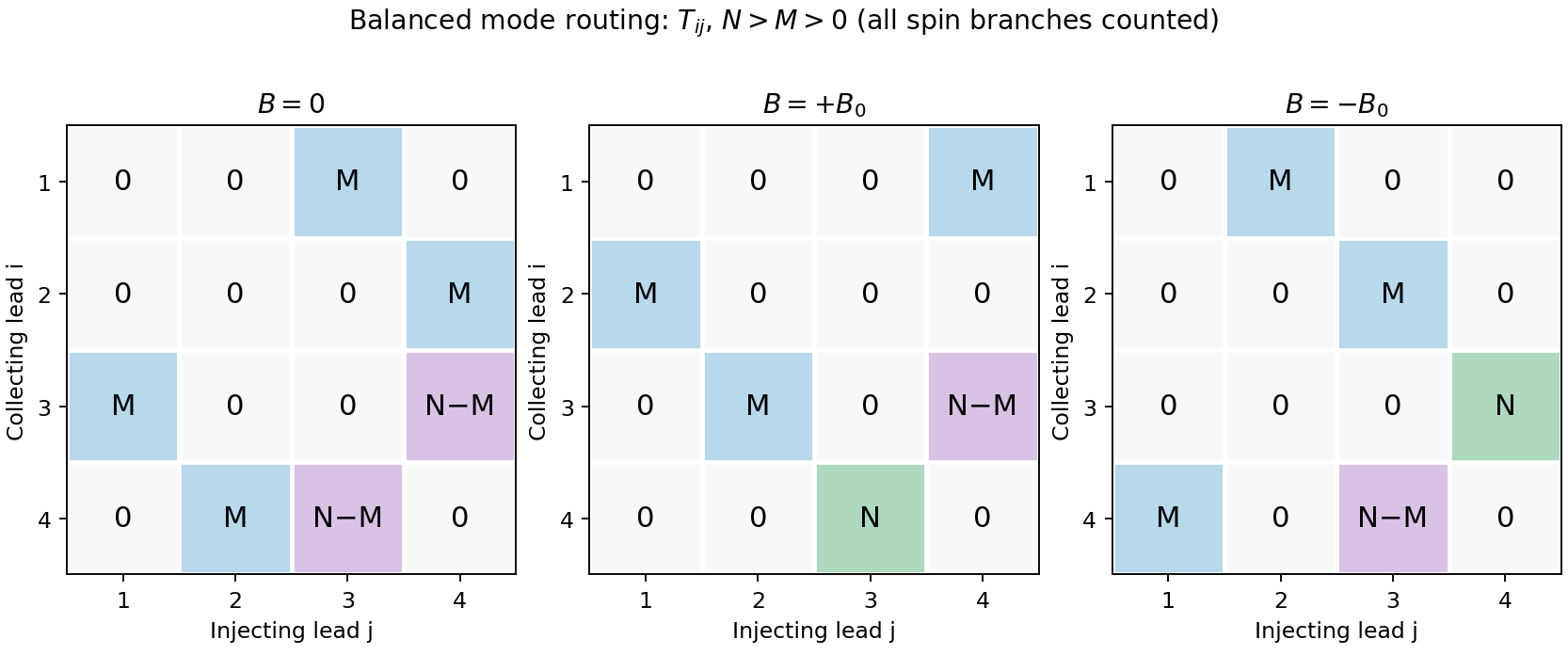
Original transmission-matrix bookkeeping for the three ideal field limits; rows collect modes injected by columns
. Details. Comparison with the measured trace. The PDF shows a negative region around zero field, approximately zero signal at sufficiently negative field, and a positive rising resistance near and above. These signs match the three routing limits. Near zero field the depth is roughly a few tenths of a kilohm; the graph does not supply , so there is no justified exact amplitude fit. Rounded corners, collimation and finite cyclotron radius continuously change which outgoing lead is reached between the ideal limits. Skipping trajectories and geometrical focusing can produce shoulders or resonances. At larger positive fields magnetic depopulation and spin resolution can change the mode counts, increasing the positive resistance or producing structure; disorder, incomplete equilibration and finite temperature round ideal features. These are candidate mechanisms, not uniquely established assignments of every small feature from one trace.
Integer Hall transport and filling. A clean two-dimensional electron gas at low temperature in a strong perpendicular magnetic field forms Landau levels with orbital spacing , where . Examples include semiconductor heterojunctions and inversion layers. On integer plateaus,with integer plateau index . The density of states in one resolved Landau branch is per unit area, so the actual filling factor isIt varies continuously with density and field. Within a disorder-broadened plateau, localized states can change occupation without changing the integer number of transporting edge branches; the filling need not equal the plateau integer at every point in that interval.
At a boundary, the confining potential bends the Landau energies through the Fermi energy, giving chiral edge states, interpreted semiclassically as skipping orbits. Opposite edges carry opposite propagation directions. An ideal spin-resolved transmitted edge channel contributes ; such channels give . Chirality and suppressed backscattering between well-separated edges explain vanishing longitudinal voltage. Ideal reservoirs and appropriate probe equilibration are part of this edge-state transport model.
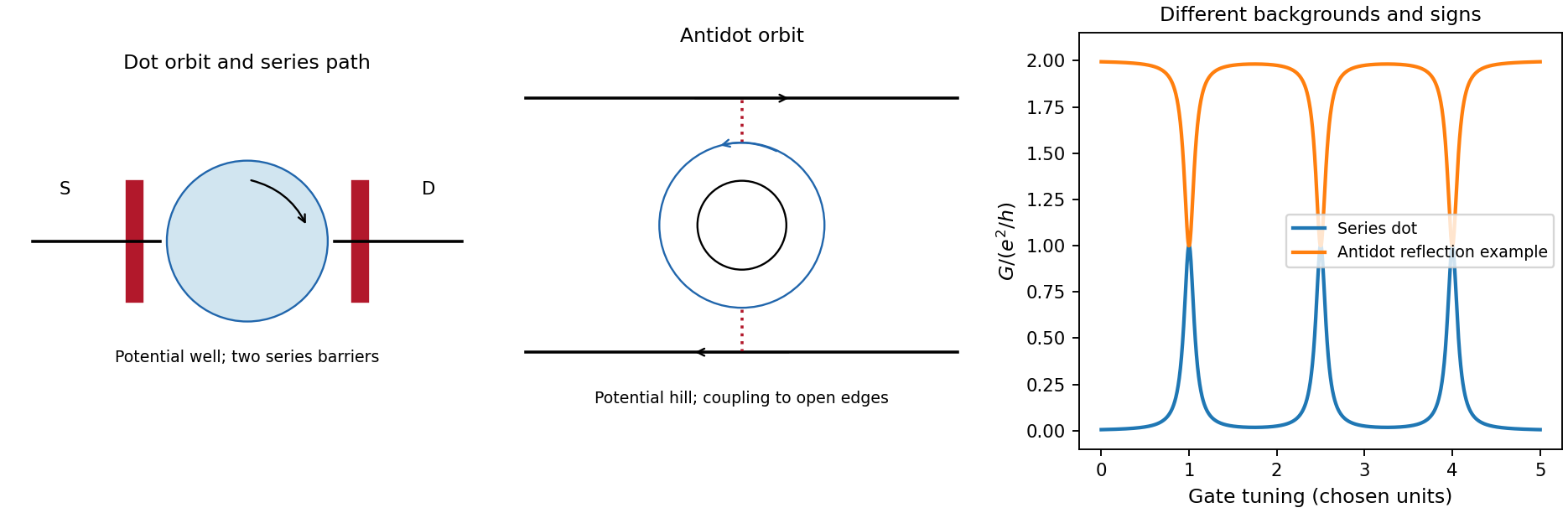
A gated antidot. A local repulsive gate potential depletes an island inside the Hall bar. Edge states circulate around its boundary as closed antidot orbits. When a localized orbit is weakly coupled to extended channels on opposite sides, resonance at the reservoir electrochemical potential permits backscattering and produces conductance dips on an otherwise quantized transmitting plateau. If the path instead adds a transmission route between otherwise disconnected channels, resonant peaks can occur: the sign depends on the device's tunnel connectivity and what conductance is measured. An isolated antidot too far from every conducting edge has negligible transport signature.
For the simplest opposite-edge backscattering picture with one active branch,where branches would otherwise transmit. A gate moves the resonance through the Fermi energy by changing both confinement and orbit area. Stronger depletion of the constrictions also changes , producing broad conductance plateaus or pinch-off, with narrow resonances superposed where coupling is finite. Low temperature resolves individual resonances; thermal and tunnel broadening can merge them.
For a fixed-area single-electron orbit, a phase change of corresponds toSweeping gate voltage at fixed field shifts enclosed area and level energy, giving oscillatory resonance tracks. This period is not automatically set by the lithographic gate area. Charging energy, self-consistent screening and spin branches modify spacings; in particular coupled spin branches in a charging model can generate two resonances per cycle without changing the electron flux quantum.[ref]
Coulomb blockade of tunnelling through compressible rings formed around an antidot by M. Kataoka and others. Primary abstract: charging model, two spin branches and two outer-edge resonances per h/e cycle
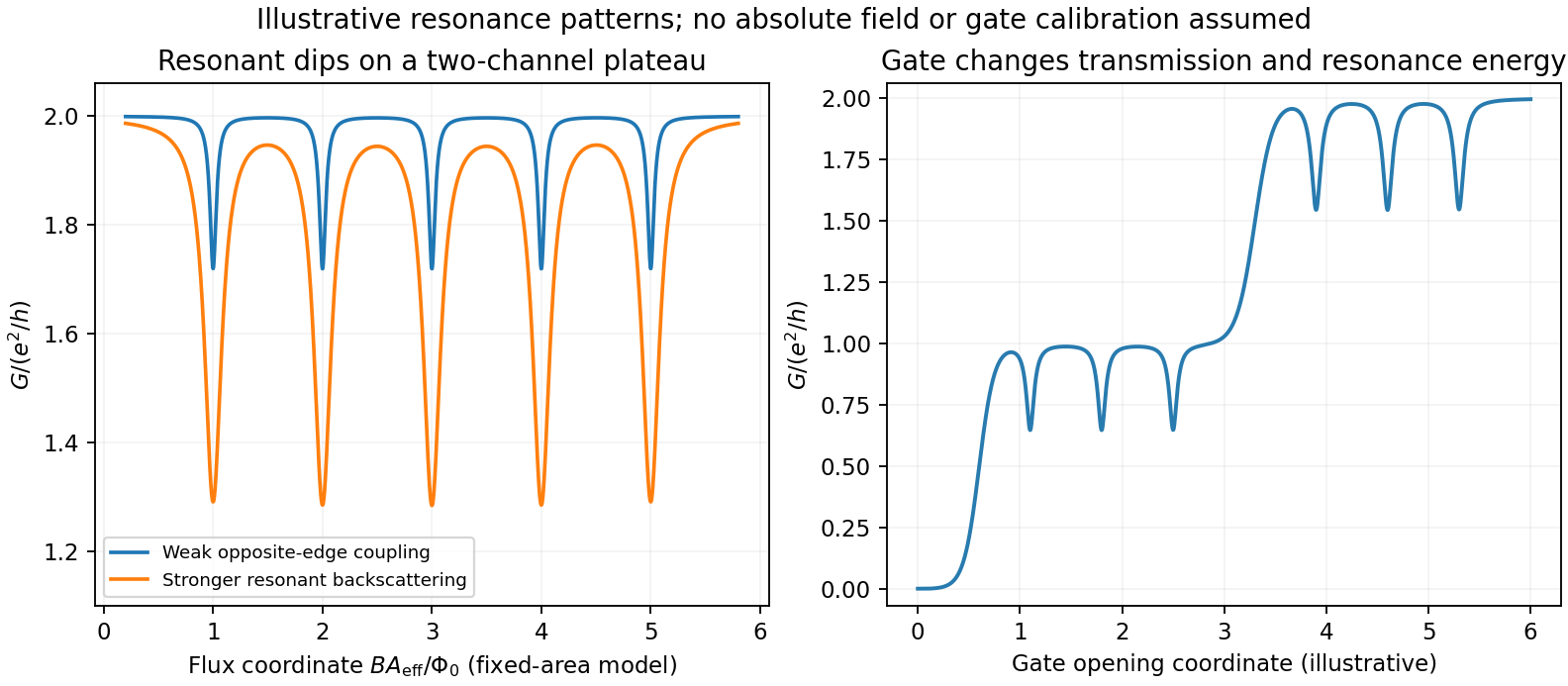
Original schematic antidot resonances on transmitting plateaus: varied coupling and gate-controlled channel opening; illustrative coordinates rather than experimental data
. Details. No antidot dimensions, capacitances, lever arms or measured spectrum are supplied, so absolute periods and resonance voltages cannot be extracted. The sketch illustrates the mechanisms and regimes requested, rather than inventing a numerical device data set.
Improving the bare edge potential. A picture of noninteracting Landau levels simply intersecting a prescribed smooth confinement ignores the redistribution and screening of electron charge. A self-consistent electrostatic calculation combines gate and donor potentials, electron density and Coulomb interactions. Where a partially occupied Landau level has a large density response, electrons screen strongly and create a compressible strip with nearly pinned level energy. Regions with the chemical potential in a gap are incompressible and support much of the potential change. Consequently the screened edge alternates between compressible and incompressible strips, rather than preserving an arbitrary externally drawn slope. Finite temperature, disorder, exchange and edge reconstruction can require refinements beyond the simplest electrostatic model.[ref]
Electrostatics of edge channels by D. B. Chklovskii and others. Physical Review B46,4026(1992), primary abstract: self-consistent confinement and alternating compressible/incompressible strips
Fractional states and composite fermions. Very clean two-dimensional systems show plateaus at selected fractional fillings, with small longitudinal resistance and a many-electron excitation gap. Electron-electron correlations are essential; partial filling of a noninteracting Landau level is not enough. The simplest composite fermion binds two statistical flux quanta to each electron. This is a representation of correlated electron motion, not a physical solenoid attached to a particle. With , , and density , the mean effective field isDefine a signed effective filling . ThenFor , filled composite-fermion levels produce . For reversed effective field write , giving ; the nontrivial fractional upper sequence starts with . If effective filling is defined as nonnegative using , retain these as separate field-direction branches instead of using the signed expression blindly. At the mean vanishes and the effective filling diverges, so it is not an integer composite-fermion Hall plateau in this simplest construction. Attaching two flux quanta preserves fermionic statistics; the emergent integer-like gaps organize a prominent sequence of fractional electronic states.[ref]
Composite-fermion approach for the fractional quantum Hall effect by J. K. Jain. Physical Review Letters63,199(1989), abstract: even-flux composite objects and fractional states as effective integer Hall states
Transverse confinement in a short clean channel gives subband dispersionsA gate varies the subband thresholds and channel width. If elastic backscattering is negligible and spin is degenerate, the two-terminal linear conductance isA fully open subband has , producing conductance steps in units . Magnetic spin splitting can resolve steps. A finite two-terminal resistance remains in a perfect ballistic channel because reservoirs supply and absorb a finite number of transport modes; it does not prove momentum-randomizing scattering inside the constriction.
At finite source-drain bias the two reservoir distributions differ over an energy window rather than at one Fermi energy. Choose and take positive current from source to drain. For spin-degenerate channels,At zero temperature with a rigid transmission spectrum, . For symmetric bias and neglecting an explicit bias response of ,If the two window edges lie above different numbers of subbands, the differential conductance can lie at half-integer values in units . For example, two open subbands at one edge and one at the other give . This is a bias-window effect, not fractional charge or a fractional Hall state.
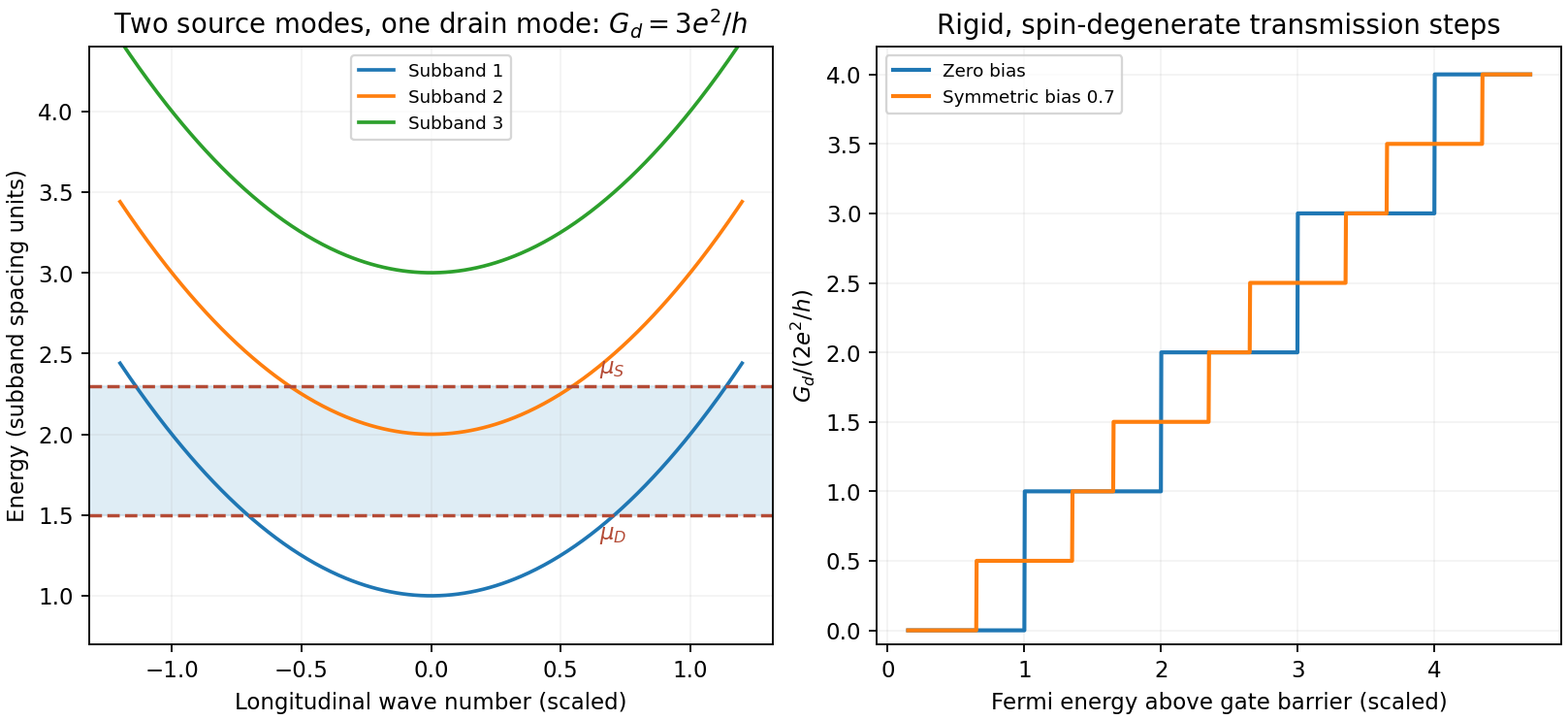
Original ideal one-dimensional subbands sampled by a symmetric bias window, with integer and half-integer differential-conductance plateaus
. Details. Mapping transconductance versus gate voltage and source-drain bias reveals boundaries where a reservoir chemical potential crosses a subband bottom, enabling energy-spacing spectroscopy under a specified lever arm and bias division. Finite temperature rounds thresholds over ; reflection, disorder, series resistance and a saddle-shaped barrier reduce or smooth plateaus. Large bias can alter the electrostatic potential, heat carriers or produce inelastic scattering, so the rigid-transmission differential formula is not generally valid without its assumptions. One-dimensional interaction effects can add anomalies beyond this independent-channel model.
A gated quantum dot is an electron island confined in all spatial directions, weakly coupled by tunnel barriers to source and drain and tuned by a plunger gate. Small capacitance makes charge addition costly, while confinement resolves orbital levels. In the constant-interaction model,The charging contribution to successive addition potentials is ; the often used charging-energy scale differs by a factor of two. Orbital spacing and spin filling add further structure.
For weak coupling, and lifetime broadening must be smaller than the relevant addition energies to see Coulomb blockade. Sequential tunnelling proceeds when an addition level is inside the source-drain bias window and the appropriate charge states are accessible. A gate sweep gives conductance peaks near charge degeneracies and low conductance between them. A bias-versus-gate map shows Coulomb diamonds, with excited-state lines when additional levels enter the window. Their slopes and sizes depend on source, drain and gate capacitances and the bias convention. Cotunnelling gives higher-order transport inside nominally blocked regions; stronger coupling and many-body effects can invalidate the simple sequential picture.
Coherent dot states as a qubit. A single-electron spin has basis , in a magnetic field, split by . A qubit is a controllable coherent state , not just a pair of classical current levels. Initialize through spin-selective loading or relaxation; resonant magnetic or spin-orbit-assisted electrical driving produces rotations. Adjacent occupied dots can couple through a gate-controlled exchange interaction. In the weak-tunnel symmetric Hubbard limit,Local spin rotations combined with a suitable exchange entangling operation provide universal control in the ideal spin-qubit proposal. Gate pulses must avoid unwanted orbital excitation and leakage, and complete coherent operations before dephasing destroys the information.[ref]
Quantum Computation with Quantum Dots by Daniel Loss and David P. DiVincenzo. Section II, coupled-dot spin encoding and electrically controlled exchange; arXiv:cond-mat/9701055
For measurement, place the reservoir electrochemical potential between Zeeman levels so that only one spin state can tunnel out, or use Pauli spin blockade in a double dot. A nearby quantum point contact or single-electron transistor detects the resulting charge change. Such spin-to-charge conversion makes transport useful for reading a spin even when the stored information is not itself a net current.[ref]
Single-shot read-out of an individual electron spin in a quantum dot by J. M. Elzerman and others. Primary experiment: energy-selective tunnelling and nearby quantum-point-contact charge detection
A double dot can alternatively encode a charge qubit in left/right occupation, with Hamiltonian . It allows electrical control and charge sensing, but couples strongly to charge noise. Spin qubits also suffer hyperfine, electrical and spin-orbit-related noise, as well as relaxation and readout errors. An observed Coulomb diamond alone establishes charging physics, not initialization, coherent control or a functioning qubit.
Carrier confinement changes both the energies and the available optical transitions of a semiconductor. A quantum well confines one direction and leaves two continuous momentum coordinates; a wire confines two directions and leaves one; a quantum dot confines all three and has discrete ideal levels. Confinement becomes important when its level spacing is comparable with thermal, lifetime and disorder energy scales, and strong excitonic confinement involves comparison with the exciton Bohr radius.
Transition energies. In a simple infinite-well effective-mass model of width , a same-index electron-hole transition has thresholdThus decreasing generally blue-shifts interband absorption and emission through the confinement contribution. Finite barriers, band mixing, strain, nonparabolicity, dielectric environment and Coulomb interactions alter this elementary estimate. In dots, confinement shifts and exciton binding have different size dependences, so a single inverse-square law is not an exact nanocrystal spectrum.
Dimensional density of states. For a parabolic continuum the phase-space volume below kinetic energy scales as , hence the density of states scales as . Each subband threshold therefore contributes a square-root onset in three free dimensions, a constant step in two, and an inverse-square-root singularity in one. A zero-dimensional ideal dot has discrete lines rather than a continuum power law. Real temperature, disorder and lifetime broadening smooth singularities and lines. Optical absorption uses the joint electron-hole density of states multiplied by transition matrix elements and occupations; a bare electronic density of states is not the entire absorption spectrum.
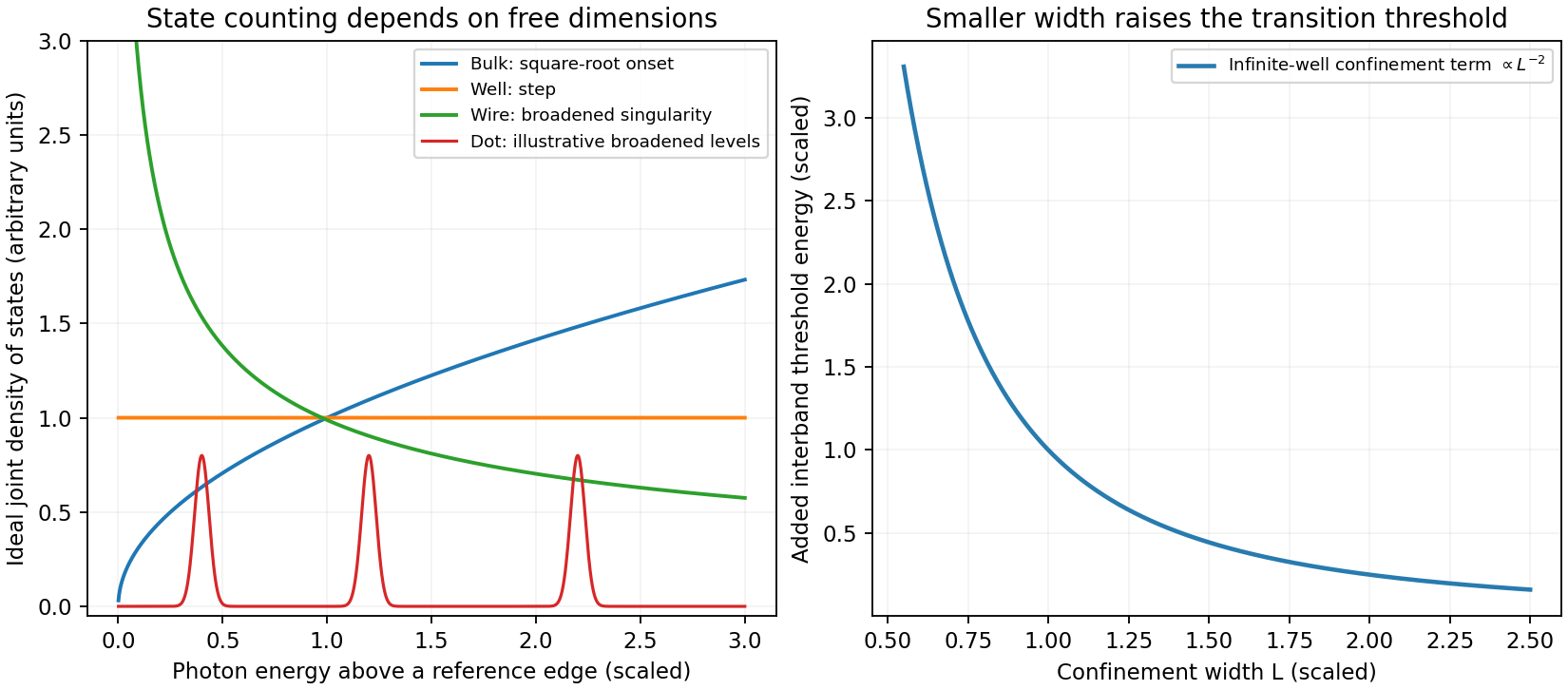
Original ideal dimensional joint-density-of-states comparison and confinement-induced optical-threshold scaling; arbitrary broadening shown for dot levels
. Details. Selection and Coulomb effects. Envelope-function overlap and Bloch-state dipole selection rules determine allowed transitions and their polarization. For equal ideal infinite-well envelopes, orthogonality favors matching transverse indices; finite barriers and asymmetric fields can relax that envelope rule. Reduced dimensionality can enhance electron-hole attraction and oscillator strength near an exciton resonance, but the binding energy depends on the actual confinement and dielectric screening. Intersubband transitions within a conduction band are different from interband recombination; in a quantum well they require an electric-field polarization component along the confinement direction.
Devices. Quantum wells, wires and dots allow wavelength engineering, carrier localization and altered optical gain for LEDs and semiconductor lasers. Concentrating states near selected transition energies can improve differential gain and reduce thresholds under appropriate injection and loss conditions. Dot ensembles can instead have substantial inhomogeneous broadening from size variation; nonradiative surface traps and carrier capture can limit an otherwise attractive design. Material confinement does not alone ensure high quantum efficiency.
An applied field across a quantum well shifts electron and hole envelopes apart, usually red-shifting the exciton transition and reducing overlap: the quantum-confined Stark effect. This supports electroabsorption modulation and tuneable optical transitions. Conduction-band intersubband energies can also be engineered for infrared detectors and cascade-laser designs. Optical waveguides and cavities confine photons and affect mode overlap or spontaneous-emission rates, but that photonic confinement is distinct from the carrier quantization derived above. Both must be specified when predicting a real device's threshold, spectrum and output.
Original paper: Public original, physical PDF pages 598–600.
Use , along , and for the electron's confinement potential energy. The spin-resolved Landau level branches in the smooth-edge approximation areThe spin labels denote upper and lower energies; the sign of a material's effective factor is not inferred from the stated positive splitting. In units of , the four occupied bulk energies are . A chemical potential in therefore gives filling factor four. The branches rise at both confining edges and cross the common Fermi energy once at each edge. Each crossing is one spin-resolved quantum Hall edge state; there are four on either side. The two spin branches within an orbital level are separated by , while the intervening gap to the next orbital pair is .
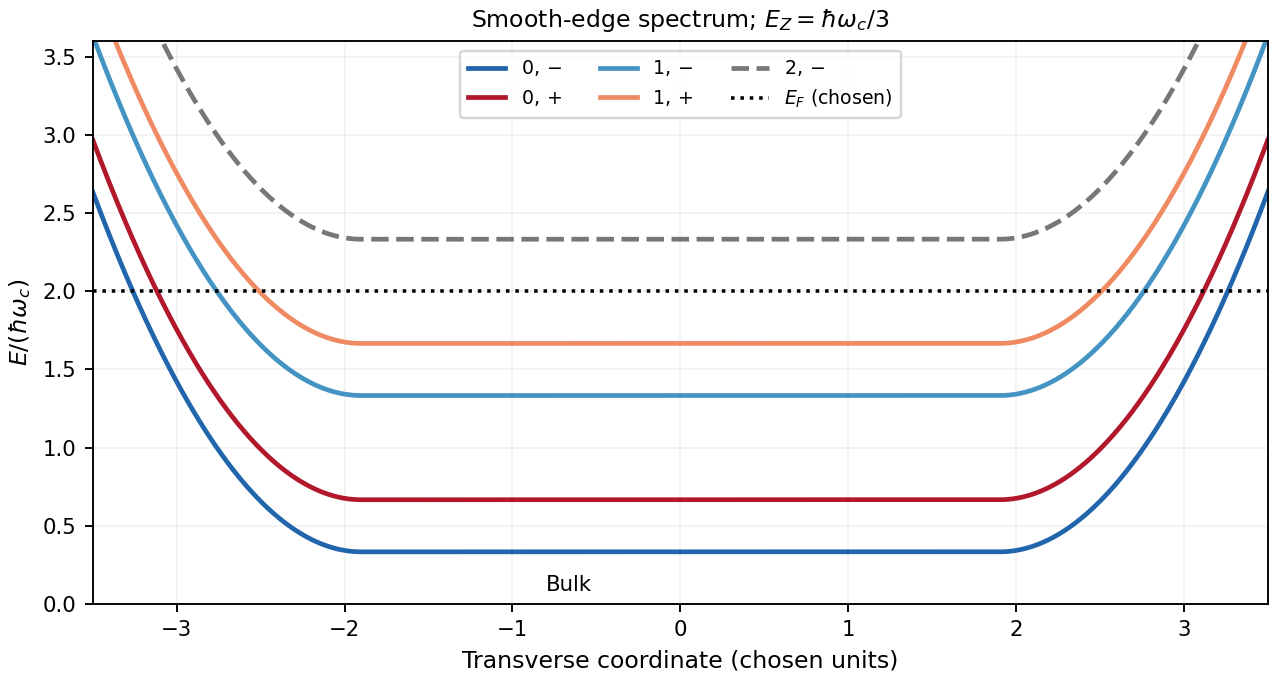
In Landau gauge for a uniform magnetic field , the guiding centre is . The group velocity isThus the upper edge in the original trajectory diagram carries electrons to the right and the lower edge to the left. Reversing the magnetic field reverses both arrows. Semiclassically these are skipping trajectories; quantum mechanically the guiding centres label propagating quantum Hall edge states. The larger orbital-plus-spin energy crosses the Fermi energy farther toward the interior, because less confinement energy is needed. Opposite spins in one orbital branch are therefore spatially separated.
In a clean bulk with the Fermi energy between Landau levels, there are no extended bulk states at that energy. Occupied bulk cyclotron orbits lie below it; one must not draw them as extra conducting Fermi-level channels. Smooth disorder can instead produce localized bulk contours without adding a direct source-to-drain channel.
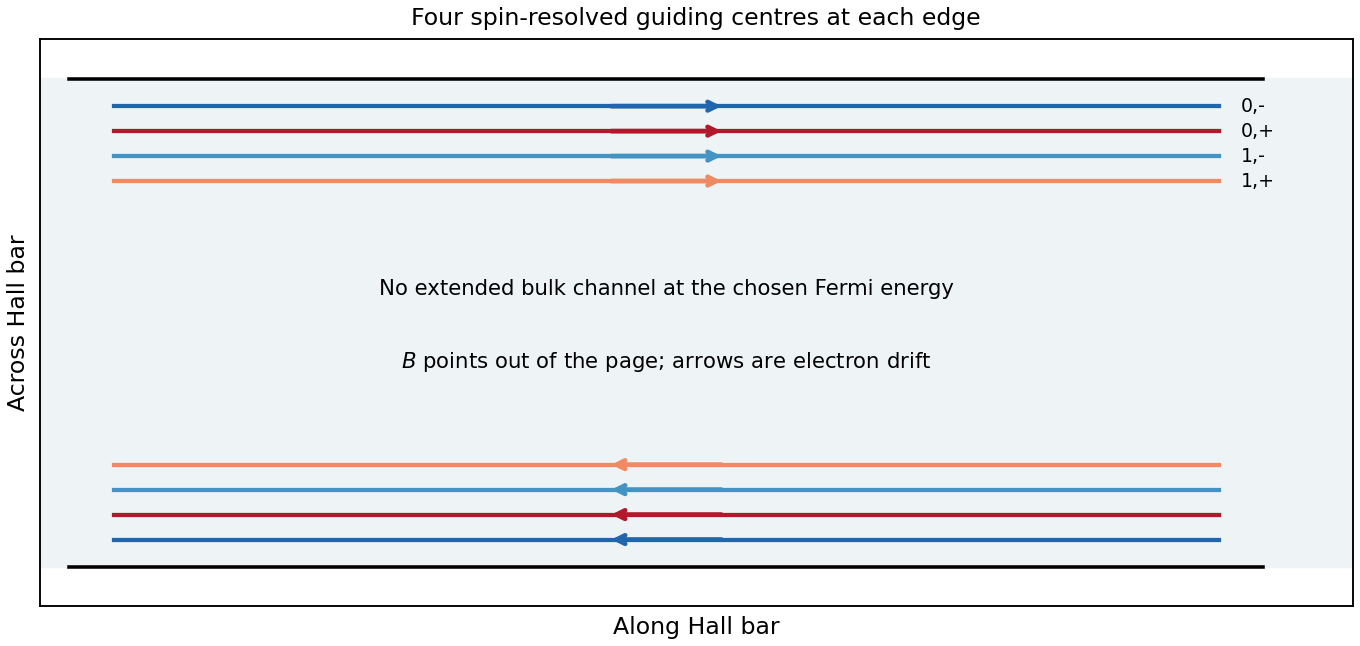
For the spin separation at a smooth quantum Hall edge, linearize the confinement energy at a crossing. Compensating a spin energy difference by a potential-energy change givesHere is interpreted as the specified slope of electron potential energy. If it denotes electrostatic voltage per length instead, the denominator is . The two edges of a neck and the two sides of an antidot have oppositely directed slopes; the formula is a positive local separation on any one edge. For local filling two, only the spin pair is occupied at the neck minimum: . Raising both branches with the confinement produces two crossings on each side, as shown in the original neck sketch. This fixed-slope estimate precedes self-consistent electrostatic screening.
An antidot is a depleted potential hill. guiding centres circulate around its closed equipotentials, with chirality opposite to the outer sample edge. A phase-coherent round trip contributes magnetic phase , with . A localized orbit resonant with the incident energy can transfer an electron between extended channels. If the outgoing channel returns toward the injecting reservoir, the process is resonant reflection and reduces electrical conductance. If coupling instead connects an otherwise blocked incident channel to the far reservoir, it is resonant transmission and adds electrical conductance. Transmission peaks require that forward connectivity; a closed orbit by itself does not guarantee them. Interchannel scattering can change which orbit participates.[ref]
Electron-electron interactions in antidot-based Aharonov-Bohm interferometers by S. Ihnatsenka and others. section I and section III.C, especially Fig. 7: localized states, interchannel scattering and resonant transmission
For the antidot resonance conductance bounds with one active spin-resolved resonance, writeHere are energy broadenings; the corresponding escape rates are . In a reflection-dominated configuration with two otherwise transmitted channels, : a background can dip to . In a transmission-dominated configuration with one spectator channel and the second otherwise blocked, : peaks rise from toward . These are the two ideal channel-count examples plotted below. More generally, or ; a different spectator count changes the integer offset. The constriction filling alone does not specify every tunnel coupling or resonance height. Equal couplings permit unit resonant transfer in the isolated-level model; asymmetry, temperature and dephasing reduce the contrast. Holding the effective orbit area approximately fixed gives for one branch, not a universal charging-corrected period.
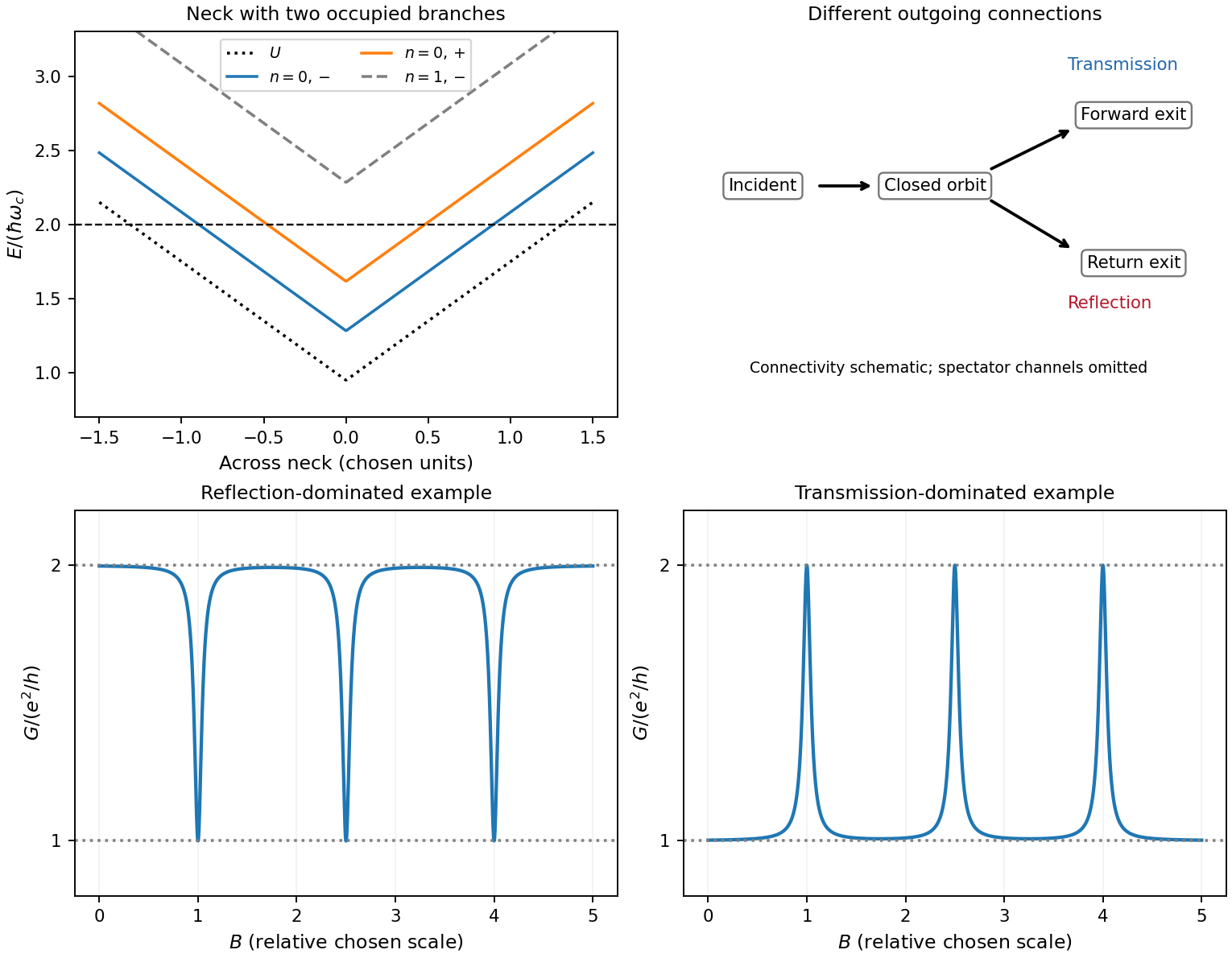
Original neck spectrum, alternative channel connectivities and illustrative antidot conductance dips and peaks
. Details. In quantum-dot versus antidot resonance topology, a quantum dot is a potential well holding a finite electron island. Its closed guiding-centre circulation is reversed relative to an antidot at the same field. With two barriers in series, current follows source dot drain; off resonance there need not be a direct conducting path. A gate shifts a level or an addition electrochemical potential into alignment with the reservoirs and produces a electrical conductance peak. For an isolated coherent spin-resolved level, the zero-temperature peak is at most and reaches it only for equal couplings; unresolved noninteracting spin degeneracy doubles this bound. In weak sequential tunnelling, peak height depends on rates and temperature rather than being quantized. Charging produces Coulomb blockade peaks with spacing set by addition energy and gate lever arm. An antidot also supports discrete orbit/charging resonances, but can be side-coupled to already open channels and produce dips. Gate voltage changes both orbit area and confinement, whereas a magnetic sweep directly changes enclosed flux.
Coulomb interactions require a self-consistent confinement potential. A gradual decrease in electron density cannot leave arbitrary uncompensated donor charge at no cost. Partly occupied Landau levels have a large charge response: electrostatic screening flattens their effective energy near the Fermi energy over compressible quantum Hall edge strips. Between them, integer-filled incompressible quantum Hall edge strips have a gap, weak density response and most of the potential variation. In an idealized cross-section the effective branch thus alternates between flat, partially occupied portions and rising portions crossing a gap; its carrier density varies oppositely. The bare levels still have Landau level and spin splittings locally, but the common electrostatic potential is no longer an imposed straight slope. exchange interaction can additionally renormalize spin gaps. Widths must follow electrostatics and the density gradient, so the unscreened separation is not a quantitative screened-strip width.[ref]
Electrostatics of edge channels by D. B. Chklovskii and others. abstract: steplike self-consistent potential and alternating compressible and incompressible strips
A modulation-doped GaAs-AlGaAs electron gas is confined on the GaAs side of the interface. The larger-gap AlGaAs supplies a conduction-band barrier; charge transfer from remote donors and the resulting electric field bend the bands into an approximately triangular well. transverse electronic mode wavefunctions are confined normal to the interface but free in its plane. electrons settle into the well until their electrochemical potential agrees with the donor/contact environment. An undoped spacer separates mobile electrons from ionized donors, reducing impurity scattering. Equilibrium has one Fermi level across the structure; the conduction-band edge is not flat. Surface depletion and the cap also affect the profile. The original drawing illustrates one occupied confinement transverse electronic mode; a single spatial electron gas need not in general imply only one occupied vertical transverse electronic mode.
molecular beam epitaxy can grow a clean GaAs buffer/channel, an undoped AlGaAs spacer, a Si-doped AlGaAs supply region and a protective GaAs cap on a suitable substrate. Control composition, interface quality and background impurities during growth; placing dopants directly in the channel defeats the principal mobility advantage. Define a mesa or isolation region, fabricate low-resistance ohmic contacts to the buried gas, and pattern fine metal split gates by electron beam lithography and the lift-off process. Negative gate bias depletes the underlying gas, leaving a narrow channel between the gates. Check contact resistance, leakage, carrier density and mobility; operation with ballistic electron transport requires channel length shorter than the relevant scattering lengths and smooth confinement on the wavelength scale. The lithographic gap does not equal the electrical width because of lateral depletion.
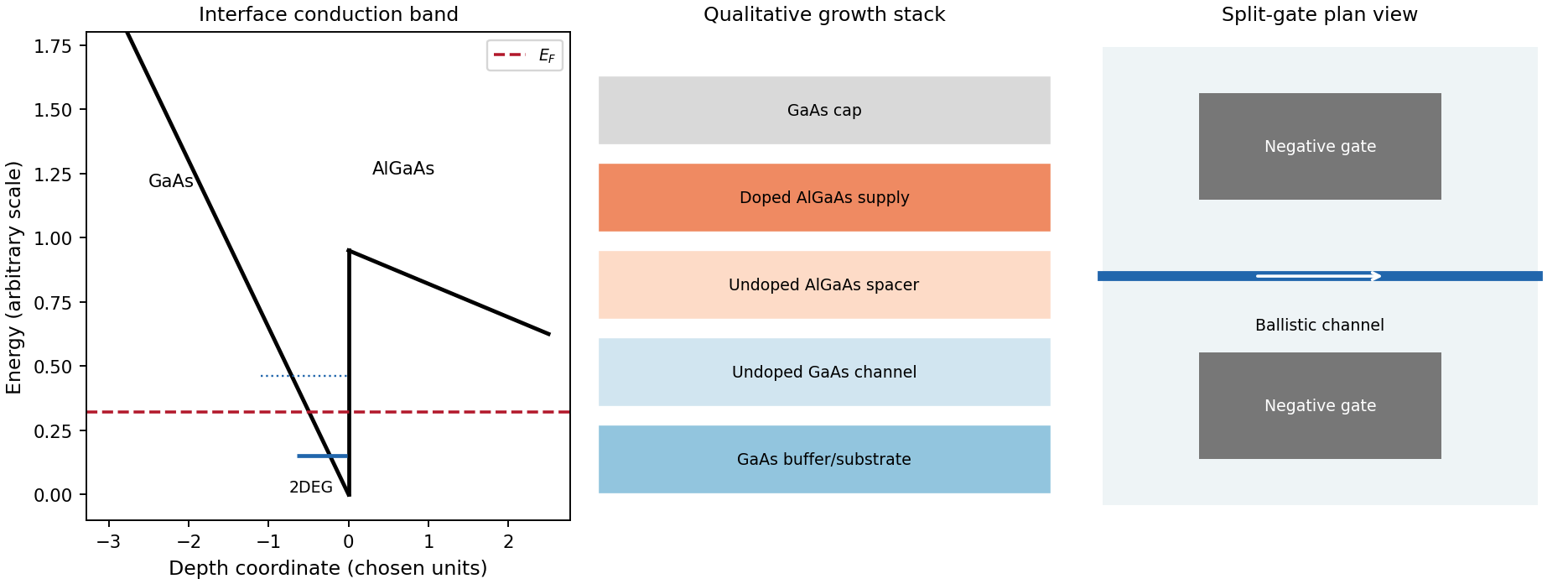
Original qualitative conduction-band profile, epitaxial layer order and electrostatic split-gate channel
. Details. For a long uniform channel supporting ballistic electron transport, transverse confinement creates thresholds with continuous longitudinal propagation above each threshold. One directed spin branch of a transverse electronic mode has states per length and group velocity . Hence : velocity cancels the one-dimensional density of states. Including two unresolved spin states,For low temperature and small bias, a fully open transverse electronic mode has , givingThe assumptions are ideal reservoirs/contacts, negligible reflection and interactions that would invalidate the independent-subband description, and unresolved spin splitting. A resolved spin branch contributes . The finite two-terminal electrical resistance is a contact/mode-injection effect, despite the absence of dissipative scattering inside the ideal channel.
For voltage partition in a ballistic constriction, a short saddle has strong local electric-field and electrostatic screening variation near its entrances and barrier, rather than the uniform Ohmic voltage gradient of a diffusive wire. Right-moving incident states inherit the source distribution and left-moving states the drain distribution; there is no unique local equilibrium chemical potential inside an ideal ballistic saddle. The electrostatic potential must be determined self-consistently. In a symmetric rigid-barrier approximation, the barrier follows the mean lead potential and half the electrochemical bias lies on each side. This is a stated approximation, not a universal spatial voltage profile.
For a saddle , transverse electronic mode thresholds are . The smooth-barrier transmission is , approaching a step for a sharp threshold on the bias/thermal scale.[ref]
Quantized transmission of a saddle-point constriction by M. Büttiker. Phys. Rev. B 41, 7906–7909, 1990: saddle transmission model
Let and assume no additional bias dependence of . At zero temperature,When the source and drain sample and thresholds, the differential electrical conductance is . These half plateaus arise from the two ends of the bias window, not fractional carriers. The dc ratio need not share their plateau values. Heating, spin splitting and interaction-induced features must be distinguished experimentally.
In bias spectroscopy of one-dimensional subbands, plot differential electrical conductance or its gate derivative against gate bias and source-drain bias. Threshold branches occur where or . When one bias-window edge meets and the other ,Thus the intersections of adjacent threshold branches calibrate the one-dimensional spacing directly in energy. A gate lever arm can then convert gate intervals to energy; it should be measured rather than guessed. Asymmetric bias partition, a moving barrier or a gate-dependent spacing modifies slopes and plateau weights, requiring the corresponding self-consistent bias model.
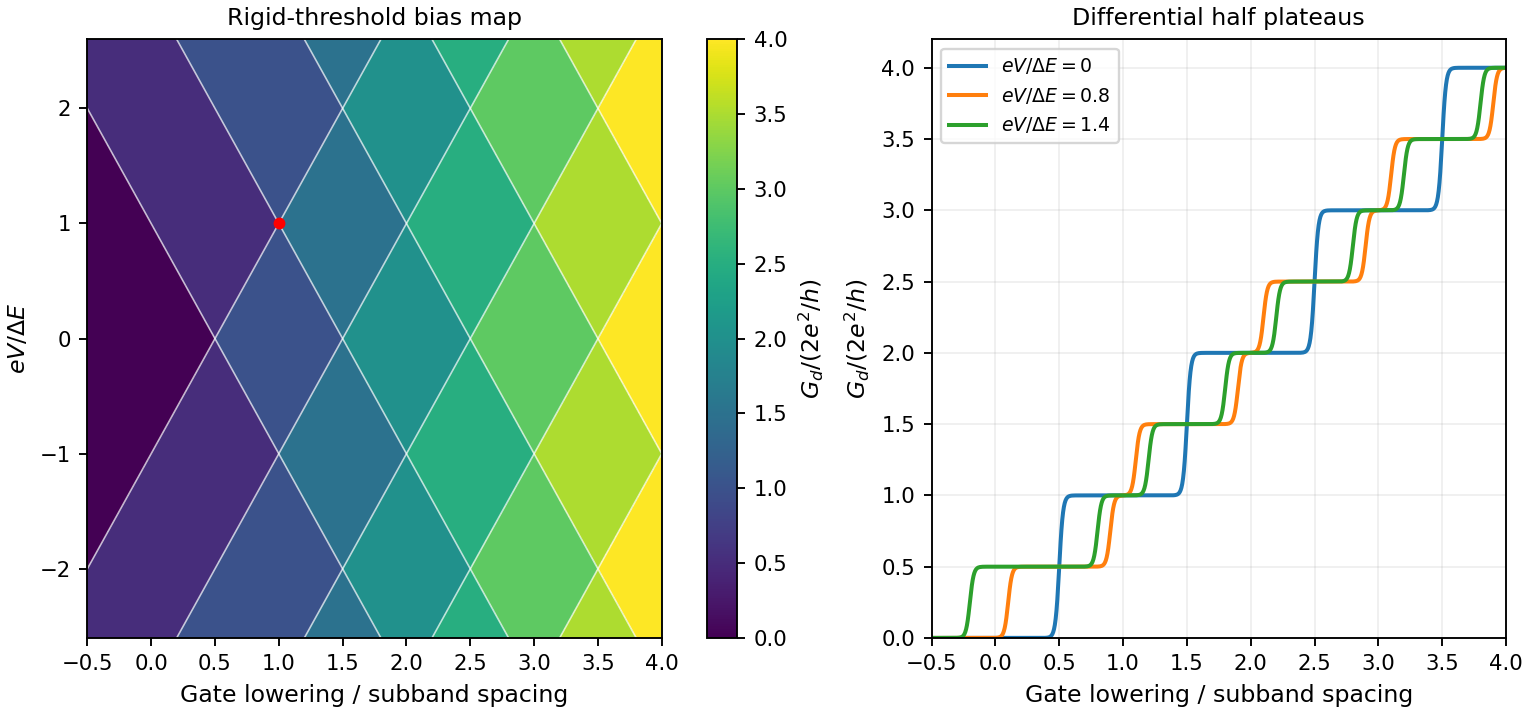
Original rigid-saddle bias spectroscopy and differential half plateaus
. Details. A single gate-defined dot can trap one electron whose lower and upper Zeeman states define . Initialize by energy-selective loading or relaxation, coherently rotate the spin with a resonant magnetic drive or electrically generated spin-dependent drive, and use neighbouring-dot exchange interaction for two-qubit operations. The dot supplies confinement; a full qubit also requires control, coherence and calibrated readout. A nearby quantum point contact or single-electron transistor detects charge capacitively, so spin-to-charge conversion is needed.
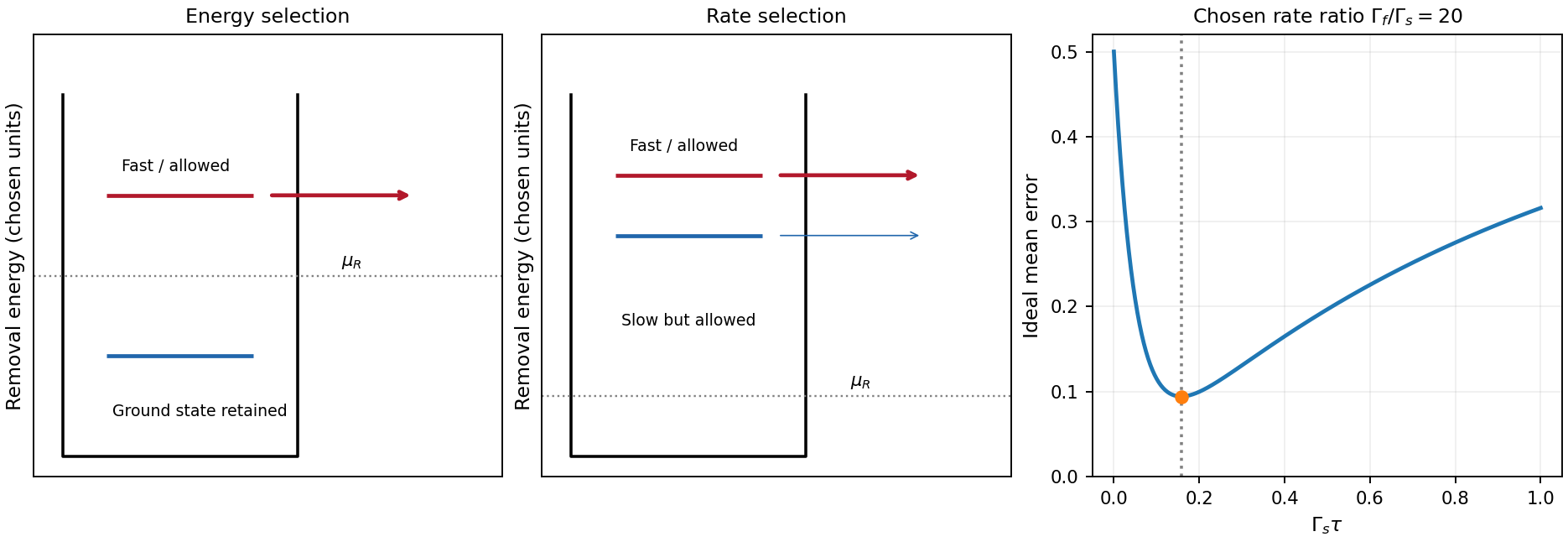
In energy-selective spin readout, set the reservoir chemical potential between the two spin-dependent removal energies. The upper state can tunnel out; the lower remains. Reloading can create a temporary empty-dot signal that a time-resolved charge detector records. Resolving this window requires sufficiently small electron-temperature broadening and stable level alignment. The escape should be faster than spin relaxation, but the empty interval must remain long enough for detection. Useful controls include known-state preparation, sensor-noise measurement, varied waiting time and readout pulses, and checks for missed events or thermally activated false escape.[ref]
Single-shot read-out of an individual electron spin in a quantum dot by J. M. Elzerman and others. main-text readout pulse sequence and spin-to-charge conversion, Fig. 1
tunnel-rate-selective spin readout instead places both candidate removal energies on the allowed side of the reservoir and uses different escape rates . After a window with , the fast state has usually changed charge while the slow state has not. It does not require the reservoir Fermi edge to resolve the state splitting, although it still requires controlled charge occupation, substantial rate contrast and relaxation slower than the mapping. The contrast must have a physical origin. A demonstrated single-dot implementation uses two-electron singlet and triplet states: Pauli symmetry puts the triplet's second electron in a higher orbital with stronger lead coupling. Nearly degenerate states can then be distinguished by rate rather than by their energy difference.[ref]
For a bare one-electron Zeeman pair in the same orbital with an unpolarized lead, different tunnel rates are not automatic. A spin-selective barrier/reservoir or another spin-dependent mechanism is needed. The two-electron singlet/triplet example is a different state encoding/readout arrangement, not evidence that the bare single-electron pair already has useful rate contrast.
For the optimal tunnel-rate readout time, assume no relaxation and equal prior probabilities. The fast-state missed-event probability is and the slow-state false-event probability is . Their average is minimized atFinite detector bandwidth, preparation errors, state relaxation and unwanted reloading alter this optimum. energy selection is direct for a resolved single-electron spin but sensitive to the narrow alignment window; rate selection has a wider energy operating window but requires engineered rate contrast and a carefully timed charge measurement. Neither method is an ideal nondestructive spin measurement merely because the charge sensor itself is noninvasive.
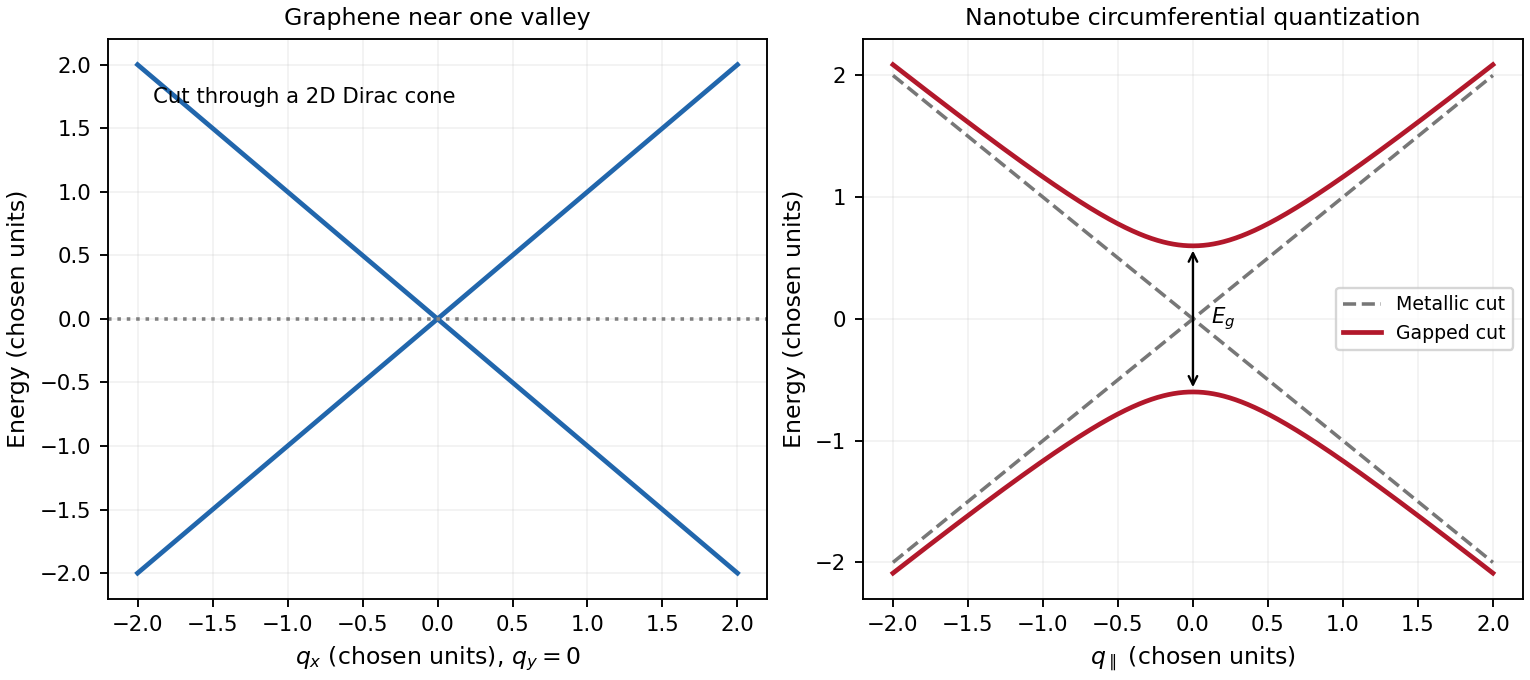
graphene is a two-dimensional honeycomb lattice with two sublattices. Nearest-neighbour hopping gives two bands . They touch at two inequivalent valleys. Expanding near valley givesThe two-component spinor describes sublattice amplitudes, not real spin. This is a massless two-dimensional Dirac Hamiltonian with material velocity in place of . The emergent band quasiparticles are relativistic in this mathematical sense; the electron's vacuum rest mass is not set to zero. Real spin and valley each contribute a degeneracy of two in the ideal low-energy model.
A single-walled carbon nanotube is a rolled graphene sheet with carbon nanotube chiral vector . Periodicity requires , selecting lines through graphene momentum space and producing one-dimensional transverse electronic modes. Near a valley,A quantization line through one of the Dirac valleys in graphene gives a metallic branch; ideal nanotube zone folding gives the criterion . Otherwise the nearest line misses the valley and opens . The transverse momentum gives a carbon-nanotube Dirac mass, with . For a large-radius ideal semiconducting tube, and , showing the inverse-diameter gap. Curvature, strain, spin-orbit coupling and interactions can change the simple classification; nominally metallic non-armchair tubes can acquire small gaps. One-dimensional transverse electronic mode thresholds give Van Hove singularities, unlike graphene's low-energy density of states proportional to .
A gate changes occupation and the Fermi level in both systems. Ideal monolayer graphene can be tuned through charge neutrality from holes to electrons, but an ordinary scalar gate does not open a bulk band gap. Including spin and valley,The gate relation includes geometric and quantum capacitances, so one should not equate gate voltage to Fermi energy without the capacitance model. A semiconducting carbon nanotube can instead be depleted when its Fermi level lies in a gap and turned on in electron or hole bands. Contact Schottky barriers can strongly influence the observed nanotube field effect. A truly gapless ideal metallic tube cannot be switched off simply by moving the Fermi level through its band crossing. These gate responses reflect band structure and contacts, not a change of wrapping indices.


Articles by others on the same topic
There are currently no matching articles.