A trajectory-resolving ballistic experiment. Use a high-mobility modulation-doped GaAs-AlGaAs heterostructure with a two-dimensional electron gas. Grow the layers by molecular-beam epitaxy, separate the donor layer from the conducting interface with an undoped spacer, and pattern an isolated mesa with ohmic reservoir contacts. Electron-beam lithography defines metal split gates; negative gate voltage depletes the underlying electron gas, leaving narrow adjustable injector and collector quantum point contacts along an edge. Keep the relevant path shorter than the momentum-relaxation mean free path, cool to suppress phonon scattering and thermal smearing, and use a small excitation to avoid heating.
Inject a low-frequency current through one contact to a distant drain and measure the collector's open-circuit voltage with a high-input-impedance amplifier. Sweep perpendicular magnetic field and gate settings. The cyclotron radius is , with for a spin-degenerate single-valley gas. For contact separation , semicircular or skipping trajectories focus into the collector whenThe appropriate field sign bends carriers toward the collector; the opposite sign suppresses the peaks. Density-dependent focusing positions, suppression with increased scattering and reproducible gate control distinguish directional ballistic propagation from an ordinary diffusive voltage. Quantum interference may add fine structure, but the basic focusing signal does not require phase coherence over every path. Split-gate injection and collection in a two-dimensional gas were directly demonstrated in the original focusing experiment.[ref]
Coherent electron focusing with quantum point contacts in a two-dimensional electron gas by H. van Houten and others. 1989 primary publication, institutional abstract: split Schottky gates, injector/collector, skipping orbits and field-dependent focusing
Multi-probe current bookkeeping. For one directed spin-resolved mode, velocity times one-dimensional density of states gives a particle flux . A small reservoir electrochemical-energy shift therefore supplies excess flux . Let be the number of propagating modes at lead , their summed return probability, and the total transmission from reservoir into lead . Multiplying outgoing-minus-incoming electron flux by charge gives the source's convention,The reservoirs equilibrate arriving carriers; an ideal voltage probe adjusts its chemical potential until its net current vanishes. Here is an energy, not a voltage. Choose the lead-voltage convention and positive conventional current injected into the junction. The working equation is thenConservation of scattering probability and gauge invariance require both column and row balance: every outgoing channel is accounted for and equal voltages give zero current. The counts below include every occupied internal channel; an extra factor of two must not be inserted if spin is already counted. If one instead counts orbital channels with unresolved spin degeneracy, double all transmission counts consistently.
Zero-field routing. The original diagram labels lead 1 at the left, 2 above, 3 at the right and 4 below. With columns denoting injectors and rows collectors, straight-through ballistic routing and the stipulated excess-wide-channel rule giveThere is no reflection in this ideal routing model. Set , , and . The two probe equations giveThusThe derivation assumes . At , the ideal network splits into two disconnected opposite-lead pairs and cannot carry the imposed 1-to-4 current at finite voltage; the divergence diagnoses failure of that limiting transport configuration, not an infinite dissipative resistance of each channel. Negative bend resistance is a nonlocal voltage sign, compatible with positive total dissipated power.
Positive field. At , left-deflected incoming carriers go , , . Lead 4 supplies modes to narrow lead 1; the remaining enter wide lead 3. The balanced transmission matrix isTherefore , and , givingNegative field. Reversing the chirality gives , as expected from reciprocity for this spin-independent routing model. With , the zero-current conditions become and . ThusThis does not contradict reciprocity: the general relation interchanges the current and voltage lead pairs when reversing field; it does not require the same fixed-contact four-terminal resistance to be even in .
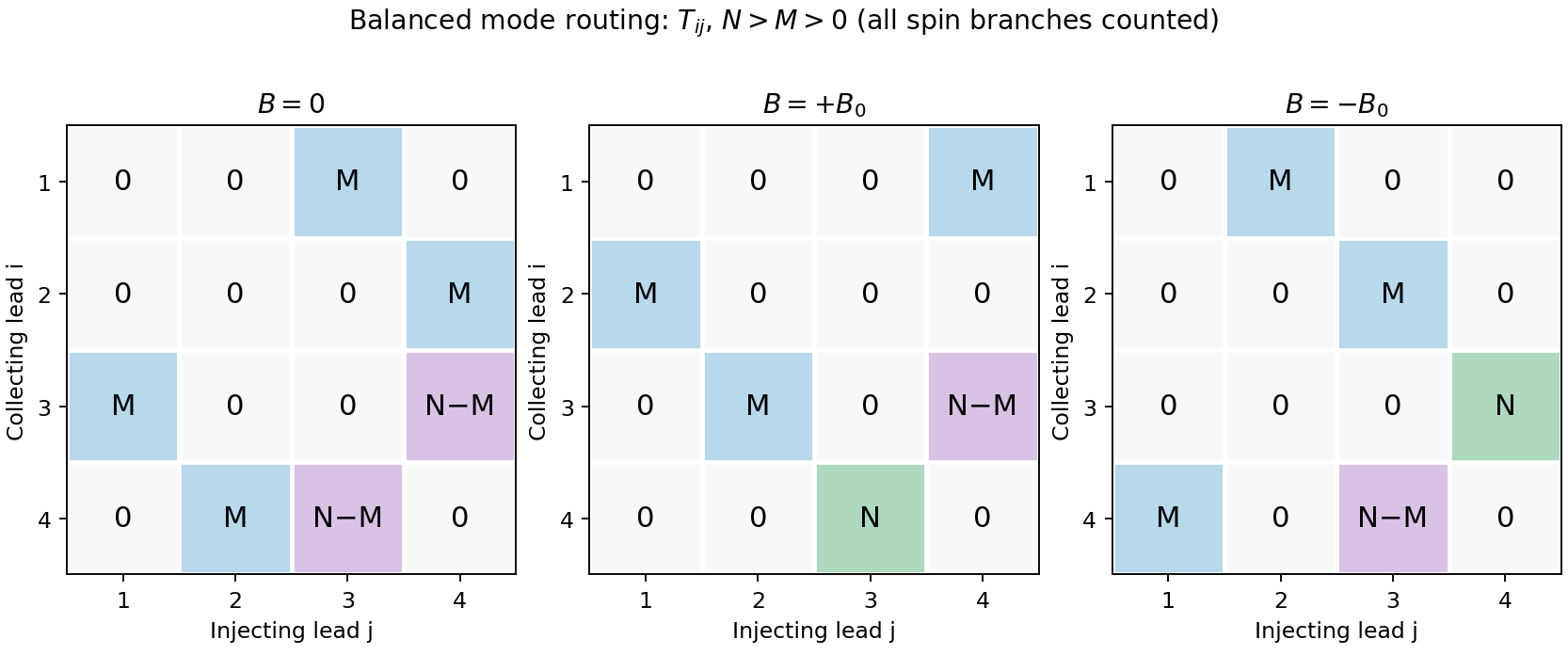
Original transmission-matrix bookkeeping for the three ideal field limits; rows collect modes injected by columns
. Details. 
Comparison with the measured trace. The PDF shows a negative region around zero field, approximately zero signal at sufficiently negative field, and a positive rising resistance near and above. These signs match the three routing limits. Near zero field the depth is roughly a few tenths of a kilohm; the graph does not supply , so there is no justified exact amplitude fit. Rounded corners, collimation and finite cyclotron radius continuously change which outgoing lead is reached between the ideal limits. Skipping trajectories and geometrical focusing can produce shoulders or resonances. At larger positive fields magnetic depopulation and spin resolution can change the mode counts, increasing the positive resistance or producing structure; disorder, incomplete equilibration and finite temperature round ideal features. These are candidate mechanisms, not uniquely established assignments of every small feature from one trace.
Integer Hall transport and filling. A clean two-dimensional electron gas at low temperature in a strong perpendicular magnetic field forms Landau levels with orbital spacing , where . Examples include semiconductor heterojunctions and inversion layers. On integer plateaus,with integer plateau index . The density of states in one resolved Landau branch is per unit area, so the actual filling factor isIt varies continuously with density and field. Within a disorder-broadened plateau, localized states can change occupation without changing the integer number of transporting edge branches; the filling need not equal the plateau integer at every point in that interval.
At a boundary, the confining potential bends the Landau energies through the Fermi energy, giving chiral edge states, interpreted semiclassically as skipping orbits. Opposite edges carry opposite propagation directions. An ideal spin-resolved transmitted edge channel contributes ; such channels give . Chirality and suppressed backscattering between well-separated edges explain vanishing longitudinal voltage. Ideal reservoirs and appropriate probe equilibration are part of this edge-state transport model.
A gated antidot. A local repulsive gate potential depletes an island inside the Hall bar. Edge states circulate around its boundary as closed antidot orbits. When a localized orbit is weakly coupled to extended channels on opposite sides, resonance at the reservoir electrochemical potential permits backscattering and produces conductance dips on an otherwise quantized transmitting plateau. If the path instead adds a transmission route between otherwise disconnected channels, resonant peaks can occur: the sign depends on the device's tunnel connectivity and what conductance is measured. An isolated antidot too far from every conducting edge has negligible transport signature.
For the simplest opposite-edge backscattering picture with one active branch,where branches would otherwise transmit. A gate moves the resonance through the Fermi energy by changing both confinement and orbit area. Stronger depletion of the constrictions also changes , producing broad conductance plateaus or pinch-off, with narrow resonances superposed where coupling is finite. Low temperature resolves individual resonances; thermal and tunnel broadening can merge them.
For a fixed-area single-electron orbit, a phase change of corresponds toSweeping gate voltage at fixed field shifts enclosed area and level energy, giving oscillatory resonance tracks. This period is not automatically set by the lithographic gate area. Charging energy, self-consistent screening and spin branches modify spacings; in particular coupled spin branches in a charging model can generate two resonances per cycle without changing the electron flux quantum.[ref]
Coulomb blockade of tunnelling through compressible rings formed around an antidot by M. Kataoka and others. Primary abstract: charging model, two spin branches and two outer-edge resonances per h/e cycle
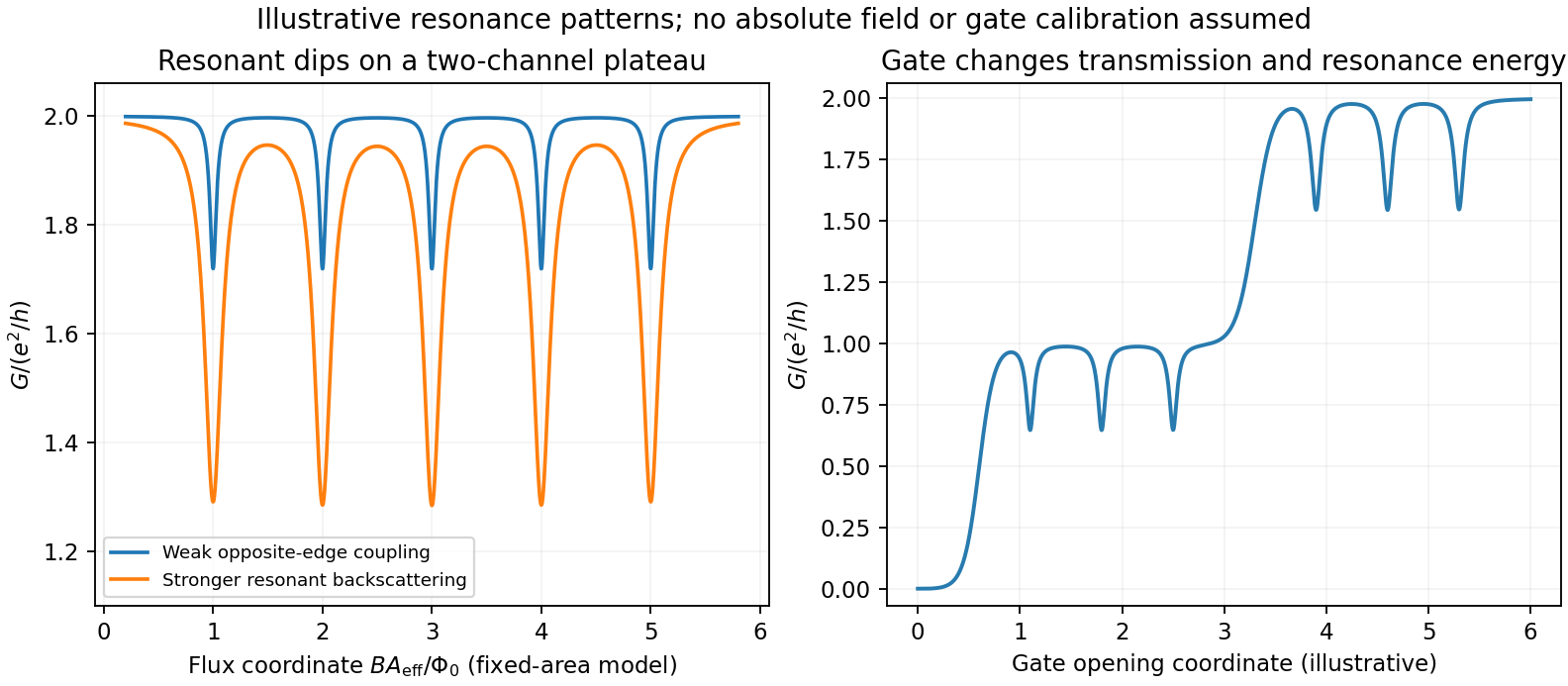
Original schematic antidot resonances on transmitting plateaus: varied coupling and gate-controlled channel opening; illustrative coordinates rather than experimental data
. Details. 
No antidot dimensions, capacitances, lever arms or measured spectrum are supplied, so absolute periods and resonance voltages cannot be extracted. The sketch illustrates the mechanisms and regimes requested, rather than inventing a numerical device data set.
Improving the bare edge potential. A picture of noninteracting Landau levels simply intersecting a prescribed smooth confinement ignores the redistribution and screening of electron charge. A self-consistent electrostatic calculation combines gate and donor potentials, electron density and Coulomb interactions. Where a partially occupied Landau level has a large density response, electrons screen strongly and create a compressible strip with nearly pinned level energy. Regions with the chemical potential in a gap are incompressible and support much of the potential change. Consequently the screened edge alternates between compressible and incompressible strips, rather than preserving an arbitrary externally drawn slope. Finite temperature, disorder, exchange and edge reconstruction can require refinements beyond the simplest electrostatic model.[ref]
Electrostatics of edge channels by D. B. Chklovskii and others. Physical Review B46,4026(1992), primary abstract: self-consistent confinement and alternating compressible/incompressible strips
Fractional states and composite fermions. Very clean two-dimensional systems show plateaus at selected fractional fillings, with small longitudinal resistance and a many-electron excitation gap. Electron-electron correlations are essential; partial filling of a noninteracting Landau level is not enough. The simplest composite fermion binds two statistical flux quanta to each electron. This is a representation of correlated electron motion, not a physical solenoid attached to a particle. With , , and density , the mean effective field isDefine a signed effective filling . ThenFor , filled composite-fermion levels produce . For reversed effective field write , giving ; the nontrivial fractional upper sequence starts with . If effective filling is defined as nonnegative using , retain these as separate field-direction branches instead of using the signed expression blindly. At the mean vanishes and the effective filling diverges, so it is not an integer composite-fermion Hall plateau in this simplest construction. Attaching two flux quanta preserves fermionic statistics; the emergent integer-like gaps organize a prominent sequence of fractional electronic states.[ref]
Composite-fermion approach for the fractional quantum Hall effect by J. K. Jain. Physical Review Letters63,199(1989), abstract: even-flux composite objects and fractional states as effective integer Hall states
Transverse confinement in a short clean channel gives subband dispersionsA gate varies the subband thresholds and channel width. If elastic backscattering is negligible and spin is degenerate, the two-terminal linear conductance isA fully open subband has , producing conductance steps in units . Magnetic spin splitting can resolve steps. A finite two-terminal resistance remains in a perfect ballistic channel because reservoirs supply and absorb a finite number of transport modes; it does not prove momentum-randomizing scattering inside the constriction.
At finite source-drain bias the two reservoir distributions differ over an energy window rather than at one Fermi energy. Choose and take positive current from source to drain. For spin-degenerate channels,At zero temperature with a rigid transmission spectrum, . For symmetric bias and neglecting an explicit bias response of ,If the two window edges lie above different numbers of subbands, the differential conductance can lie at half-integer values in units . For example, two open subbands at one edge and one at the other give . This is a bias-window effect, not fractional charge or a fractional Hall state.
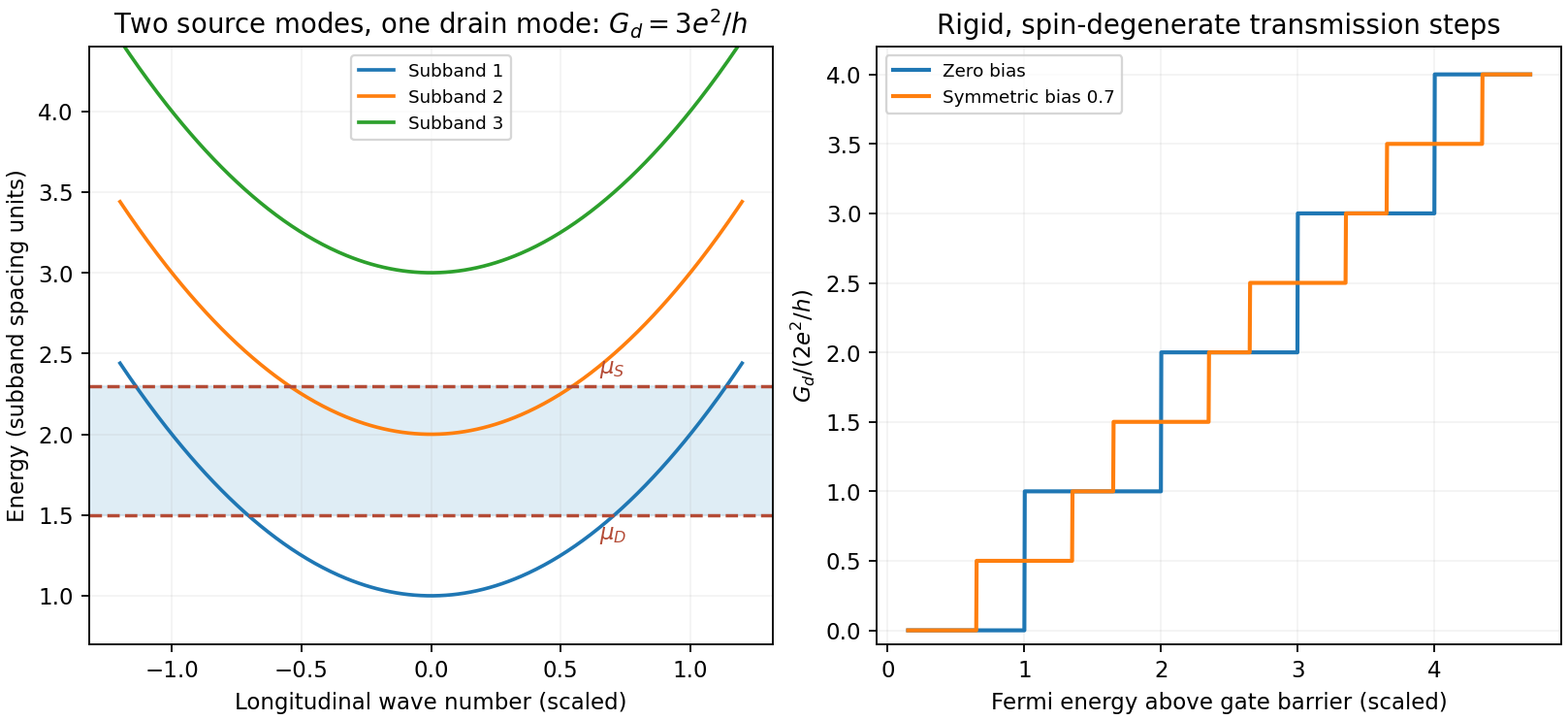
Original ideal one-dimensional subbands sampled by a symmetric bias window, with integer and half-integer differential-conductance plateaus
. Details. 
Mapping transconductance versus gate voltage and source-drain bias reveals boundaries where a reservoir chemical potential crosses a subband bottom, enabling energy-spacing spectroscopy under a specified lever arm and bias division. Finite temperature rounds thresholds over ; reflection, disorder, series resistance and a saddle-shaped barrier reduce or smooth plateaus. Large bias can alter the electrostatic potential, heat carriers or produce inelastic scattering, so the rigid-transmission differential formula is not generally valid without its assumptions. One-dimensional interaction effects can add anomalies beyond this independent-channel model.
A gated quantum dot is an electron island confined in all spatial directions, weakly coupled by tunnel barriers to source and drain and tuned by a plunger gate. Small capacitance makes charge addition costly, while confinement resolves orbital levels. In the constant-interaction model,The charging contribution to successive addition potentials is ; the often used charging-energy scale differs by a factor of two. Orbital spacing and spin filling add further structure.
For weak coupling, and lifetime broadening must be smaller than the relevant addition energies to see Coulomb blockade. Sequential tunnelling proceeds when an addition level is inside the source-drain bias window and the appropriate charge states are accessible. A gate sweep gives conductance peaks near charge degeneracies and low conductance between them. A bias-versus-gate map shows Coulomb diamonds, with excited-state lines when additional levels enter the window. Their slopes and sizes depend on source, drain and gate capacitances and the bias convention. Cotunnelling gives higher-order transport inside nominally blocked regions; stronger coupling and many-body effects can invalidate the simple sequential picture.
Coherent dot states as a qubit. A single-electron spin has basis , in a magnetic field, split by . A qubit is a controllable coherent state , not just a pair of classical current levels. Initialize through spin-selective loading or relaxation; resonant magnetic or spin-orbit-assisted electrical driving produces rotations. Adjacent occupied dots can couple through a gate-controlled exchange interaction. In the weak-tunnel symmetric Hubbard limit,Local spin rotations combined with a suitable exchange entangling operation provide universal control in the ideal spin-qubit proposal. Gate pulses must avoid unwanted orbital excitation and leakage, and complete coherent operations before dephasing destroys the information.[ref]
Quantum Computation with Quantum Dots by Daniel Loss and David P. DiVincenzo. Section II, coupled-dot spin encoding and electrically controlled exchange; arXiv:cond-mat/9701055
For measurement, place the reservoir electrochemical potential between Zeeman levels so that only one spin state can tunnel out, or use Pauli spin blockade in a double dot. A nearby quantum point contact or single-electron transistor detects the resulting charge change. Such spin-to-charge conversion makes transport useful for reading a spin even when the stored information is not itself a net current.[ref]
Single-shot read-out of an individual electron spin in a quantum dot by J. M. Elzerman and others. Primary experiment: energy-selective tunnelling and nearby quantum-point-contact charge detection
A double dot can alternatively encode a charge qubit in left/right occupation, with Hamiltonian . It allows electrical control and charge sensing, but couples strongly to charge noise. Spin qubits also suffer hyperfine, electrical and spin-orbit-related noise, as well as relaxation and readout errors. An observed Coulomb diamond alone establishes charging physics, not initialization, coherent control or a functioning qubit.
Carrier confinement changes both the energies and the available optical transitions of a semiconductor. A quantum well confines one direction and leaves two continuous momentum coordinates; a wire confines two directions and leaves one; a quantum dot confines all three and has discrete ideal levels. Confinement becomes important when its level spacing is comparable with thermal, lifetime and disorder energy scales, and strong excitonic confinement involves comparison with the exciton Bohr radius.
Transition energies. In a simple infinite-well effective-mass model of width , a same-index electron-hole transition has thresholdThus decreasing generally blue-shifts interband absorption and emission through the confinement contribution. Finite barriers, band mixing, strain, nonparabolicity, dielectric environment and Coulomb interactions alter this elementary estimate. In dots, confinement shifts and exciton binding have different size dependences, so a single inverse-square law is not an exact nanocrystal spectrum.
Dimensional density of states. For a parabolic continuum the phase-space volume below kinetic energy scales as , hence the density of states scales as . Each subband threshold therefore contributes a square-root onset in three free dimensions, a constant step in two, and an inverse-square-root singularity in one. A zero-dimensional ideal dot has discrete lines rather than a continuum power law. Real temperature, disorder and lifetime broadening smooth singularities and lines. Optical absorption uses the joint electron-hole density of states multiplied by transition matrix elements and occupations; a bare electronic density of states is not the entire absorption spectrum.
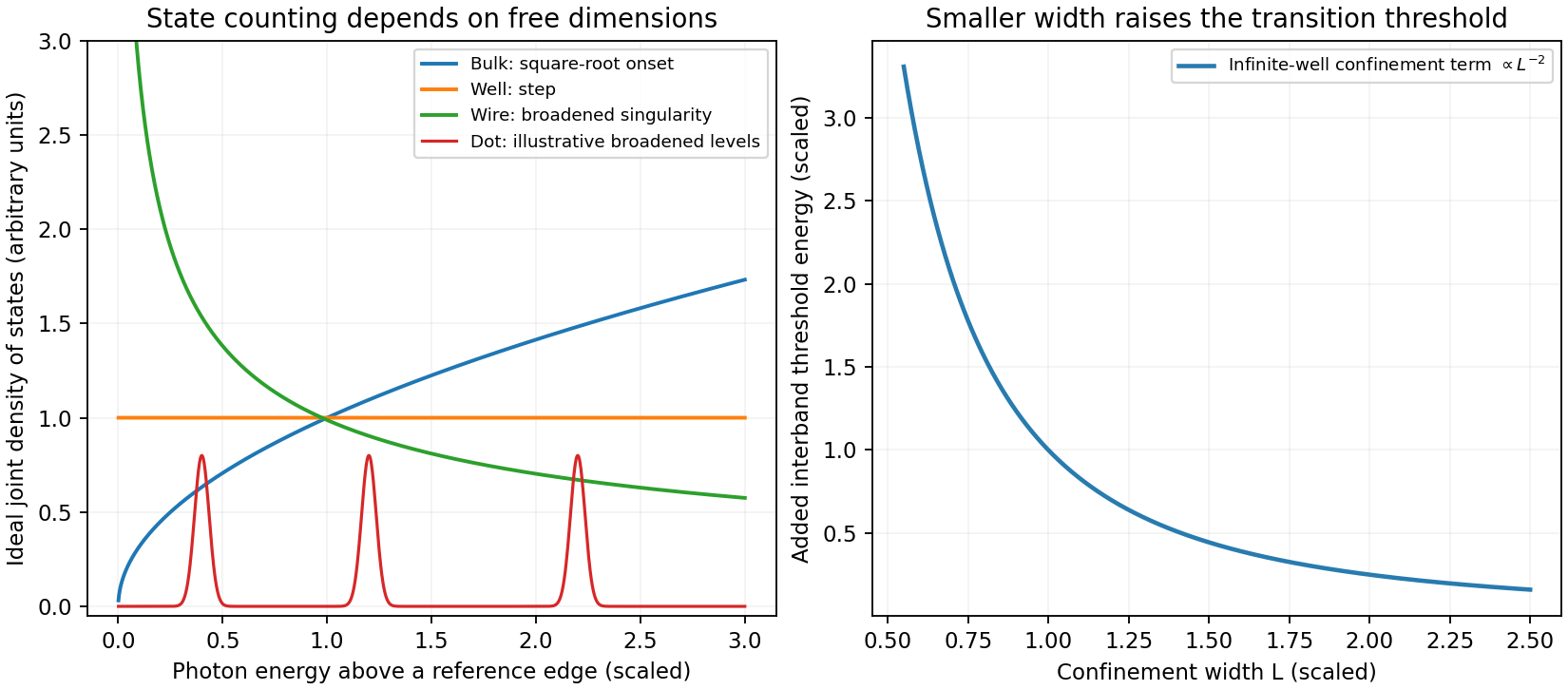
Original ideal dimensional joint-density-of-states comparison and confinement-induced optical-threshold scaling; arbitrary broadening shown for dot levels
. Details. 
Selection and Coulomb effects. Envelope-function overlap and Bloch-state dipole selection rules determine allowed transitions and their polarization. For equal ideal infinite-well envelopes, orthogonality favors matching transverse indices; finite barriers and asymmetric fields can relax that envelope rule. Reduced dimensionality can enhance electron-hole attraction and oscillator strength near an exciton resonance, but the binding energy depends on the actual confinement and dielectric screening. Intersubband transitions within a conduction band are different from interband recombination; in a quantum well they require an electric-field polarization component along the confinement direction.
Devices. Quantum wells, wires and dots allow wavelength engineering, carrier localization and altered optical gain for LEDs and semiconductor lasers. Concentrating states near selected transition energies can improve differential gain and reduce thresholds under appropriate injection and loss conditions. Dot ensembles can instead have substantial inhomogeneous broadening from size variation; nonradiative surface traps and carrier capture can limit an otherwise attractive design. Material confinement does not alone ensure high quantum efficiency.
An applied field across a quantum well shifts electron and hole envelopes apart, usually red-shifting the exciton transition and reducing overlap: the quantum-confined Stark effect. This supports electroabsorption modulation and tuneable optical transitions. Conduction-band intersubband energies can also be engineered for infrared detectors and cascade-laser designs. Optical waveguides and cavities confine photons and affect mode overlap or spontaneous-emission rates, but that photonic confinement is distinct from the carrier quantization derived above. Both must be specified when predicting a real device's threshold, spectrum and output.
Articles by others on the same topic
There are currently no matching articles.