Transverse confinement in a short clean channel gives subband dispersionsA gate varies the subband thresholds and channel width. If elastic backscattering is negligible and spin is degenerate, the two-terminal linear conductance isA fully open subband has , producing conductance steps in units . Magnetic spin splitting can resolve steps. A finite two-terminal resistance remains in a perfect ballistic channel because reservoirs supply and absorb a finite number of transport modes; it does not prove momentum-randomizing scattering inside the constriction.
At finite source-drain bias the two reservoir distributions differ over an energy window rather than at one Fermi energy. Choose and take positive current from source to drain. For spin-degenerate channels,At zero temperature with a rigid transmission spectrum, . For symmetric bias and neglecting an explicit bias response of ,If the two window edges lie above different numbers of subbands, the differential conductance can lie at half-integer values in units . For example, two open subbands at one edge and one at the other give . This is a bias-window effect, not fractional charge or a fractional Hall state.
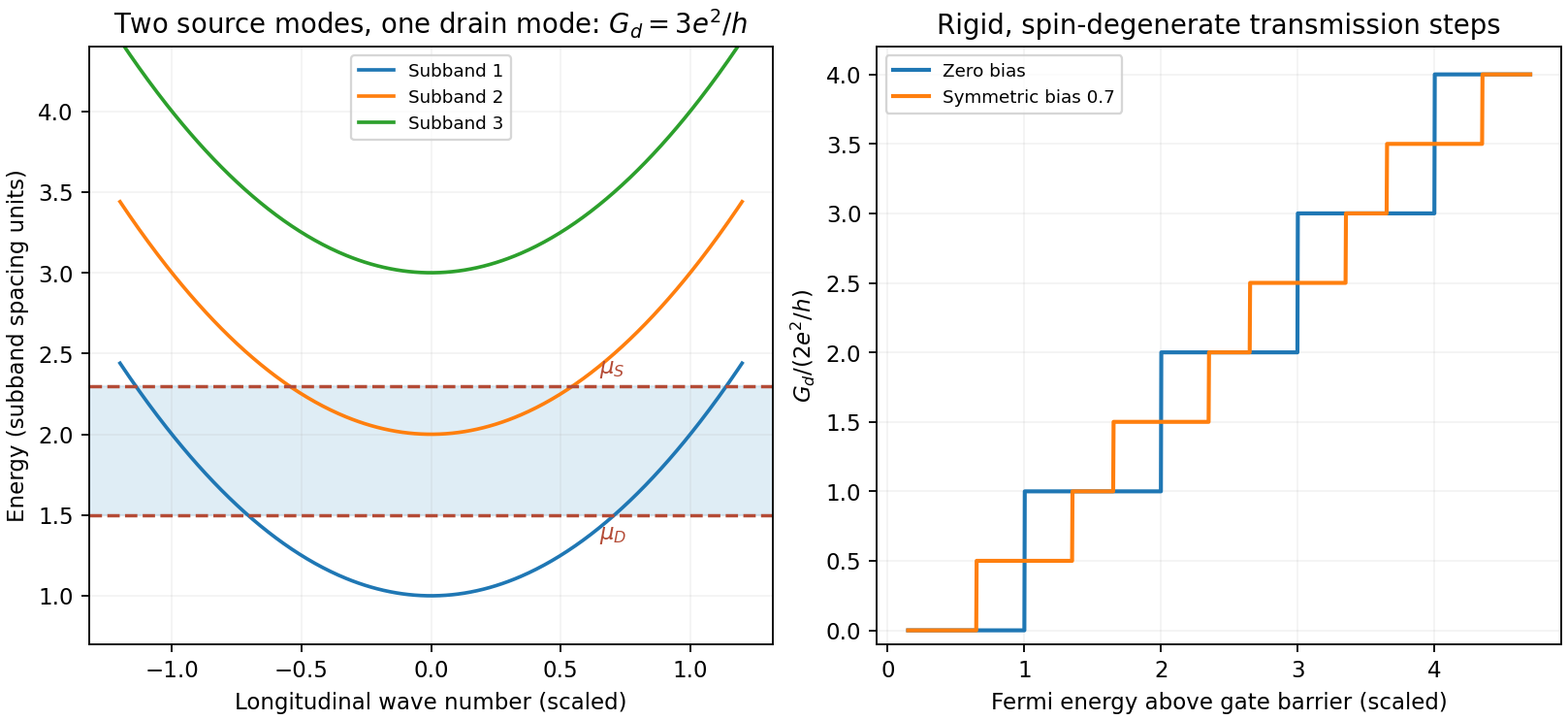
Original ideal one-dimensional subbands sampled by a symmetric bias window, with integer and half-integer differential-conductance plateaus
. Details. 
Mapping transconductance versus gate voltage and source-drain bias reveals boundaries where a reservoir chemical potential crosses a subband bottom, enabling energy-spacing spectroscopy under a specified lever arm and bias division. Finite temperature rounds thresholds over ; reflection, disorder, series resistance and a saddle-shaped barrier reduce or smooth plateaus. Large bias can alter the electrostatic potential, heat carriers or produce inelastic scattering, so the rigid-transmission differential formula is not generally valid without its assumptions. One-dimensional interaction effects can add anomalies beyond this independent-channel model.
A gated quantum dot is an electron island confined in all spatial directions, weakly coupled by tunnel barriers to source and drain and tuned by a plunger gate. Small capacitance makes charge addition costly, while confinement resolves orbital levels. In the constant-interaction model,The charging contribution to successive addition potentials is ; the often used charging-energy scale differs by a factor of two. Orbital spacing and spin filling add further structure.
For weak coupling, and lifetime broadening must be smaller than the relevant addition energies to see Coulomb blockade. Sequential tunnelling proceeds when an addition level is inside the source-drain bias window and the appropriate charge states are accessible. A gate sweep gives conductance peaks near charge degeneracies and low conductance between them. A bias-versus-gate map shows Coulomb diamonds, with excited-state lines when additional levels enter the window. Their slopes and sizes depend on source, drain and gate capacitances and the bias convention. Cotunnelling gives higher-order transport inside nominally blocked regions; stronger coupling and many-body effects can invalidate the simple sequential picture.
Coherent dot states as a qubit. A single-electron spin has basis , in a magnetic field, split by . A qubit is a controllable coherent state , not just a pair of classical current levels. Initialize through spin-selective loading or relaxation; resonant magnetic or spin-orbit-assisted electrical driving produces rotations. Adjacent occupied dots can couple through a gate-controlled exchange interaction. In the weak-tunnel symmetric Hubbard limit,Local spin rotations combined with a suitable exchange entangling operation provide universal control in the ideal spin-qubit proposal. Gate pulses must avoid unwanted orbital excitation and leakage, and complete coherent operations before dephasing destroys the information.[ref]
Quantum Computation with Quantum Dots by Daniel Loss and David P. DiVincenzo. Section II, coupled-dot spin encoding and electrically controlled exchange; arXiv:cond-mat/9701055
For measurement, place the reservoir electrochemical potential between Zeeman levels so that only one spin state can tunnel out, or use Pauli spin blockade in a double dot. A nearby quantum point contact or single-electron transistor detects the resulting charge change. Such spin-to-charge conversion makes transport useful for reading a spin even when the stored information is not itself a net current.[ref]
Single-shot read-out of an individual electron spin in a quantum dot by J. M. Elzerman and others. Primary experiment: energy-selective tunnelling and nearby quantum-point-contact charge detection
A double dot can alternatively encode a charge qubit in left/right occupation, with Hamiltonian . It allows electrical control and charge sensing, but couples strongly to charge noise. Spin qubits also suffer hyperfine, electrical and spin-orbit-related noise, as well as relaxation and readout errors. An observed Coulomb diamond alone establishes charging physics, not initialization, coherent control or a functioning qubit.
Carrier confinement changes both the energies and the available optical transitions of a semiconductor. A quantum well confines one direction and leaves two continuous momentum coordinates; a wire confines two directions and leaves one; a quantum dot confines all three and has discrete ideal levels. Confinement becomes important when its level spacing is comparable with thermal, lifetime and disorder energy scales, and strong excitonic confinement involves comparison with the exciton Bohr radius.
Transition energies. In a simple infinite-well effective-mass model of width , a same-index electron-hole transition has thresholdThus decreasing generally blue-shifts interband absorption and emission through the confinement contribution. Finite barriers, band mixing, strain, nonparabolicity, dielectric environment and Coulomb interactions alter this elementary estimate. In dots, confinement shifts and exciton binding have different size dependences, so a single inverse-square law is not an exact nanocrystal spectrum.
Dimensional density of states. For a parabolic continuum the phase-space volume below kinetic energy scales as , hence the density of states scales as . Each subband threshold therefore contributes a square-root onset in three free dimensions, a constant step in two, and an inverse-square-root singularity in one. A zero-dimensional ideal dot has discrete lines rather than a continuum power law. Real temperature, disorder and lifetime broadening smooth singularities and lines. Optical absorption uses the joint electron-hole density of states multiplied by transition matrix elements and occupations; a bare electronic density of states is not the entire absorption spectrum.
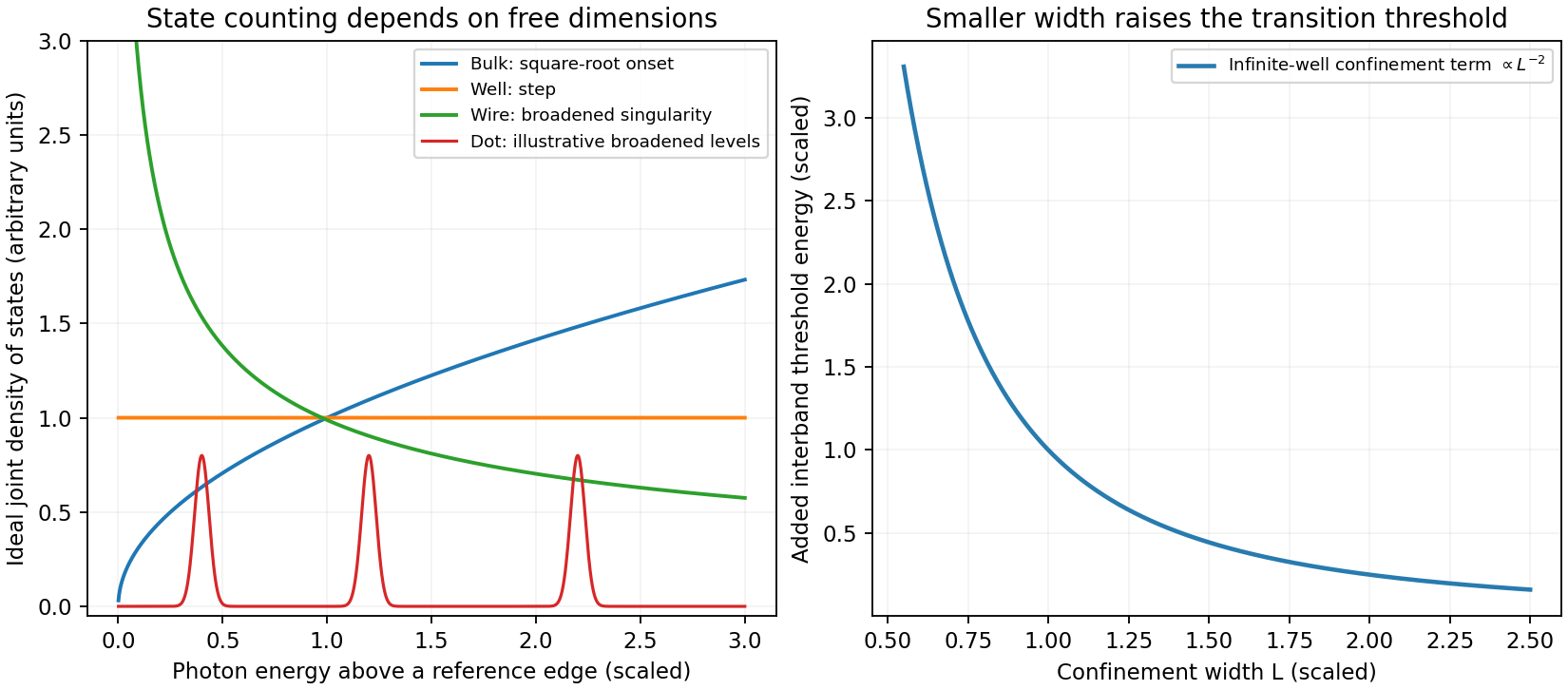
Original ideal dimensional joint-density-of-states comparison and confinement-induced optical-threshold scaling; arbitrary broadening shown for dot levels
. Details. 
Selection and Coulomb effects. Envelope-function overlap and Bloch-state dipole selection rules determine allowed transitions and their polarization. For equal ideal infinite-well envelopes, orthogonality favors matching transverse indices; finite barriers and asymmetric fields can relax that envelope rule. Reduced dimensionality can enhance electron-hole attraction and oscillator strength near an exciton resonance, but the binding energy depends on the actual confinement and dielectric screening. Intersubband transitions within a conduction band are different from interband recombination; in a quantum well they require an electric-field polarization component along the confinement direction.
Devices. Quantum wells, wires and dots allow wavelength engineering, carrier localization and altered optical gain for LEDs and semiconductor lasers. Concentrating states near selected transition energies can improve differential gain and reduce thresholds under appropriate injection and loss conditions. Dot ensembles can instead have substantial inhomogeneous broadening from size variation; nonradiative surface traps and carrier capture can limit an otherwise attractive design. Material confinement does not alone ensure high quantum efficiency.
An applied field across a quantum well shifts electron and hole envelopes apart, usually red-shifting the exciton transition and reducing overlap: the quantum-confined Stark effect. This supports electroabsorption modulation and tuneable optical transitions. Conduction-band intersubband energies can also be engineered for infrared detectors and cascade-laser designs. Optical waveguides and cavities confine photons and affect mode overlap or spontaneous-emission rates, but that photonic confinement is distinct from the carrier quantization derived above. Both must be specified when predicting a real device's threshold, spectrum and output.
Articles by others on the same topic
There are currently no matching articles.