Count facial boundary walks with each edge-side counted once. Their total length is . Every face walk has length at least four: simplicity excludes loops and parallel-edge two-cycles, absence of triangles excludes length three, and a length-two face walk consisting solely of a bridge traversed twice could be the whole boundary only for the excluded connected graph on two vertices. Bridges may occur twice in a longer boundary walk and are still correctly counted. Thus .
The complete bipartite graph is connected, simple, and has no triangles because all its cycles have even length. It has vertices and edges. A planar drawing would require by part (i), a contradiction. Therefore is nonplanar.
The modified graph is planar. Place and , and place the other vertices on the vertical line between them in the bottom-to-top order . Draw each edge as a straight segment. Each half of the drawing is a fan sharing one endpoint, so its edges do not cross. The added edges and are consecutive vertical segments, meeting other edges only at their endpoints. The following original drawing exhibits the embedding.
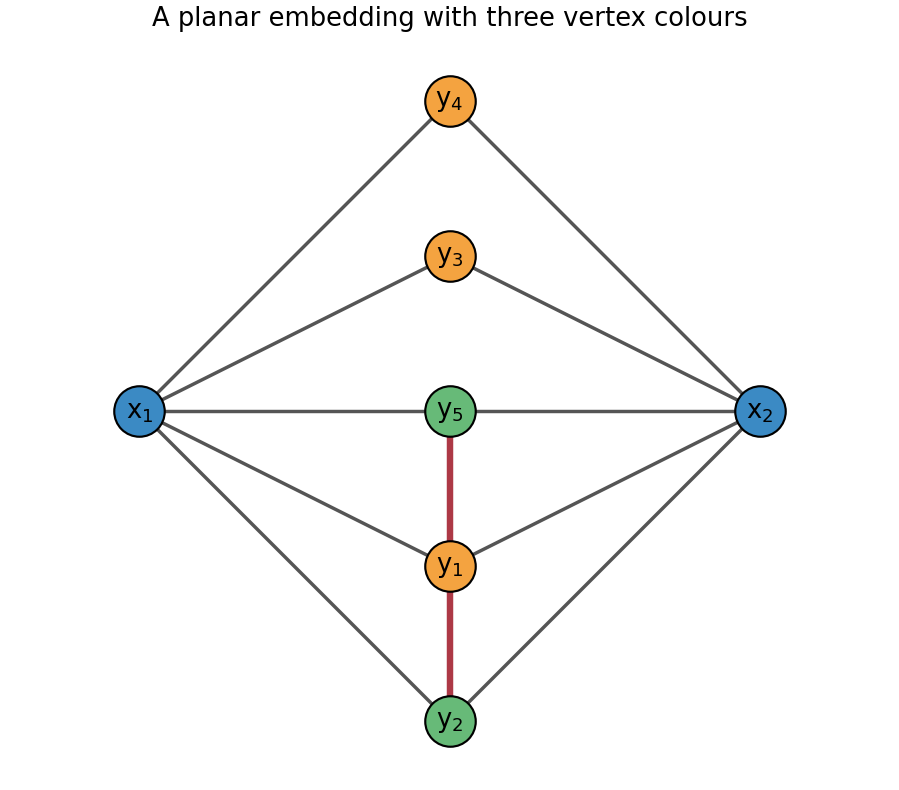

A triangle forces at least three vertex colours. Three suffice: colour blue; orange; and green, as in the drawing. Hence the chromatic number is three.
The five edges incident to force at least five edge colours. An explicit proper five-edge-colouring is
Give colour 5 and colour 3. At the incident colours are ; at they are ; at they are ; all are distinct. The two remaining vertices each have two distinct incident colours. Thus the edge chromatic number is five.
Articles by others on the same topic
There are currently no matching articles.