First make the units explicit. Use angular momentum operators in units of , so their squared eigenvalues are rather than ; the coefficient then has units of energy. The operator identitygives, at fixed ,Subtracting the expression for the adjacent allowed value leavesThis is the Landé interval rule. Its content is that consecutive gaps grow in proportion to the higher total-angular-momentum quantum number, with the same coefficient within an isolated coupled multiplet. A negative reverses the ordering of the levels, while positive observed transition frequencies alone measure gap magnitudes.
If the source symbols instead denote physical angular momenta with units of action, the Hamiltonian written literally as gives the gap . Recovering the printed form then requires absorbing into the coefficient or writing . The convention is essential to dimensional consistency rather than an extra dynamical assumption.
For two valence electrons, the central-field shell structure should be the largest scale, residual electrostatic interactions should establish a reasonably definite configuration and atomic term, and spin-orbit coupling should be weaker than the separations between the relevant terms. Then and remain approximately good quantum numbers. Within a well-isolated term the leading fine structure interaction can be represented as . Its coefficient must be effectively constant for all levels in that term. Mixing of neighboring terms, spin-spin interactions, higher-order corrections or strong applied fields can spoil the simple interval rule; hyperfine structure must be negligible or separately resolved.
A suitable approximate example is the magnesium term, with , and . The interval-rule prediction isAn arbitrary common term energy may be added. For the levels ascend in the order , with gap ratio one to two. Each level still contains degenerate magnetic sublevels in zero external field. The superscript three labels the spin multiplicity , while the different subscripts identify fine structure components of that same term. This is an approximate example of LS coupling, not a claim that every real two-electron atom has exact one-to-two fine splitting.
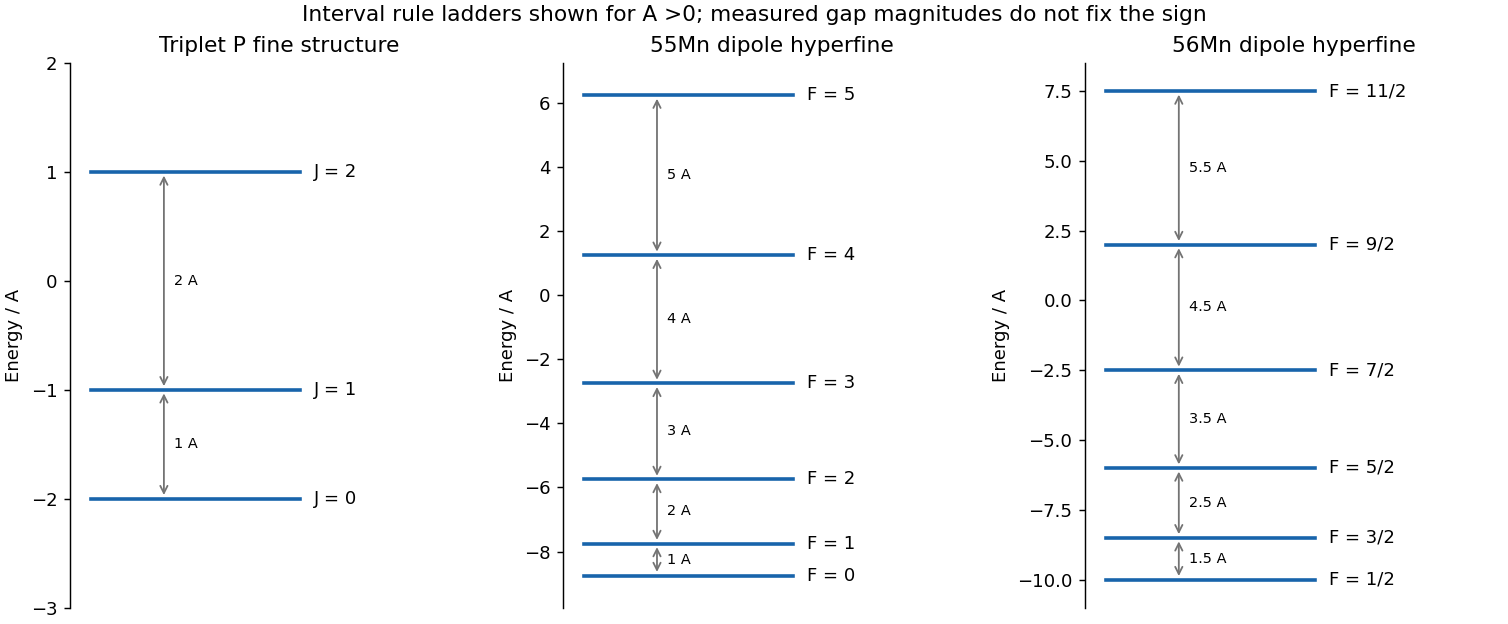
Fine-structure and magnetic-dipole hyperfine interval ladders
. Original angular-momentum eigenvalues for positive coupling coefficients. The fine-structure gaps are A and2A; the two hyperfine examples have different lowest total angular momenta. Measured positive gaps alone do not fix the coupling signs. Details.
Within a fixed isolated electronic multiplet, the electronic field at the nucleus is a vector operator. Rotational symmetry and the Wigner-Eckart theorem imply that its projection into this multiplet is proportional to :Its detailed orbital, spin-dipolar and contact contributions are included in the reduced coefficient . Consequently the projected magnetic-dipole hyperfine interaction becomesin the same dimensionless angular-momentum convention as a. The proportionality is a statement about matrix elements within the chosen electronic manifold, not an identity for the electron field operator on the entire atomic Hilbert space.
Define . In zero external field the quantum states obtained by addition of angular momentum are labelled , where specifies the electron configuration and other fixed labels. The good quantum numbers include , with and . In a description using LS coupling the fixed electronic labels can also include . The energies depend on but not :This neglects coupling to other electronic manifolds, electric-quadrupole hyperfine interactions and the Zeeman effect from external fields. Those additions can shift the intervals or change which quantum numbers remain useful.
For a hyperfine multiplet governed by the magnetic-dipole hyperfine interaction, adjacent frequency gaps obey . The five measured gaps for the first isotope are approximately in the ratios . Therefore the six levels have : the first measured gap corresponds to higher . In particular and , givingThis inference uses both the number of intervals and their successive ratios. Merely seeing six levels would specify only and would not by itself establish equality.
Solving a linear least-squares problem for a fit through the origin, taking the rounded frequencies as equally weighted, givesThus the scale of the hyperfine structure is about J, or eV. The displayed frequencies have unequal rounding precision, so additional fit digits are not physically warranted. The gap pattern supports a leading dipole interval rule, with small residuals that do not establish higher-multipole constants without uncertainties.
The total width between and is , about GHz in frequency units. The sign of , the absolute nuclear g-factor and the electronic field coefficient cannot be separated from these gap magnitudes alone. Measuring the level ordering or using another known magnetic property would supply additional information. The figure in b shows the positive- ordering as an illustration.
For the second isotope, consecutive gap differences are approximately MHz, but the smallest gap is about times this value. The higher- values for the five gaps are therefore . The six levels run from to . The electronic state is unchanged, so as in d; the endpoints giveFor example, fitting to with the same equal-weight convention gives MHz. The nearly constant gap differences are compatible with the same leading model of the magnetic-dipole hyperfine interaction and the printed rounding.
Within an unchanged electronic state, and neglecting isotope-dependent changes of the electronic wave function and hyperfine anomaly, . Thusor the reciprocal magnitude is about . This is a ratio of nuclear g-factors, not directly a ratio of nuclear magnetic moments: , so the moment-magnitude ratio would additionally contain and is about .
The positive transition frequencies do not fix either coupling sign. If a signed ratio is required, equal signs must be supplied as an additional assumption or determined by an ordering-sensitive measurement. No absolute nuclear g-factor is inferred without a calibrated electronic field coefficient. The second ladder in b illustrates the inferred half-integer sequence without turning that sign ambiguity into a falsely measured ordering.
Articles by others on the same topic
There are currently no matching articles.