A direct band gap has its conduction minimum and valence maximum at the same crystal momentum. A photon can then connect the band-edge states with negligible momentum change. An indirect band gap requires an additional phonon to supply or remove momentum, making radiative recombination much less probable. Direct-gap materials such as gallium arsenide or gallium nitride are therefore usually better for a light-emitting diode than silicon.
For the graded junction, let , , and use electrostatic potential with . Fully ionized dopants have charge density , so Poisson's equation is . The paper's displayed plus sign corresponds to using the negative potential , or a signed electron charge in that formula. The positive barrier magnitude and charge magnitude must be used consistently in the width below.
The intended compensation point is , where and the net doping changes sign. A locally neutral model with comparable electron and hole mobilities has its lowest carrier conductivity near there. The depletion approximation neglects mobile-carrier conductivity throughout the layer, so it does not by itself locate an exact conductivity minimum; unequal mobilities or asymmetric carrier profiles can shift it.
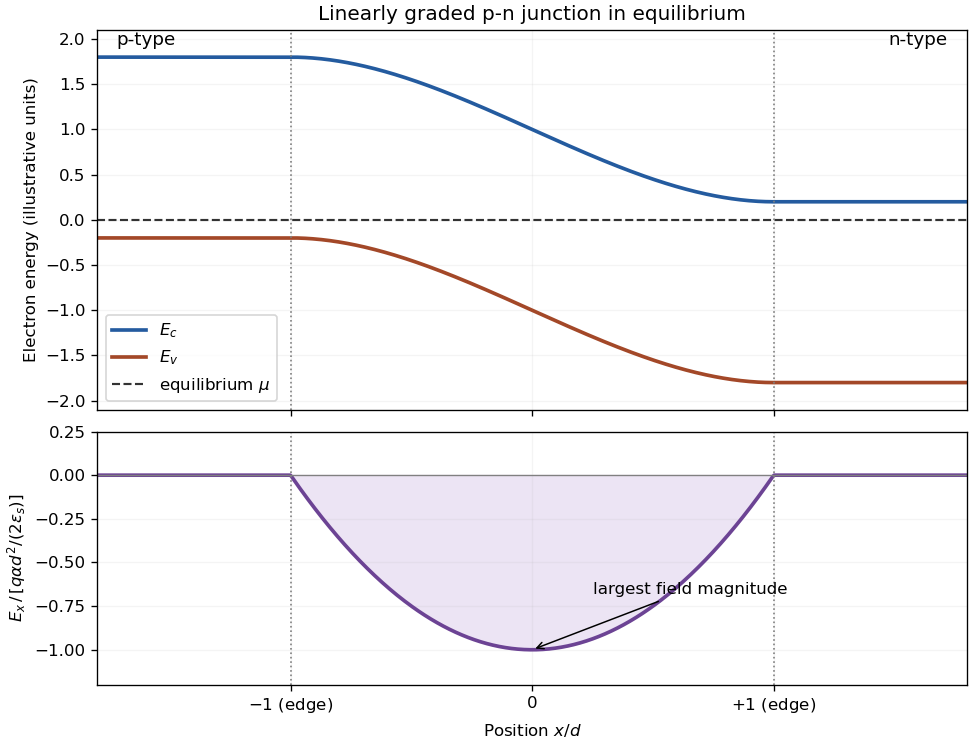
Let the depletion edges be . With zero exterior field, integrating and imposing gives the linearly graded p-n junction fieldIts integral gives , so the electric potential increases toward the n-type side while the electron band edges bend downward together. Their separation is the local band gap, and the equilibrium electrochemical potential is flat. The built-in potential arises when carrier diffusion exposes ionized dopants until the opposing field balances further diffusion.

Articles by others on the same topic
There are currently no matching articles.