The mobile electrons in a metal screen an incident optical field. In the weak-damping Drude model, . Below the screened plasma frequency, the real dielectric response is negative, the wave is evanescent inside the metal, and a clean surface is highly reflective. Above the plasma edge, the response can become positive and propagating waves are allowed, explaining the qualitative transmission window at sufficiently high, often ultraviolet, frequencies.
This is a free-carrier argument, not a statement that every metal is transparent throughout the ultraviolet. Interband absorption, damping and sample thickness can still produce strong absorption above the plasma edge.
The hydrogenic donor state radius is the Bohr radius rescaled by screening and effective mass:The donor-state overlap estimate compares the mean spacing to this radius. Taking the spacing as gives . Taking it as the orbital diameter gives a factor eight less, . Thus a geometric estimate is roughly –, with its contact convention stated. The exponential tails do not have a sharp overlap boundary, and this estimate should not be identified with a precise metal-insulator transition threshold.
Let the missing electron occupy the Bloch state of crystal momentum and energy . Relative to the filled band, define modulo a reciprocal-lattice vector and , with a fixed reference . ThenThe velocity equality follows by differentiating the hole energy with respect to ; two minus signs cancel. The signed band effective mass is therefore opposite, becoming a positive hole mass near an electron-band maximum. The hole electric charge is when the electron charge is . These momenta are crystal momenta, and the electron mass being compared is the signed band mass, not the bare electron mass. The positive hole current equals the current lost by removing that electron.
Angle-resolved photoemission spectroscopy maps occupied energy bands: ultraviolet or x-ray photons eject electrons, and an energy- and angle-resolving analyzer measures and emission direction. The photoelectric effect gives the binding energy ; the parallel momentum follows from , up to surface reciprocal vectors. Clean surfaces and controlled photon energy are needed, and an occupied-state measurement alone does not map an empty conduction band.
Scanning tunneling spectroscopy instead brings a conducting tip close to a surface and modulates the bias while recording the differential tunnel current. At low temperature with a smooth tip density of states and tunnelling matrix element, probes the local density of states near energy . The signal is thermally broadened and depends on tunnelling selection, so it is not an unqualified map of the whole bulk band structure.
Bulk probes complement these surface measurements. In the de Haas-van Alphen effect, a low-temperature magnetization or torque measurement versus magnetic field gives quantum-oscillation frequencies , measuring extremal Fermi surface sections; temperature damping gives a cyclotron effective mass. The linear electronic heat capacity gives the density of low-energy excitations at the Fermi level. Optical absorption measures transition thresholds and matrix-element-weighted joint densities, rather than a unique full dispersion by itself.
In a heavy fermion material, interactions of narrow, often -derived states with conduction electrons produce low-energy quasiparticles with very large thermodynamic effective mass. A coherent Kondo lattice can form a narrow low-energy band, so the large mass is an interaction-renormalized response rather than a larger bare electron mass.
Two concrete experimental signatures are an enormous linear electronic heat capacity coefficient and a strongly enhanced quadratic low-temperature electrical resistivity. Calorimetry separates by plotting against ; the intercept measures the electronic coefficient rather than a lattice contribution. Four-terminal transport tests the Fermi liquid law . The low-temperature calorimetry and resistivity of CeAl3 found and below , making both signatures quantitative.[ref]
4f-Virtual-Bound-State Formation in CeAl3 at Low Temperatures by Klaus Andres and others. Abstract: specific heat and electrical resistivity below 0.2 K, with gamma and the quadratic resistivity coefficient
An enhanced nearly temperature-independent spin susceptibility and a large quantum-oscillation cyclotron effective mass provide additional tests. Not every heavy-fermion compound has the same ordered ground state; magnetism or superconductivity can intervene before a simple normal Fermi-liquid limit is reached.
A partly filled one-dimensional energy band is especially sensitive to a lattice modulation at . At half filling, , so the Peierls distortion alternates the bond lengths and doubles the primitive unit cell. Mixing states at the Fermi points opens a band gap, lowering the energy of occupied states. In the ideal weak-coupling, zero-temperature chain, the electronic gain behaves as while the elastic cost is proportional to , favouring a small distortion. The dimerized tight-binding chain gives an explicit band calculation.
The structural signature is extra diffraction intensity at the modulation wavevector; optical absorption can detect the gap and transport can detect loss of metallic conduction. A dynamic precursor is a Kohn anomaly, with phonon softening near . Inelastic neutron scattering of TTF-TCNQ, using a deuterated sample over –, found an anomaly near developing below about as the transition was approached. This probes a lattice mode coupled to the electronic instability rather than inferring distortion from resistance alone.[ref]
Away from half filling, the modulation need not simply double the lattice. Finite-temperature ordering in real quasi-one-dimensional solids also involves interchain coupling and fluctuations; the ideal isolated-chain argument alone does not establish a finite-temperature transition.
The nearly-free electron model treats a weak periodic potential as a perturbation of plane waves. Near a Bragg plane, states with wavevectors and are nearly degenerate and must be mixed together. Their two-state Hamiltonian isAt the unperturbed crossing, the band gap is . The corresponding standing waves place different charge densities near the ions and between them, giving different potential energies. Far from a crossing, ordinary perturbation theory is adequate; near it, the degenerate two-wave calculation is essential. In three dimensions, gaps at individual zone boundaries do not guarantee a global insulating gap because bands from different directions can overlap.
A direct band gap has its conduction minimum and valence maximum at the same crystal momentum. A photon can then connect the band-edge states with negligible momentum change. An indirect band gap requires an additional phonon to supply or remove momentum, making radiative recombination much less probable. Direct-gap materials such as gallium arsenide or gallium nitride are therefore usually better for a light-emitting diode than silicon.
For the graded junction, let , , and use electrostatic potential with . Fully ionized dopants have charge density , so Poisson's equation is . The paper's displayed plus sign corresponds to using the negative potential , or a signed electron charge in that formula. The positive barrier magnitude and charge magnitude must be used consistently in the width below.
The intended compensation point is , where and the net doping changes sign. A locally neutral model with comparable electron and hole mobilities has its lowest carrier conductivity near there. The depletion approximation neglects mobile-carrier conductivity throughout the layer, so it does not by itself locate an exact conductivity minimum; unequal mobilities or asymmetric carrier profiles can shift it.
Let the depletion edges be . With zero exterior field, integrating and imposing gives the linearly graded p-n junction fieldIts integral gives , so the electric potential increases toward the n-type side while the electron band edges bend downward together. Their separation is the local band gap, and the equilibrium electrochemical potential is flat. The built-in potential arises when carrier diffusion exposes ionized dopants until the opposing field balances further diffusion.
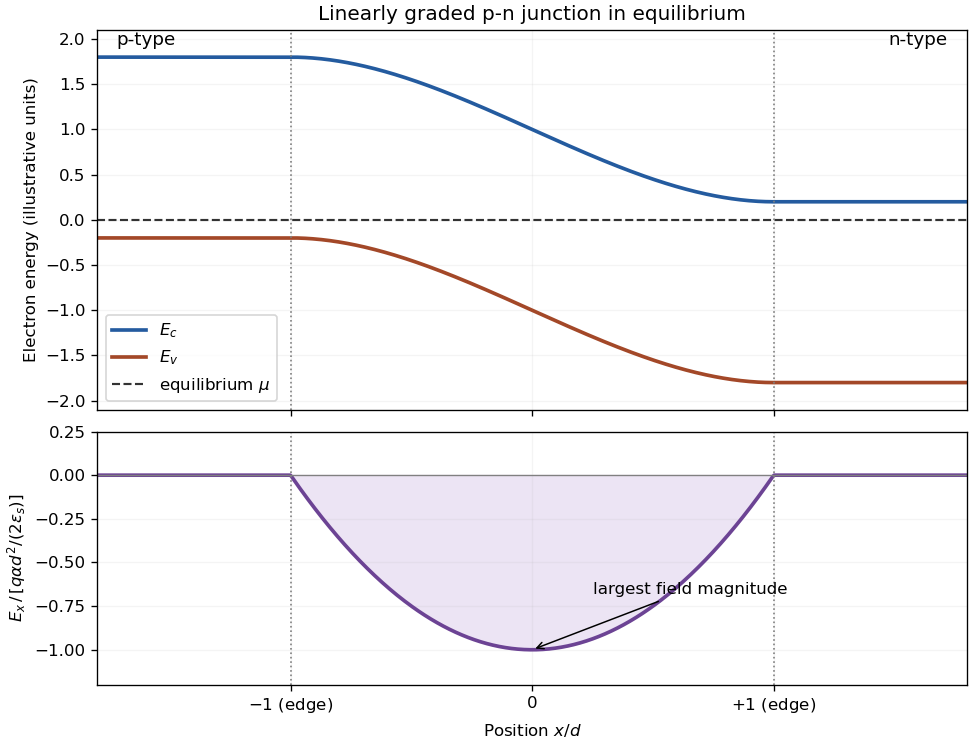
Finally the positive barrier isWith total width , this yields the linearly graded junction depletion widthHere labels p-to-n progression with increasing ; otherwise use its magnitude in the width formula.
Bloch's theorem states that an eigenfunction in a periodic potential can be written , with lattice-periodic. In the orthogonal tight-binding approximation, choose localized orthonormal orbitals with on-site matrix element and real nearest-neighbour hopping integral . The Bloch sum is an eigenstate because each neighbour shift contributes a phase . ThusThe simple-cubic nearest-neighbour tight-binding band has six neighbours, giving . The cosine sum ranges from to , so the positive bandwidth is . The stated hopping formula is negative when , so the printed must be read as a bandwidth magnitude.
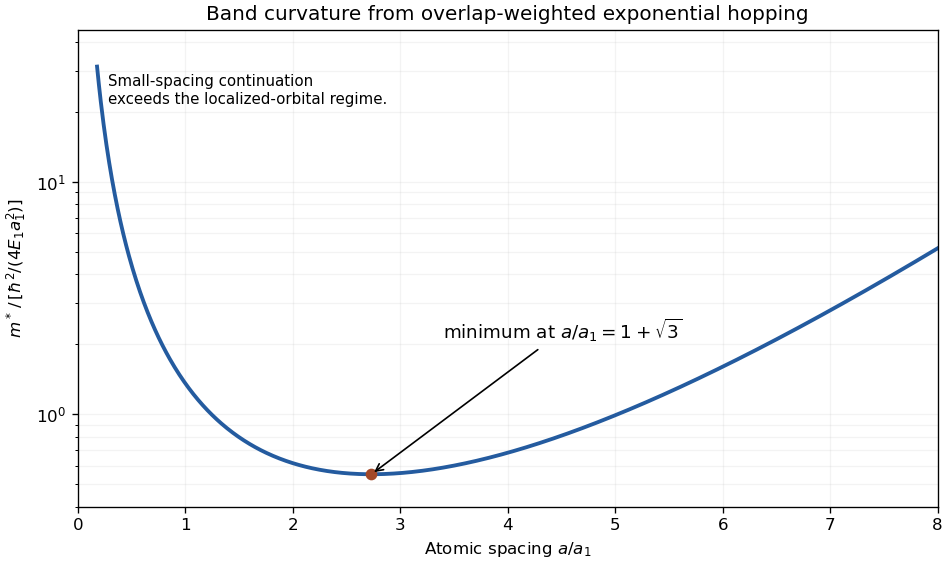
Near the zone centre, . To leading order the constant-energy surfaces are spheres, and comparison with givesThis is the effective mass for overlap-weighted exponential hopping. With , its logarithmic derivative is . The positive stationary point is , and it is a minimum. The formula grows at both very small and very large ; the small-separation divergence is a mathematical extrapolation into a regime where localized tight binding itself becomes unreliable.


Articles by others on the same topic
There are currently no matching articles.