In the nearly-free electron model, the free parabola is coupled to copies shifted by reciprocal wavevectors . The first degeneracy is at , where the counterpropagating waves have equal kinetic energy. Retaining their coupling gives two branchesConsequently a nonzero Fourier component opens a gap at the zone edge. The dispersion remains approximately free-electron-like away from the crossing, but the branches avoid crossing and their slopes flatten at the band edges. The horizontal axis can be labeled either wavevector , with edges at , or physical momentum , with edges at .
At the edge, an appropriate choice of spatial origin makes real. The eigenstates are equal-weight standing waves. In a normalization length containing an integer number of periods, representative real forms areThey come from the sum and difference of and , up to a global phase. Their densities have maxima and nodes displaced by relative to one another. Both wavefunctions change sign under translation by , as required by their zone-edge Bloch phase, while their densities are lattice-periodic.
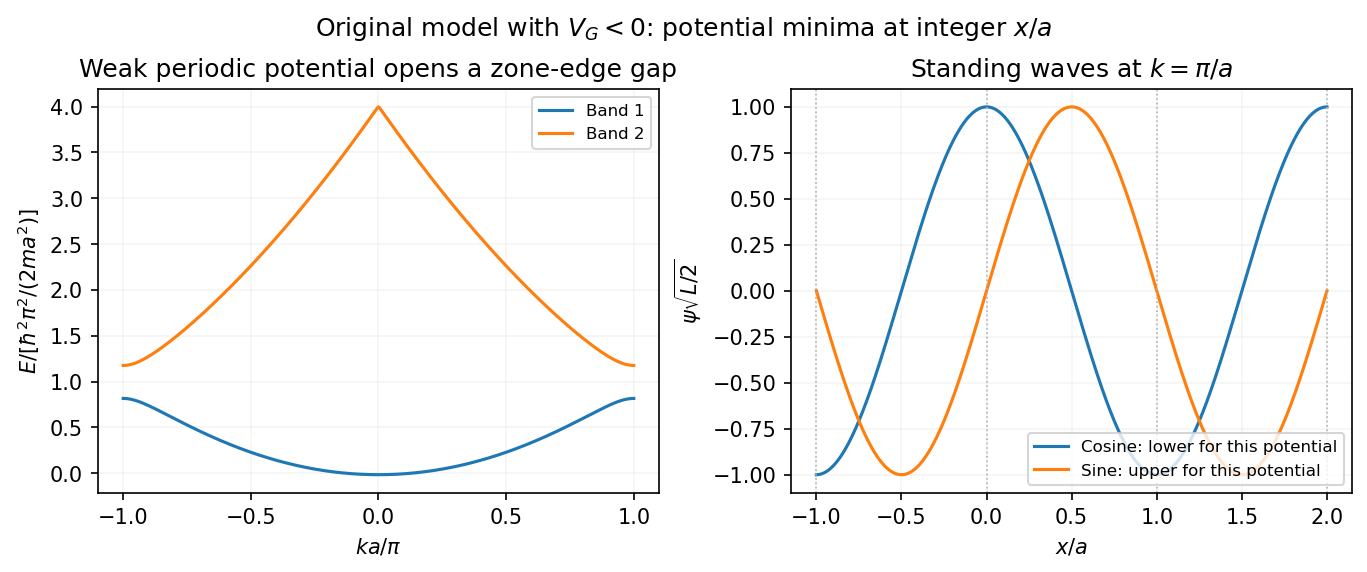

For the figure's choice with , the potential minima occur at . The cosine state puts density there and is lower, while the sine state puts a node there and is higher. Reversing the potential's phase relative to the coordinate origin exchanges that assignment. Since the question supplies only the spatial period, it fixes the zone-edge locations and qualitative standing-wave structure, but not a numerical gap or an origin-independent choice of which drawn sine/cosine is lower.
Articles by others on the same topic
There are currently no matching articles.