Official past-paper archive: www.sp.phy.cam.ac.uk/drp2/home. The direct PDF link has not yet been verified.
Use the convention, so passive photon absorption has positive imaginary permittivity. For a single Lorentz oscillator model resonance, write the photon energy as andHere has units of energy squared, is a damping energy, and is an approximately constant background. The corresponding real and imaginary parts areThus the real part starts above the background, rises on the low-energy side of the resonance, drops rapidly through at , and approaches the background from below at larger energy. The imaginary part starts at zero, has a positive photon absorption peak near , and decays above it. For weak damping its peak is close to the resonance, but not exactly fixed there for arbitrary damping. At asymptotically large energy the corrections scale as and .
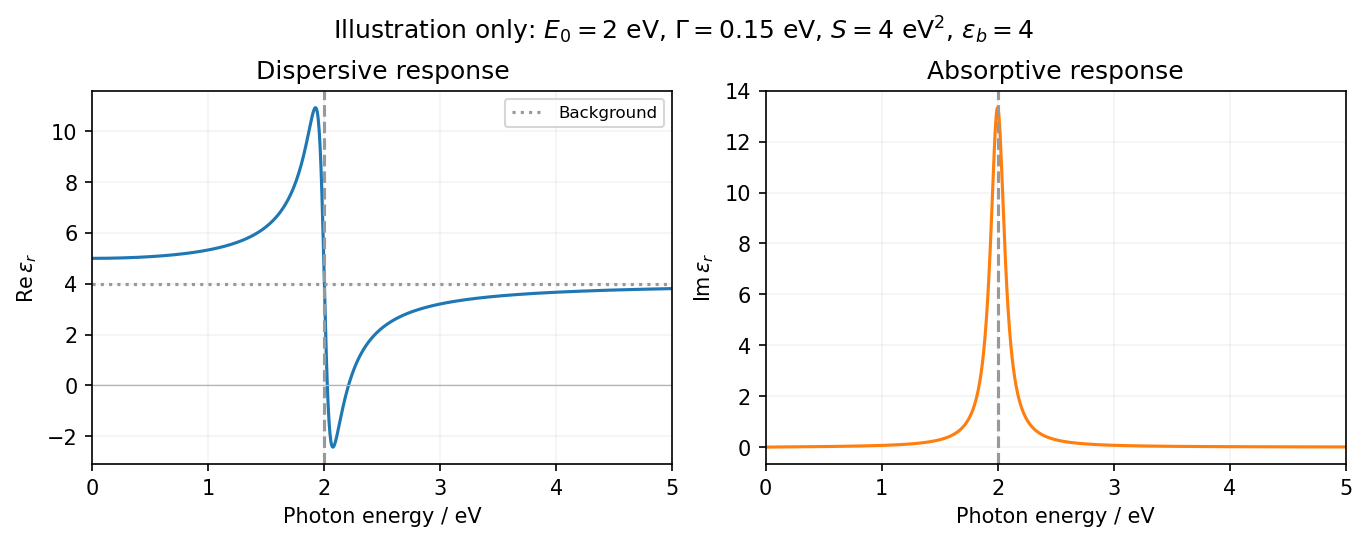
The resonance position is fixed at 2 eV; peak height, width and background are not specified. The figure chooses an explicit finite damping and oscillator strength only to illustrate the shape over 0–5 eV. In particular, a negative real permittivity above resonance is possible for suitable strength and damping, but is not forced by the resonance energy alone. Setting damping exactly to zero would give a singular idealized response instead of a finite-width photon absorption peak.
In the nearly-free electron model, the free parabola is coupled to copies shifted by reciprocal wavevectors . The first degeneracy is at , where the counterpropagating waves have equal kinetic energy. Retaining their coupling gives two branchesConsequently a nonzero Fourier component opens a gap at the zone edge. The dispersion remains approximately free-electron-like away from the crossing, but the branches avoid crossing and their slopes flatten at the band edges. The horizontal axis can be labeled either wavevector , with edges at , or physical momentum , with edges at .
At the edge, an appropriate choice of spatial origin makes real. The eigenstates are equal-weight standing waves. In a normalization length containing an integer number of periods, representative real forms areThey come from the sum and difference of and , up to a global phase. Their densities have maxima and nodes displaced by relative to one another. Both wavefunctions change sign under translation by , as required by their zone-edge Bloch phase, while their densities are lattice-periodic.
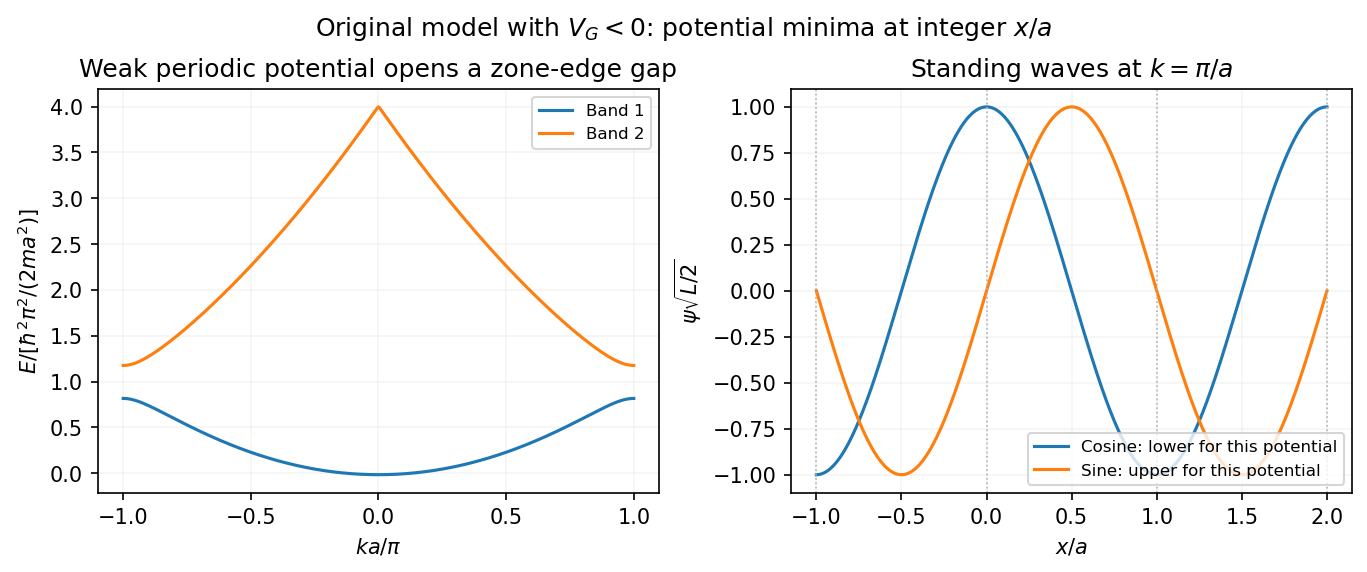
For the figure's choice with , the potential minima occur at . The cosine state puts density there and is lower, while the sine state puts a node there and is higher. Reversing the potential's phase relative to the coordinate origin exchanges that assignment. Since the question supplies only the spatial period, it fixes the zone-edge locations and qualitative standing-wave structure, but not a numerical gap or an origin-independent choice of which drawn sine/cosine is lower.
For one isotropic carrier species in the Drude model, the longitudinal electrical resistivity at zero transverse electric current is , and the Hall electrical resistivity has magnitude . Equivalently, the electric field balances the magnetic deflection through , while . Therefore the magnitude of the Hall angle obeysThe required ratio givesThe electron density cancels. With electric current along and field along , Electrons have negative Hall coefficient and hence ; the requested one-percent condition concerns the magnitude. This calculation assumes Electrons dominate transport and the transverse contacts draw no electric current, so a Hall field can develop.
A solid stores thermal energy in lattice vibrations and, when available, electronic and other excitations. For a nonmagnetic insulating crystal at sufficiently low temperature, the gap suppresses mobile electronic excitations and the leading bulk contribution normally comes from acoustic phonons. The three-dimensional Debye heat capacity isThe vibrational density of states scales as , so only a fraction proportional to of the modes is thermally active at low temperature. The two limiting forms areThe high-temperature value is the Dulong-Petit law, or per mole of atoms. Optical phonons add thermally activated contributions as their characteristic energies become accessible. A multiatom cell has more branches, but still three vibrational degrees of freedom per atom.
A normal metal has an additional low-temperature electronic heat capacity. The Pauli exclusion principle restricts excitations to a shell of width about around the Fermi energy. The number of thermally active Electrons is therefore proportional to , rather than the total Electron number contributing a classical heat capacity. With spin-summed electronic density of states for the whole specimen,For a three-dimensional free-electron gas, and . Only a small fraction of the classical electronic value is accessible when , even though the electronic term dominates the phonon term as in a normal gapless metal.
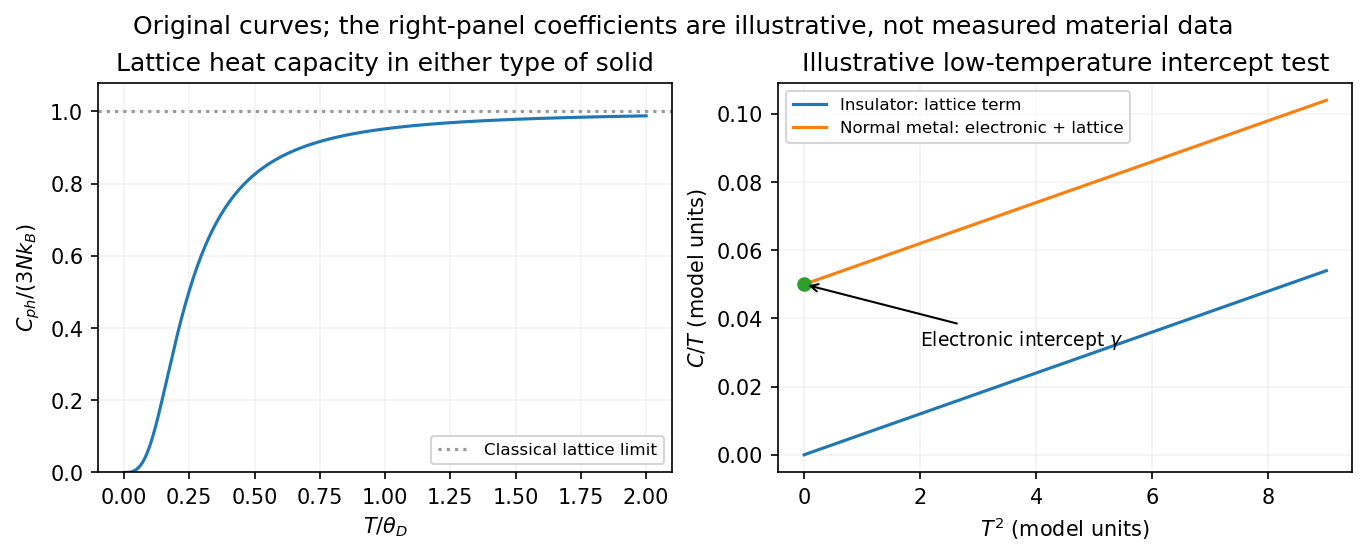
Plotting against gives a straight line with intercept and slope in the appropriate low-temperature range. This separates the electronic density-of-states information from the acoustic-phonon scale. In a Fermi liquid, the interacting quasiparticle density of states replaces the free value, so an enhanced effective mass enhances .
The qualifications matter experimentally. Superconductivity can gap electronic excitations, magnetic order adds magnetic excitations, defects can generate additional low-temperature terms, and low-dimensional or very small specimens need not obey the bulk cubic law. The Debye expression is for constant-volume heat capacity; constant-pressure heat capacity differs through thermal expansion, although the difference is often small at low temperature. Thus the normal-metal and ordinary insulating limits are useful leading behaviors, not universal formulas for every solid in every phase.
A Peierls distortion is a spontaneous lattice modulation that can lower the energy of a one-dimensional metal by opening a gap at its Fermi points. The associated change from metallic to gapped electronic behavior is a Peierls transition. The key wavevector is : it couples states near and , which otherwise have the same energy.
Consider a spin-degenerate chain with one orbital per atom at spacing and one Electron per atom. The band is half filled and . A distortion of period alternates short and long bonds, doubles the primitive cell, and folds the original Fermi points onto the new zone boundary. The distortion can therefore mix the degenerate states precisely where the occupied and empty states meet.
An explicit dimerized tight-binding chain has alternating hopping amplitudes and , where . In the reduced zone ,There are two Electrons per doubled cell, including spin, so the lower band is filled and the upper one empty. Splitting the degenerate states pushes occupied levels downward and empty ones upward, giving an electronic energy gain.
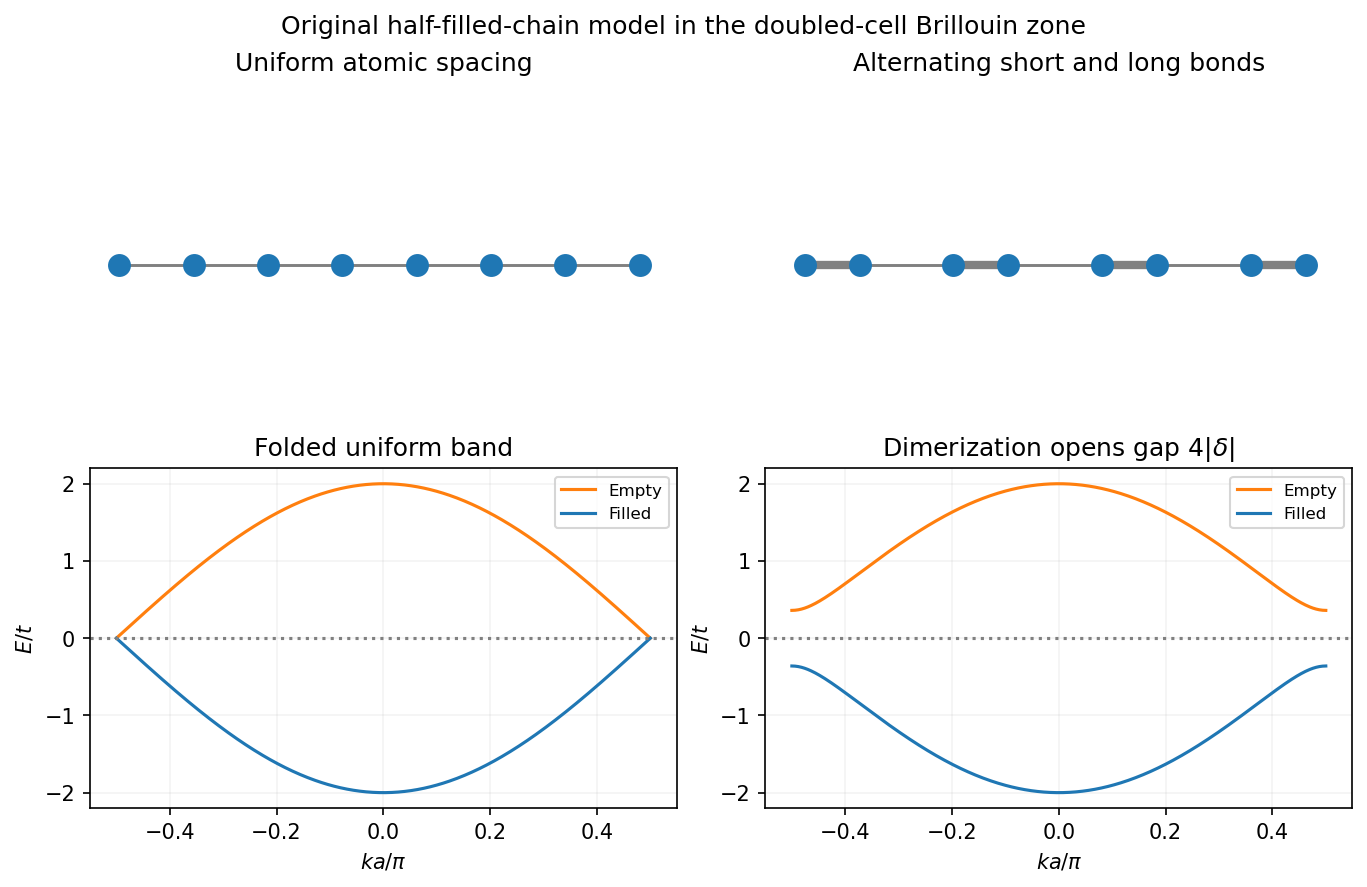
In weak coupling the electronic gain per length has the characteristic form , with . The elastic cost of moving the ions is proportional to . The logarithm makes the undistorted ideal one-dimensional zero-temperature metal unstable to a small distortion even when the electron-lattice coupling is weak. A self-consistent balance selects a finite distortion amplitude. Two opposite dimerization patterns have the same energy for a translation-symmetric isolated chain.
The basic picture links structural modulation to electronic bond order or charge-density modulation, and can open an insulating gap. It does not assert that every real chain has exactly one Electron per atom or period doubling: away from half filling, a modulation at need not be commensurate with two lattice spacings. Temperature, finite chain length and fluctuations cut off the ideal logarithmic response. Interchain coupling and the real lattice dynamics determine whether a macroscopic finite-temperature ordered phase actually forms. The strictly one-dimensional zero-temperature instability alone is not a proof of finite-temperature long-range order.
A normal Fermi liquid describes an interacting fermion system whose low-energy excitations remain continuously connected to adding particles to or removing particles from a Fermi gas. The elementary long-lived excitation is a Landau quasiparticle: adding a particle also changes the surrounding many-body state. Its energy, velocity and interactions are renormalized, even though its electric charge and spin remain those appropriate to the excitation.
Near an isotropic Fermi surface,Residual interactions make the quasiparticle energy depend on the occupations of other quasiparticles, expressed by the Landau quasiparticle energy functional. Its angular components give the Landau parameters controlling density and spin responses. Thus the successful particle picture does not mean that interactions have become zero.
Pauli blocking restricts the final states available for low-energy collisions. In an ordinary three-dimensional Fermi liquid with regular interactions, a representative decay law isAt , the width vanishes faster than , so an excitation becomes increasingly sharp as it approaches the Fermi surface. Its coherent spectral weight is the quasiparticle residue , and the physical Electron occupation has a discontinuity of height at zero temperature. Incoherent spectral weight accounts for the remainder. The quasiparticle occupations themselves obey a Fermi-Dirac distribution.
Several leading thermodynamic signatures retain their gas-like form but have interaction-dependent coefficients. In particular,for an isotropic spin-one-half model, with the spin-summed quasiparticle density of states per volume. effective mass changes , while the dimensionless interaction parameters separately change the spin susceptibility and compressibility. Collisionless collective density motion can propagate as zero sound, distinct from the single-particle excitations.
The quasiparticle scattering rate often underlies a low-temperature contribution to metallic electrical resistivity, but a mechanism relaxing electrical electric current is needed. In a clean Galilean-invariant continuum, electron-electron collisions conserve total momentum and do not alone give a finite dc electrical resistivity. Crystal Umklapp scattering or other current-relaxing processes change that conclusion.
Normal liquid helium-3 and many metals motivate the Fermi-liquid framework. Pairing, magnetic ordering or other transitions can reconstruct the low-energy states. Generic interacting one-dimensional fermion systems instead form a different low-energy state, so the three-dimensional quasiparticle conclusions should not simply be transferred to a chain.
Dopant atoms and carrier type. Substitutional semiconductor doping places a small fraction of foreign atoms on host lattice sites. In a tetrahedrally bonded group-IV semiconductor, a group-V substitution such as phosphorus in silicon has an extra valence Electron. A shallow donor level just below the conduction edge can release that Electron, leaving a positively charged donor. In an n-type semiconductor, mobile Electrons are the majority carriers and the chemical potential shifts toward the conduction band.
A group-III substitution such as boron in silicon has one fewer valence Electron. An acceptor level just above the valence edge captures an Electron from the valence states, leaving a mobile electron hole and a negatively charged acceptor. In a p-type semiconductor, electron holes are the majority carriers and the chemical potential shifts toward the valence band. The material can remain electrically neutral in both cases: mobile carrier electric charge is compensated by fixed ionized impurity electric charge. Dopant freeze-out, compensation and degeneracy qualify the simplest one-carrier-per-dopant picture.
Making the junction. Choose p material at and n material at . Electrons initially diffuse from n to p, and electron holes from p to n, recombining near the interface. Negative ionized acceptors are exposed on the p side and positive ionized donors on the n side. They produce an electric field directed from n to p. The field opposes further majority-carrier diffusion until drift and diffusion balance and the equilibrium electrochemical potential is uniform.
The depletion regions are depleted of mobile majority carriers, not of the fixed dopant charges that create the space charge. At equilibrium the conduction and valence edges bend together, while the chemical potential is flat. The specified is a electric potential difference: the corresponding initial chemical-potential energy separation is . This convention is required by the quoted units and width formulas. Write for the absolute permittivity; the paper's is relative permittivity.
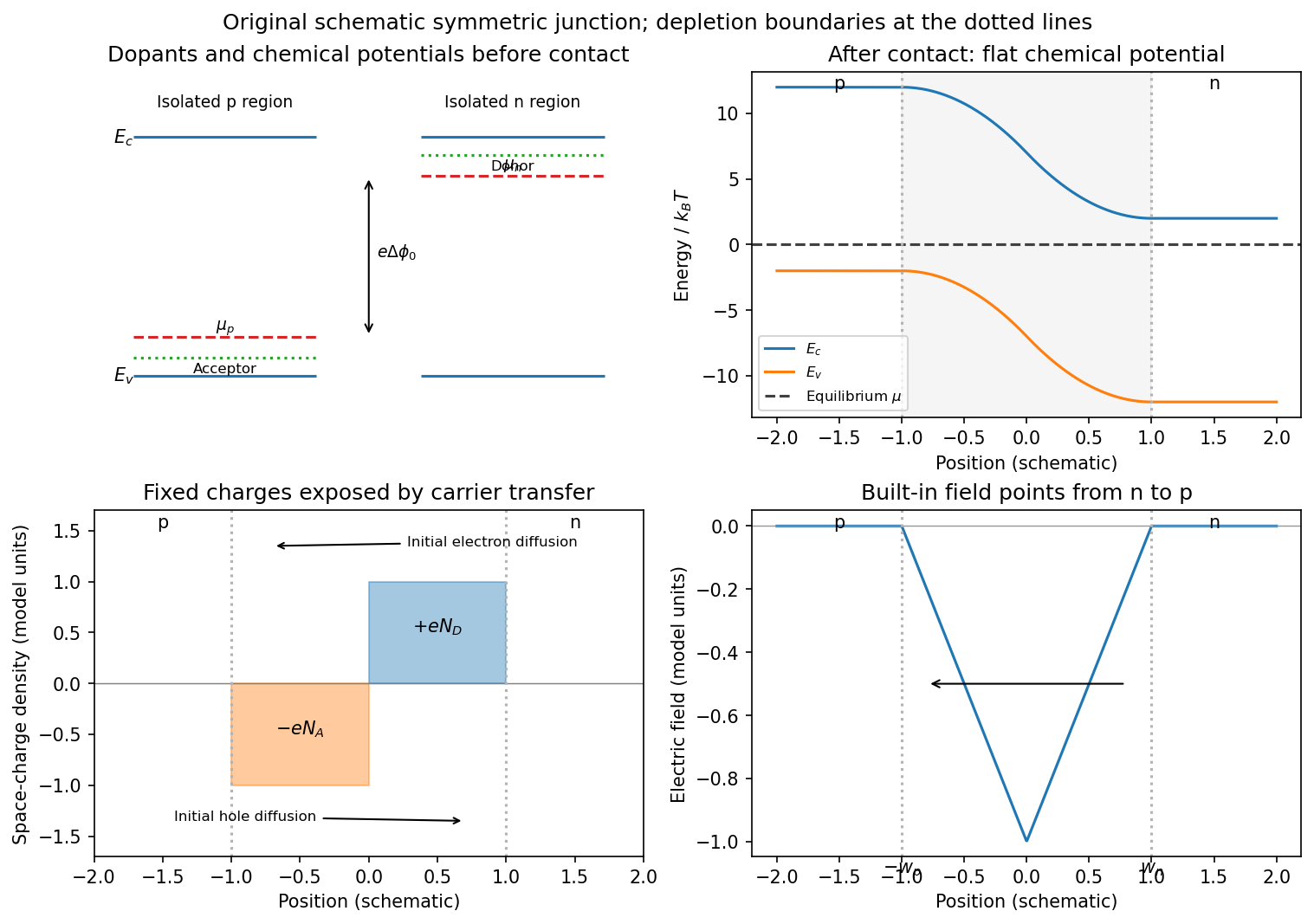
Substitutional donor/acceptor levels, equilibrium band bending, fixed space charge and the junction electric field
. Details. Poisson equation and widths. Let the depleted intervals be and . Fully ionized number densities correspond to electric charge densities , respectively. ThusThe factor converts a dopant concentration to a space-charge density. Requiring zero field in both neutral regions gives charge neutrality,With , direct integration gives the triangular fieldContinuity at the interface is the same neutrality condition. The field is negative throughout the depleted interval. Set . Its integral givesPotential continuity therefore requiresCombining it with neutrality yields the abrupt-junction depletion width and capacitance resultsThe more lightly doped side depletes farther, because equal and opposite space charges must be exposed.
Applied bias. Define positive as forward bias, raising the p-side terminal potential relative to the n-side terminal. It lowers the remaining barrier from to . Reverse bias has and raises that barrier. The same Poisson integration applies, with this replacement:Forward bias narrows the depleted region; reverse bias widens it. Under bias there need not be one equilibrium chemical potential across the device, so the equilibrium flat-level argument must not be reapplied unchanged. The barrier/width change is illustrated in the next figure.
Differential capacitance and electric charge sign. Put and . The signed p-side fixed electric charge per unit area isDifferentiating with respect to forward electric potential difference gives the positive capacitance per unit areaThe n-side electric charge is , so instead. If denotes a positive space-charge magnitude, the positive capacitance is for this forward-voltage convention. This resolves the sign implicit in the paper's positive . The total device capacitance is , where is its cross-sectional area.
Finite device and numerical sketch. For the symmetric device, and each side has thickness . Before full depletion,Using , the zero-bias width on each side is , less than . The total zero-bias capacitance is .
Full depletion occurs when , soAt larger reverse bias the depleted thickness cannot exceed . In the ideal fully depleted slab, incremental terminal electric charge changes the field uniformly through that fixed thickness, giving the full-depletion capacitance of a symmetric junction slabThus the idealized piecewise sketch over the specified range isIt is continuous at full depletion, rises through at zero bias, and has a formal inverse-square-root divergence as from below.
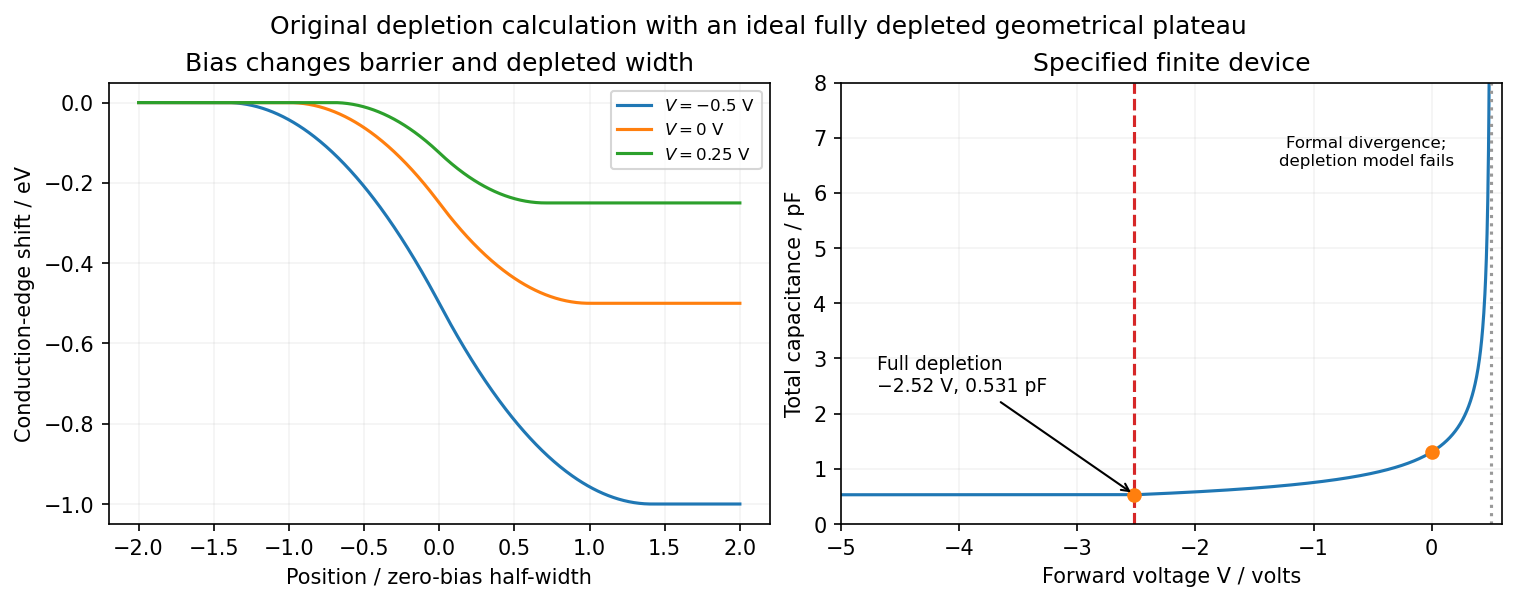


There are two physical limits to this extension. Once all dopants are exposed, their fixed space charge no longer increases, but the terminal electrodes can still acquire incremental electric charge; differentiating only the fixed ionized electric charge would incorrectly predict zero capacitance. Near , the depletion approximation itself fails as mobile carriers and forward injection become important, so the formal infinite endpoint is not a prediction of an actual infinite measured capacitance. The fully depleted plateau assumes ideal contacts and no breakdown, injection storage or extra series capacitance.
Why degenerate perturbation theory is needed. If several unperturbed states have equal or nearly equal energy, a perturbation can mix them at leading order. In that subspace, diagonalize the perturbation matrix rather than using nondegenerate formulas with small energy denominators. The resulting eigenvectors identify the combinations selected by the coupling, and the eigenvalues give the leading splitting. Other remote states can then be included perturbatively.
For the linear combination of atomic orbitals description of molecular hydrogen, equivalent atomic states on the two nuclei supply the nearly degenerate starting functions. In an orthonormal two-state model, equal diagonal energy and real hopping give and symmetric/antisymmetric combinations. For actual overlapping atomic functions with overlap and Hamiltonian coupling , one instead solves a generalized eigenvalue problem:The bonding state has enhanced density between the nuclei and the antibonding state a separating node. Two opposite-spin Electrons occupying the bonding molecular orbital describe the simplest closed-shell hydrogen-molecule bond. Electron-electron interaction and nuclear repulsion are needed to calculate a realistic total binding energy; the two-state splitting alone is not the full molecular energy.
In the nearly-free electron model, the analogous degenerate states are plane waves and at a Bragg scattering. A Fourier coefficient of the periodic potential couples them. At exact degeneracy , diagonalizing their two-by-two matrix givesThe associated standing waves place electronic density differently relative to the ionic potential. These are the same gap-opening combinations illustrated in Q1(b). The labels of the two starting basis states survive as mixed orbital or plane-wave character, rather than independent crossing eigenstates.
Origin of broad and narrow bands. Spatially extended s/p-derived orbitals have substantial overlap and therefore large hopping amplitudes and broad bands. More localized d orbitals overlap less strongly and produce narrower bands. A multiorbital tight-binding calculation assigns the on-site orbital energies and hopping matrices, forms Bloch sums, and diagonalizes the resulting matrix at each wavevector. Different hopping ranges and orbital symmetry determine the bandwidths and allowed interband coupling. The two-band description retains one broad combination and one nearly flat d-derived combination; a real transition metal contains several d orbitals and more complicated dispersions.
Hybridized eigenvalues and eigenstates. Let , in an orthonormal basis. Hermitian operator fixes the reverse coupling to be . Projection onto the two components givesSolving this quadratic yields the band hybridization dispersionFor nonzero , one eigenvector representation is , followed by normalization. Thus the wavefunctions exchange broad-band and d-band character through the avoided crossing; the levels are equal mixtures at the uncoupled crossing.
At , the parabola crosses the horizontal level at , with . For small nonzero , the curves avoid crossing with minimum direct separation . The lower branch follows the parabola below the crossing and flattens toward above it; the upper does the opposite. The lower branch satisfies everywhere and tends to from below as , while the upper branch always lies above . This is the perfectly flat-band continuum approximation, with zone-boundary intersections excluded as requested.
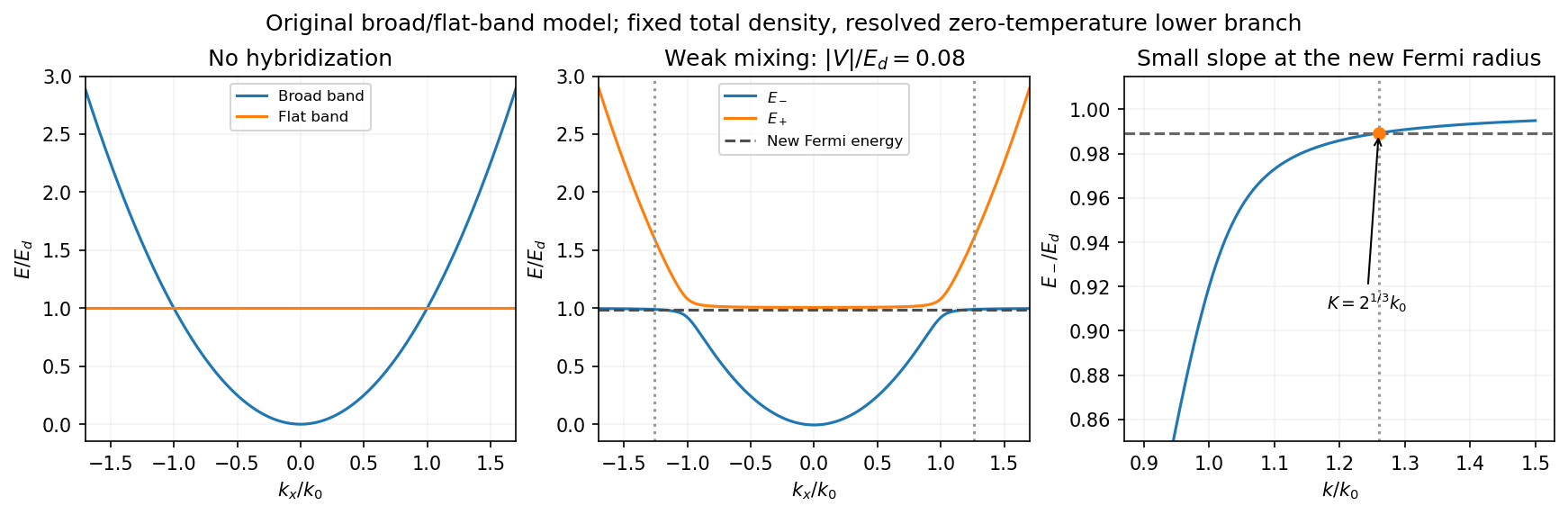
Uncoupled and weakly hybridized broad/flat bands, with the shifted Fermi radius and small lower-band slope
. Details. 
Fixed particle number and the larger Fermi sphere. Denote the uncoupled broad-band Fermi radius by to distinguish it from the new one . With two spin states, the broad-band number density at is . The stipulated equal population in the flat sector makes the total density twice that value. At zero temperature and any nonzero hybridization, all occupied states fit into the monotonic lower branch below , while the upper branch is empty. ThereforeThis is the stated factor increase. It uses fixed total particle number, equal spin counting, an exactly flat unhybridized band and enough available states below any Brillouin-zone restriction. In generic pairs of dispersive bands both hybridized pockets can remain occupied; then Fermi-volume conservation in two hybridized electron bands fixes a sum of volumes rather than this one radius. The exactly flat band is degenerate at , so its initial occupation must be specified, as it is here.
Fermi-velocity suppression. Set . The exact derivative of the lower branch isAt , and . For , the square bracket divided by two is . Since group velocity is and the broad-band reference velocity is ,so the flat-band hybridization Fermi-velocity suppression isThe reference velocity is that of the original broad-band Fermi sphere, not the broad-band slope at the larger ; omitting the radius change loses the factor .
The low-temperature qualification becomes more stringent as : the new chemical potential approaches with , and the relevant thermal energy must be small compared with this hybridization scale. At fixed nonzero temperature the singular flat-band redistribution is not automatically resolved for arbitrarily small coupling. A small but finite narrow-band dispersion can also change the occupation topology.
Density of states and magnetism. For an isotropic three-dimensional branch with spin degeneracy two,A small Fermi velocity therefore produces a large density of states. The localized, partially filled d-derived bands in iron, cobalt and nickel place many states close to the Fermi level; broad s/p-derived conduction bands in copper, silver and gold coexist with filled d bands lying below it. This explains the substantially larger Fermi-level density of states of the former group within the band picture. An exact factor of ten requires the actual band parameters and is not fixed by the two-band toy model.
A high density of states lowers the kinetic-energy cost of spin polarization. A repulsive exchange interaction can then satisfy the Stoner criterion and stabilize ferromagnetism. With a single-spin density of states and an on-site interaction normalization, the criterion is ; with spin-summed , it is . The large d-state contribution favors this instability in Fe, Co and Ni. The noble metals do not satisfy the corresponding instability condition in the same ordinary state; this does not imply that they have no weak magnetic response whatsoever.
Articles by others on the same topic
There are currently no matching articles.