Choose the convention. The steady displacement in the Lorentz oscillator model has complex amplitudeThe induced electric dipole moment is , so the microscopic electric polarizability is . For identical oscillators per unit volume, . ConsequentlyHere the dimensionless quantity called polarizability in the paper is the electric susceptibility; the single-electron polarizability has different units. The sign of the Electron charge disappears because both the driving force and dipole moment contain .
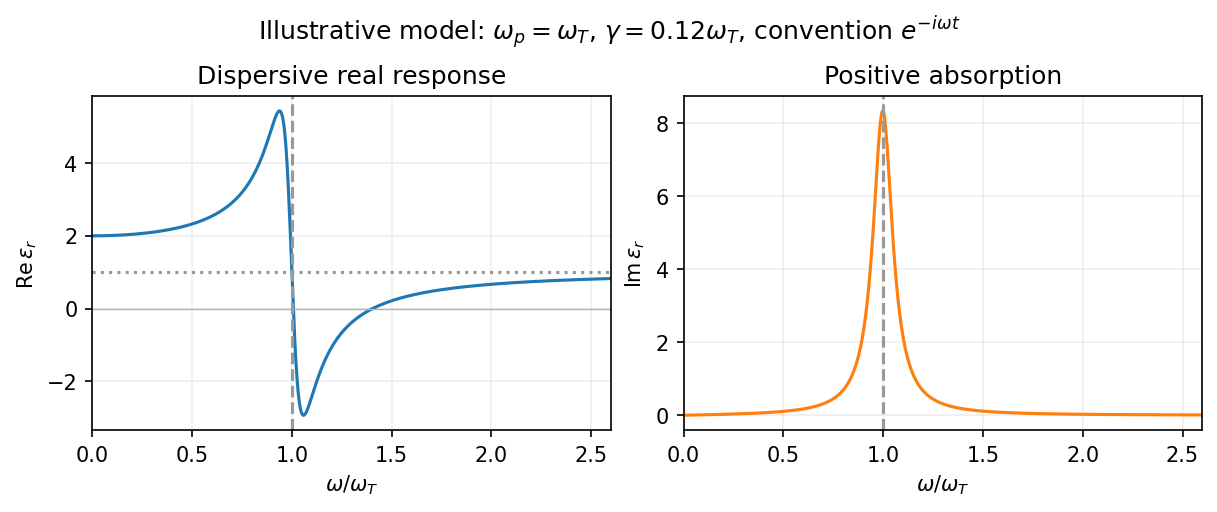
Multiplying by the complex conjugate of the denominator givesFor positive damping and positive frequency, , as required for passive wave absorption in this Fourier convention. At zero frequency, and . Near a weakly damped resonance the imaginary part has a narrow positive peak, while the real part rises on the low-frequency side and then falls steeply through at . It can become negative above resonance for sufficiently strong oscillator strength and weak damping. At large frequency, and : both approach the vacuum values. The absorption maximum is close to, but need not be exactly at, for finite damping.

Articles by others on the same topic
There are currently no matching articles.