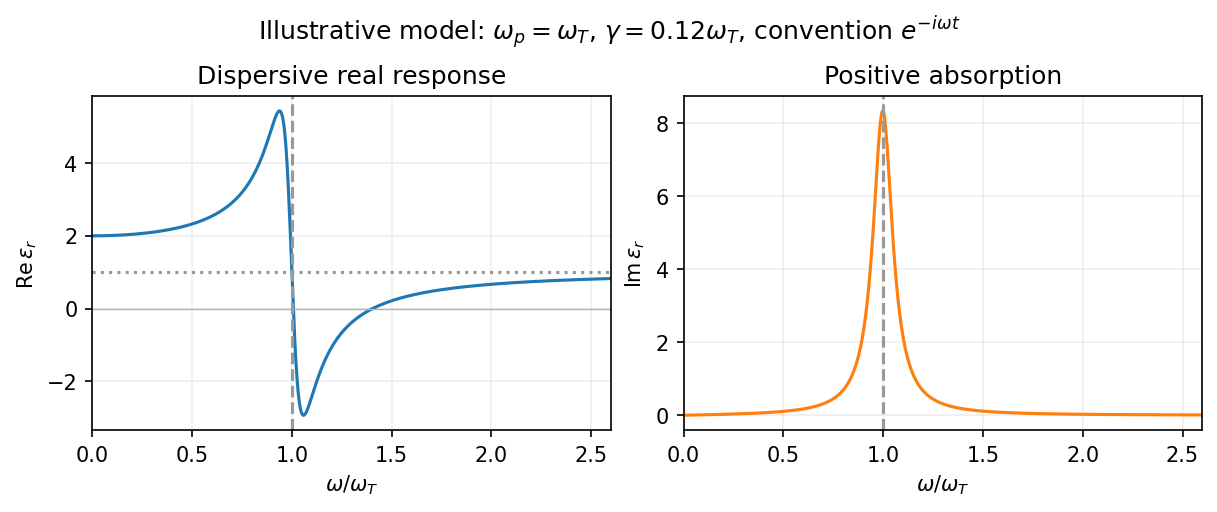
Choose the convention. The steady displacement in the Lorentz oscillator model has complex amplitudeThe induced electric dipole moment is , so the microscopic electric polarizability is . For identical oscillators per unit volume, . ConsequentlyHere the dimensionless quantity called polarizability in the paper is the electric susceptibility; the single-electron polarizability has different units. The sign of the Electron charge disappears because both the driving force and dipole moment contain .
Multiplying by the complex conjugate of the denominator givesFor positive damping and positive frequency, , as required for passive wave absorption in this Fourier convention. At zero frequency, and . Near a weakly damped resonance the imaginary part has a narrow positive peak, while the real part rises on the low-frequency side and then falls steeply through at . It can become negative above resonance for sufficiently strong oscillator strength and weak damping. At large frequency, and : both approach the vacuum values. The absorption maximum is close to, but need not be exactly at, for finite damping.
A self-assembled InAs quantum-dot single-photon source uses small indium arsenide islands inside a larger-gap gallium arsenide host. Strain during epitaxial growth favors islands after a thin wetting layer has formed. Their characteristic diameter is of order – and their height a few nanometres, for example –. Growth conditions determine the areal density: low-density samples suitable for isolating dots can be around –, while ordinary dense layers can be much denser. The particular electrically driven device underlying the supplied image had about . These are characteristic scales, not dimensions deducible from the emission image.[ref]
Quantum confinement in the dot traps both Electrons and electron holes in three directions, giving discrete energy levels. In a junction device, injected carriers relax into these levels. Electron-hole recombination then emits a photon, and the dot must be repopulated before emitting again on that same transition. Spatial selection of one dot, spectral selection of one line, and well-separated injection pulses make this a single-photon source. Photon antibunching, rather than low average brightness alone, establishes suppression of simultaneous photons. In particular, collecting both photons of a cascade without selecting a line would not produce exactly one collected photon per excitation.
The lower-current feature is the transition from one confined exciton to the empty dot. The higher-current feature is the first step of the biexciton cascade : it becomes strong when the dot can contain two electron-hole pairs. In the weak-pumping limit the probabilities of one and two pairs scale approximately as and , respectively. Coulomb and confinement energies shift the two transitions relative to one another; is not a photon of twice the energy. In this particular image the photon is about – higher in energy. With , this is a negative biexciton binding energy, since .
For the mass estimate, the original plot places the line at approximately , with graph-reading precision of order . Under the prescribed identification of photon energy with the full lowest exciton excitation energy,The three-dimensional screened Wannier-Mott exciton has the hydrogenic exciton binding energyThereforeReading the line as instead gives ; about – is an appropriate precision. This inference uses the supplied pair-creation energy and a three-dimensional screened hydrogenic model. In a real dot, strain and confinement also alter transition energies, so it is an effective model estimate and does not independently determine either individual carrier mass.
Specify the spin counting first. Let denote the unpolarized single-spin density of states per atom per energy, and put . At fixed total occupation , the two Hubbard model mean-field energies can be writtenThe common shift can be absorbed into the chemical potential. Lowering the up-spin band by adds carriers, while raising the down-spin band removes the same number. ThusIf is the atom number density, the magnetization is . The Stoner-enhanced magnetic susceptibility in SI volume units is thereforeHere is the noninteracting Pauli paramagnetism result. If the paper's counts both spins, and the same result isA susceptibility per atom omits . Stating the spin and volume conventions avoids an otherwise spurious factor of two or a dimensional mismatch.
The Stoner criterion is , equivalently with spin-summed . To see the instability, transfer Electrons per atom from one spin band to the other. The band-filling cost is , whereas the interaction energy changes by . Their sum becomes negative at the threshold. The unpolarized state then ceases to be a local minimum, and nonlinear band filling determines the spontaneous ferromagnetism. The negative continuation of the displayed linear susceptibility beyond the threshold is not a stable paramagnetic response.
Dielectric screening is the rearrangement of a medium's charges in response to an applied charge. In a metal, mobile Electrons accumulate near a positive perturbation and reduce its long-range potential. Thomas-Fermi screening treats the electron gas locally as an equilibrium gas whose density responds to the local electrostatic potential, ignoring gradients of the density on the microscopic wavelength scale.
Take , background permittivity , and electrostatic potential . An Electron's potential energy is , so the local kinetic Fermi energy becomes . For a three-dimensional spin-degenerate parabolic band at zero temperature,where is the spin-summed density of states per volume per energy. The induced charge is . Combining it with Poisson equation givesFor a point external charge , spherical symmetry and decay at infinity selectThus the bare potential is cut off exponentially. Fourier transformation makes the same result transparent: , so the static longitudinal dielectric factor is relative to the background. For a free Electron band, and .
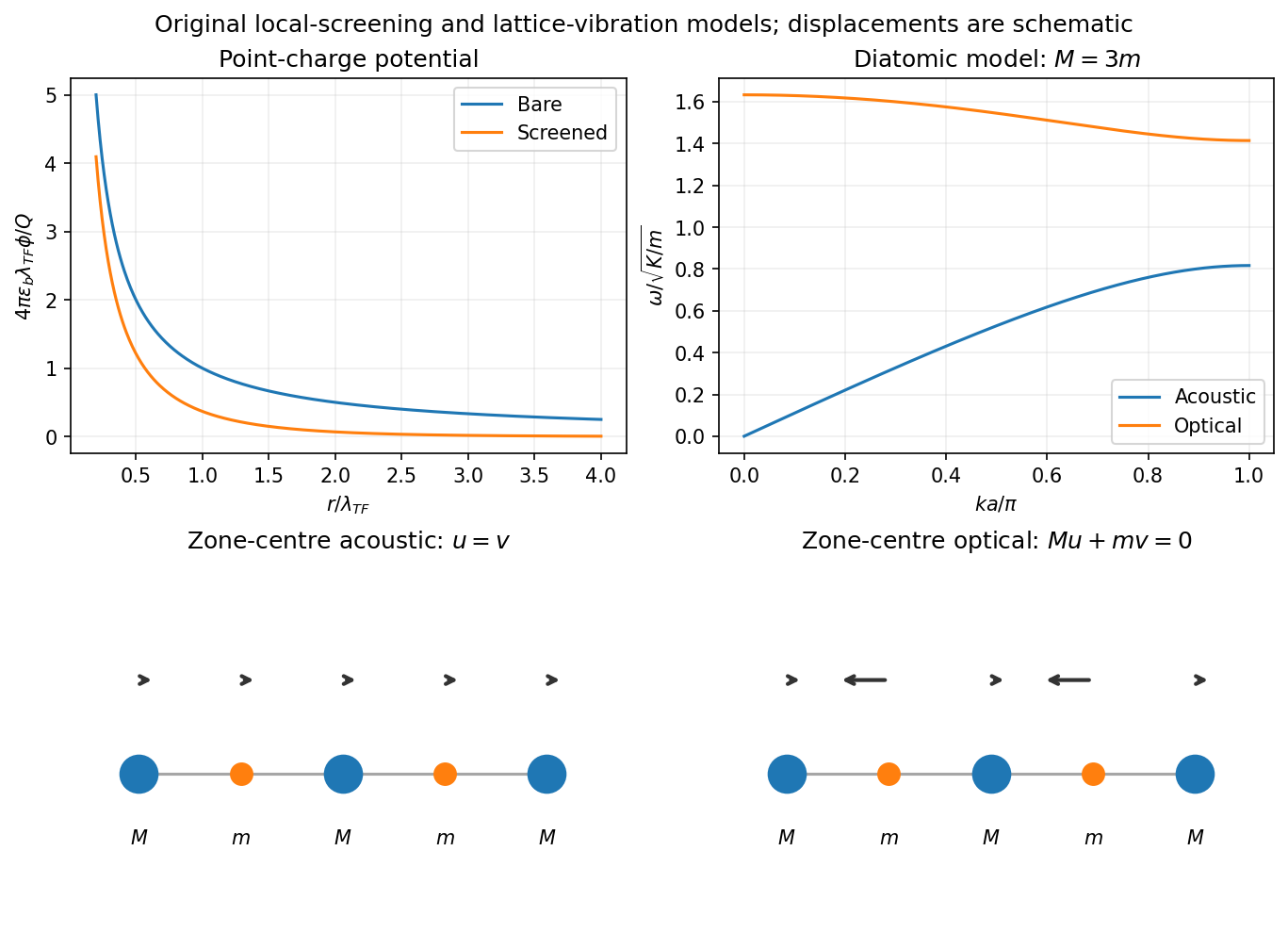
Local Thomas-Fermi screening and optical/acoustic modes of an illustrative diatomic chain
. Details. The local linear approximation requires a weak perturbation and slowly varying fields on the relevant microscopic scale. It omits nonlocal Friedel oscillations and atom-scale structure; a nonlinear local-density treatment is needed near a sufficiently strong charge. Finite temperature replaces by the appropriate compressibility derivative . The nondegenerate limit gives classical screening rather than the degenerate Thomas-Fermi length. A larger density of states means that a smaller potential can move more carriers, hence stronger screening.
A primitive cell containing two atoms has two independent displacement coordinates for each chosen polarization. Their coupled normal modes split into an acoustic phonon branch, which translates the cell at long wavelength, and an optical phonon branch, which moves its constituents against one another. The nonzero restoring force for the relative displacement gives a nonzero optical frequency even at the zone centre.
For an explicit scalar model, take alternating masses , equal nearest-neighbor spring constant , and cell length . If are the displacements of the two atoms in cell , Newton's second law givesA mode proportional to has a nonzero amplitude only when the two-by-two dynamical determinant vanishes. The resulting diatomic-chain dispersion relation with equal springs, in this cell-length convention, isThe minus branch is acoustic, with and a linear small- dispersion. The plus branch is optical, withAt , the acoustic eigenvector has . The optical eigenvector instead satisfies : its cell centre of mass stays fixed while the atoms move oppositely. At the zone edge, for , the frequencies are and , giving a gap between branches. Both slopes vanish there. The dispersion and displacement patterns are shown in the preceding original figure.
If the two atoms carry opposite effective charges, the relative motion creates an oscillating electric dipole moment, enabling infrared absorption by long-wavelength light. The photon momentum is tiny compared with the zone size, so ordinary optical absorption principally excites modes close to . Raman activity instead depends on modulation of polarizability; the name optical does not imply that every such mode is infrared active. Three-dimensional crystals have separate longitudinal and transverse polarizations, and long-range Coulomb forces can split their optical frequencies. A monatomic primitive cell has no internal relative coordinate and therefore no optical branch of this type.
A normal Fermi liquid has interacting fermions whose low-energy excitations can be followed continuously from those of a Fermi gas, provided no phase transition destroys that correspondence. A Landau quasiparticle is a particle together with the surrounding many-body response. It has the appropriate charge and spin, a renormalized dispersion and a long lifetime close to the Fermi surface. Interactions remain in both the quasiparticle parameters and the interactions between quasiparticles; they have not been discarded.
Near an isotropic Fermi surface,The last relation defines the local isotropic Fermi-liquid effective mass. The Landau quasiparticle energy functional expresses how changing occupations shifts other quasiparticle energies:with normalization of the sum absorbed into . Its angular components give Landau parameters describing collective density and spin response.
The Pauli exclusion principle severely restricts the available final states for low-energy collisions. In an ordinary three-dimensional Fermi liquid with regular interactions,At zero temperature the decay width decreases faster than , making quasiparticles increasingly sharp near the Fermi surface. Their coherent spectral weight is the quasiparticle residue , and the true Electron momentum distribution has a discontinuity of height at zero temperature. The rest of the spectral weight is incoherent. The quasiparticle occupation itself still follows a Fermi-Dirac distribution.
The low-temperature electronic heat capacity is linear, , where is the spin-summed quasiparticle density of states. In an isotropic spin-one-half model, the uniform spin susceptibility and compressibility take the formsThus enhanced effective mass and residual interactions can separately change observable responses. The familiar electrical resistivity requires a mechanism relaxing electrical current, such as allowed Umklapp processes; collisions in a perfectly clean Galilean-invariant continuum conserve total momentum and do not alone produce a finite dc resistivity.
Zero sound is a collisionless collective density oscillation sustained by the quasiparticle interaction; ordinary first sound occurs when collisions establish local equilibrium during a cycle. Metals and normal liquid helium-3 supply important examples. The description fails in phases with no sufficiently sharp low-energy quasiparticles, such as generic interacting one-dimensional systems, and must be modified after pairing or another ordering transition.
Band edges and optical transitions. A direct band gap has the conduction minimum and valence maximum at the same crystal momentum. A near-edge photon then connects the two almost vertically on an energy-versus-wavevector plot, because its momentum is small on the Brillouin zone scale. An indirect band gap has the extrema at different momenta, so an additional momentum transfer, commonly supplied by phonon absorption or emission, is required for a near-edge radiative transition. This reduces its probability relative to an allowed direct transition.
Near the zone centre, an isotropic direct-gap model has and downward valence dispersions . The heavy-hole and light-hole bands are the upper branches with large and small positive hole masses: the heavy branch is flatter. In common cubic semiconductors these arise from the manifold, while spin-orbit coupling places the split-off valence band lower by . Its thermally generated hole population is suppressed by approximately relative to upper-valence holes, apart from density-of-states factors. Neglect is justified when ; it is not a universal exclusion of this band at arbitrary temperature.
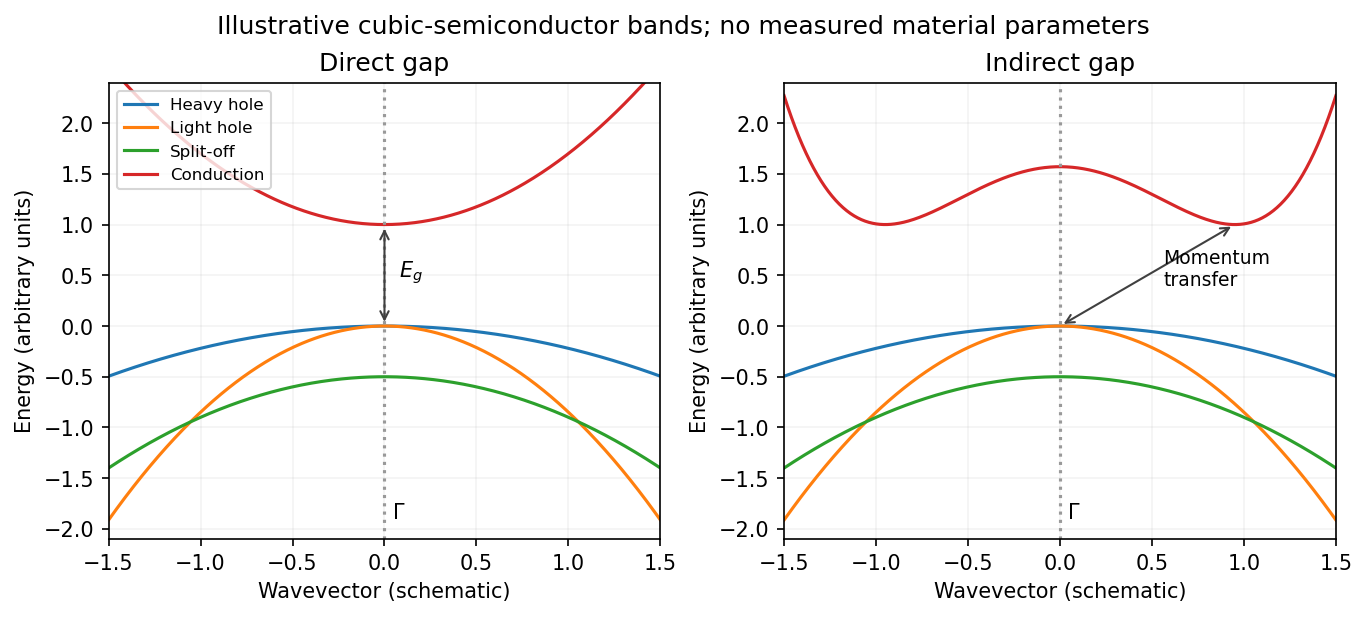
Original schematic direct and indirect band edges, including heavy, light and split-off hole branches
. Details. For an indirect material such as Si, the conduction minimum need not be at . In applying the carrier-density formulae, must mean the actual minimum of the included conduction valley. The supplied scalar effective masses and densities of states constitute a simplified band-edge model; they do not specify Si's full valley anisotropy or multiplicity.
Carrier populations. Let be the Fermi-Dirac distribution. In the nondegenerate conduction tail, . Set and integrate the given density of states:The integral is . Defining the effective density of states givesThe factor two is already included in the supplied density of states; it must not be added a second time.
A hole is an unoccupied valence state. For sufficiently below , . Substitution of gives in exactly the same wayTheir product eliminates the chemical potential:This is the semiconductor mass-action law at thermal equilibrium. In an intrinsic semiconductor, charge neutrality additionally givesIn a doped semiconductor the product still applies in this nondegenerate equilibrium model, but the two populations need not be equal.
Intrinsic chemical potential. Taking logarithms of yields the intrinsic-semiconductor chemical potentialFor unequal band degeneracies, use the first form with the full . For the supplied mass ratio , the shift from midgap at is approximately , toward the valence edge.
Three temperature regimes. The original plot runs from high temperature on the left to low temperature on the right. At high temperature, thermal excitation across the gap dominates and rises rapidly with temperature. In the middle, donors and acceptors are effectively ionized, the material is extrinsic, and makes the plateau. At low temperature, dopant freeze-out binds increasing numbers of Electrons to donor levels, reducing the mobile-electron population as the sample cools. Its activation scale is a donor binding energy, not the full band gap. Compensation and incomplete ionization affect that regime.
Gap estimate from the original figure. On the dashed intrinsic branch, . Hence band-gap extraction from intrinsic carrier activation uses the slope of versus . With and expressed in eV/K, two points giveThe very compressed intrinsic branch is only approximately readable: near and near . These give , rather than a precision determination. Neglecting the thermal prefactor gives about from those same rough points. Thus a gap of order – is justified by this schematic plot; its resolution does not support distinguishing a few hundredths of an electronvolt. The declining freeze-out branch must not be used to infer the full gap.
Room-temperature densities. At , the supplied masses giveIn the fully ionized extrinsic plateau, put . Charge neutrality and the mass-action law implySince , is insensitive to the imprecise gap. The minority density is much more sensitive:Using gives and . Using instead gives and . These are explicitly conditional estimates within the stated mass model. The plot alone cannot fix a precise minority density because the uncertain gap occurs inside an exponential.
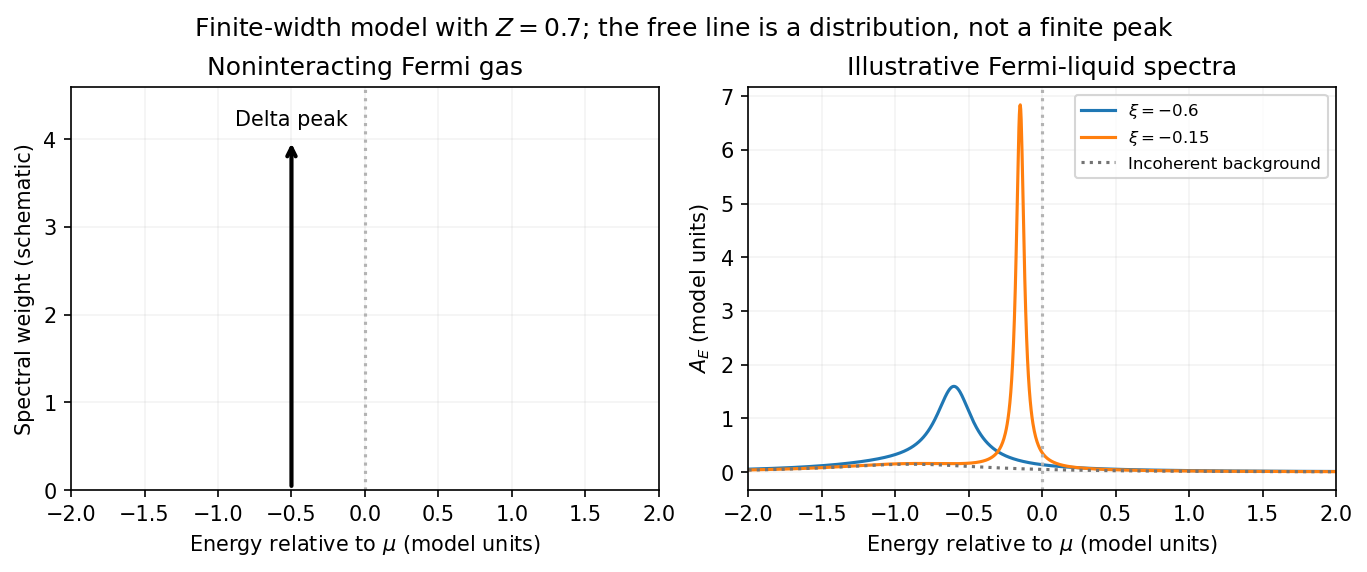
Noninteracting spectral line. Treat as a wavevector, so physical crystal momentum is . Write ; an energy zero at the chemical potential can be chosen throughout. The temporal factor of a noninteracting state is . With the Fourier transform convention ,Thus its normalized frequency spectral function isOne should not square the delta distribution as if it were an ordinary finite-time transition amplitude. More precisely, the fermionic retarded Green function is . Its Fourier transform is , whose negative imaginary part divided by is the same delta peak.
Interactions and lifetime. Interactions change the dispersion through the real part of the self-energy and permit decay into other excitations through its imaginary part. In the simplest quasiparticle-pole model, exponential decay of the retarded amplitude givesPerforming the causal integral,The corresponding Lorentzian quasiparticle spectral peak isIts total frequency integral is one. The exponential amplitude lifetime is ; the probability lifetime is . Describing as a scattering rate therefore requires the lifetime convention to be specified. The energy half-width is .
A general interacting Electron is more accurately described by near the pole. The coherent peak then integrates to the quasiparticle residue and an incoherent continuum carries the remaining weight. In an energy-unit self-energy convention,Linearizing the real denominator gives and at the pole. The requested unit-weight Lorentzian is the normalized quasiparticle model, not the most general exact interacting spectrum.
Peak position and width. At fixed , put and . Differentiation givesIt is positive for and negative for , so the only maximum is at , with height . Setting to half this height gives . ThereforeIn energy units the maximum is and the half-width is . Frequency dependence of the self-energy would require reconsidering both the shape and peak position.
Fermi gas and Fermi liquid. A noninteracting Fermi gas has a delta-function spectral line at its bare dispersion for every momentum. A normal three-dimensional Fermi liquid has a shifted coherent peak plus incoherent spectral weight; close to the Fermi surface its width scales as . At zero temperature the peak becomes arbitrarily sharp at the Fermi surface, while it broadens farther away. Spectral functions include addition and removal weight; occupied-only photoemission contains an extra Fermi factor.


Photoemission measurement. A photon of known energy ejects an Electron. Measure its kinetic energy and emission direction. For binding energy below the Fermi level and the appropriate calibrated work function , conservation of energy givesConservation of momentum parallel to a periodic surface giveswhere is a surface reciprocal-lattice vector. At suitable photon energies the photon momentum can be neglected; at higher energies it must be retained. The surface breaks perpendicular translation symmetry, so the perpendicular crystal momentum generally needs a final-state model. A two-dimensional band can be reconstructed directly from the parallel components.
Within the sudden approximation and electric-dipole approximation, photoemission intensity and spectral function are related byHere is measured relative to the chemical potential. Instrumental resolution convolves the product and inelastic scattering adds background. Thus ARPES maps the occupied electron removal spectral function, weighted by a matrix element; it does not measure the full unoccupied spectrum or an unweighted spectral function automatically. Bright ridges give dispersions, and intrinsic widths give decay information after instrumental effects are removed.
Reading the supplied image. Its bright ridges form a graphene-like cone. The crossing near is the Dirac point, not in general the Fermi level. In the paper's plotted energy coordinates its energy is roughly –. A velocity follows from a branch slope independently of the energy zero:For example, the lower branch moves by about between and . This gives andReading other points changes the estimate by tens of percent. The original exam image has unequal energy increments on nearly equally spaced labelled ticks, so it does not justify a precise fitted velocity. The value is an estimate of the cone slope extrapolated to the Fermi crossing, rather than a measured derivative exactly at a visibly identified Fermi cutoff.
To determine a Fermi energy, first calibrate the Fermi edge, then subtract the chosen reference energy. Neither a Fermi-level marker nor an explicit energy-zero convention is supplied in this crop. If its upper termination near is intended to represent the Fermi cutoff, the conditional graph answer is on that axis, or relative to the Dirac crossing. Identifying the crossing itself as the Fermi energy would incorrectly assume undoped graphene.
The research article cited by the exam identifies this as linearly polarized graphene ARPES and independently states for the substrate-doped sample. That resolves the relative energy when this external calibration is admitted.[ref]
https://hrg.pusan.ac.kr/articles/JPCM_0953-8984_26_33_335501.pdf. Section 3, printed p.2 and figure 1(b): Dirac point below the Fermi energy
The crop alone does not uniquely fix an absolute Fermi energy; the source-supported relative value and the conditional axis reading should be distinguished. Articles by others on the same topic
There are currently no matching articles.