Choose the convention. The steady displacement in the Lorentz oscillator model has complex amplitudeThe induced electric dipole moment is , so the microscopic electric polarizability is . For identical oscillators per unit volume, . ConsequentlyHere the dimensionless quantity called polarizability in the paper is the electric susceptibility; the single-electron polarizability has different units. The sign of the Electron charge disappears because both the driving force and dipole moment contain .
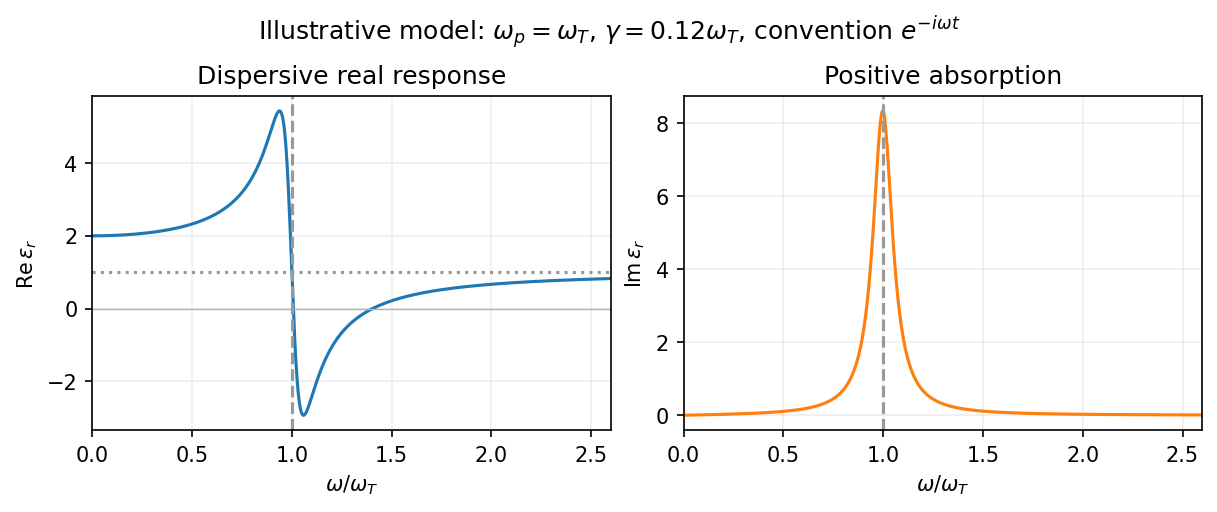
Multiplying by the complex conjugate of the denominator givesFor positive damping and positive frequency, , as required for passive wave absorption in this Fourier convention. At zero frequency, and . Near a weakly damped resonance the imaginary part has a narrow positive peak, while the real part rises on the low-frequency side and then falls steeply through at . It can become negative above resonance for sufficiently strong oscillator strength and weak damping. At large frequency, and : both approach the vacuum values. The absorption maximum is close to, but need not be exactly at, for finite damping.

A self-assembled InAs quantum-dot single-photon source uses small indium arsenide islands inside a larger-gap gallium arsenide host. Strain during epitaxial growth favors islands after a thin wetting layer has formed. Their characteristic diameter is of order – and their height a few nanometres, for example –. Growth conditions determine the areal density: low-density samples suitable for isolating dots can be around –, while ordinary dense layers can be much denser. The particular electrically driven device underlying the supplied image had about . These are characteristic scales, not dimensions deducible from the emission image.[ref]
Quantum confinement in the dot traps both Electrons and electron holes in three directions, giving discrete energy levels. In a junction device, injected carriers relax into these levels. Electron-hole recombination then emits a photon, and the dot must be repopulated before emitting again on that same transition. Spatial selection of one dot, spectral selection of one line, and well-separated injection pulses make this a single-photon source. Photon antibunching, rather than low average brightness alone, establishes suppression of simultaneous photons. In particular, collecting both photons of a cascade without selecting a line would not produce exactly one collected photon per excitation.
The lower-current feature is the transition from one confined exciton to the empty dot. The higher-current feature is the first step of the biexciton cascade : it becomes strong when the dot can contain two electron-hole pairs. In the weak-pumping limit the probabilities of one and two pairs scale approximately as and , respectively. Coulomb and confinement energies shift the two transitions relative to one another; is not a photon of twice the energy. In this particular image the photon is about – higher in energy. With , this is a negative biexciton binding energy, since .
For the mass estimate, the original plot places the line at approximately , with graph-reading precision of order . Under the prescribed identification of photon energy with the full lowest exciton excitation energy,The three-dimensional screened Wannier-Mott exciton has the hydrogenic exciton binding energyThereforeReading the line as instead gives ; about – is an appropriate precision. This inference uses the supplied pair-creation energy and a three-dimensional screened hydrogenic model. In a real dot, strain and confinement also alter transition energies, so it is an effective model estimate and does not independently determine either individual carrier mass.
Specify the spin counting first. Let denote the unpolarized single-spin density of states per atom per energy, and put . At fixed total occupation , the two Hubbard model mean-field energies can be writtenThe common shift can be absorbed into the chemical potential. Lowering the up-spin band by adds carriers, while raising the down-spin band removes the same number. ThusIf is the atom number density, the magnetization is . The Stoner-enhanced magnetic susceptibility in SI volume units is thereforeHere is the noninteracting Pauli paramagnetism result. If the paper's counts both spins, and the same result isA susceptibility per atom omits . Stating the spin and volume conventions avoids an otherwise spurious factor of two or a dimensional mismatch.
The Stoner criterion is , equivalently with spin-summed . To see the instability, transfer Electrons per atom from one spin band to the other. The band-filling cost is , whereas the interaction energy changes by . Their sum becomes negative at the threshold. The unpolarized state then ceases to be a local minimum, and nonlinear band filling determines the spontaneous ferromagnetism. The negative continuation of the displayed linear susceptibility beyond the threshold is not a stable paramagnetic response.
Articles by others on the same topic
There are currently no matching articles.