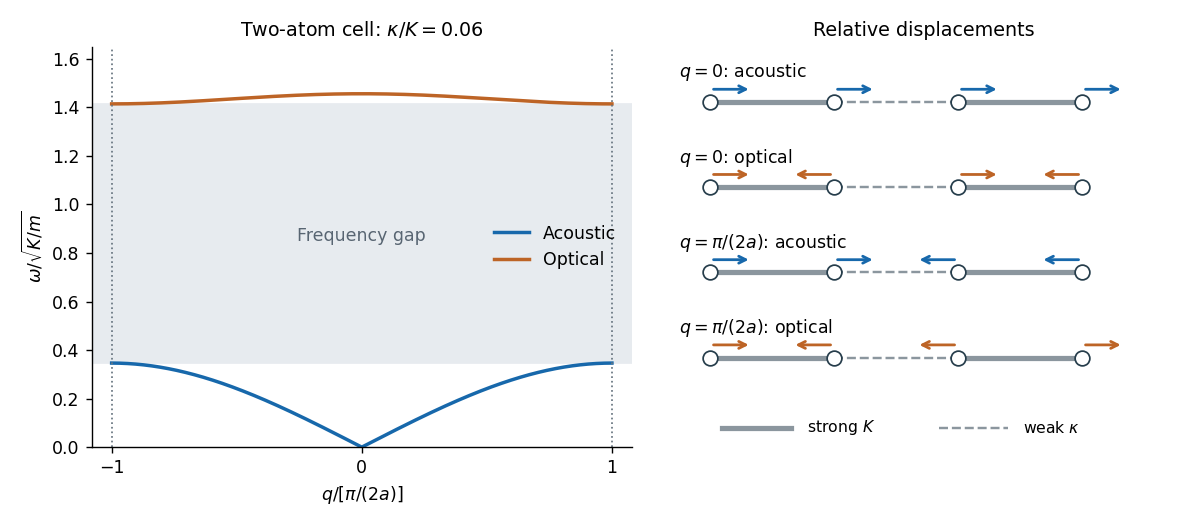
Let adjacent equal masses be separated by , with alternating strong and weak spring constants and , . The pattern repeats after , even though the masses are identical. Thus the first Brillouin zone isChoose the strong bond inside each two-atom primitive unit cell. With displacement amplitudes , the normal mode equations areThe alternating-spring chain dispersion relation is consequentlyThe lower acoustic phonon branch has in-phase motion within the strongly bound pair and . Its small- slope is the speed of sound,The upper optical phonon branch has opposite motion within each pair, with . Here “optical” names the gapped branch; equal neutral masses need not couple to light through an electric dipole.
In the strong-bond limit of the alternating-spring chain, the pairs act almost as rigid dimers in the low-frequency branch, while their internal stretch gives a high, nearly flat branch:At the zone edge the two frequencies are and , separated by a large forbidden frequency interval. Neighbouring cells are out of phase there. Both branches have horizontal tangents at the edge.

Articles by others on the same topic
There are currently no matching articles.