For state counting in a Bloch band, take a primitive cubic lattice of spacing and impose periodic boundary conditions on lengths . The allowed wavevectors are . The first Brillouin zone has side , so it contains distinct values in each direction and hence wavevectors. Each orbital-derived energy band has one state per wavevector per spin orientation. ThereforeThe phrase “per atom” attached to in the PDF is a counting error: is the total, not the per-atom count.
By the Pauli exclusion principle, a monovalent crystal supplies valence Electrons and half-fills a spin-degenerate band; its Fermi level lies within allowed states, giving a metal in the independent-electron picture. Two electrons per atom can fill one band. If a band gap separates it from all empty bands, the crystal is a band insulator. An even valence count only permits insulation: overlapping bands can still produce a metal. Conversely, electron interactions can produce a Mott insulator, and symmetry breaking can permit insulation outside this simple spin-degenerate electronic band structure criterion. The relevant count in a crystal with a basis is per primitive unit cell.
In a simple metal, conduction Electrons can move collectively in response to an incident electromagnetic wave. The Drude model gives, with time dependence ,In the low-loss range , the relative permittivity is approximately . The wavevector inside is predominantly imaginary, so the field is evanescent and penetrates only a short distance. Surface currents reradiate the field; little energy enters a good conductor. The normal-incidence Fresnel equations giveMany ordinary metals have their plasma frequency in the ultraviolet, placing visible light below this reflection edge. For the free-carrier contribution permits propagation; at , and . The electrons' inertial response becomes too small to screen the rapidly oscillating field.
Ultraviolet transparency is a simple-metal model prediction, not a universal property of real metals. Electronic transitions between bands and bound-electron absorption can remain strong, shift the plasma edge and prevent transparency; transmission also depends on thickness and attenuation. The robust explanation is the change from a reflective negative-permittivity range to a possible propagating range above the plasma edge.
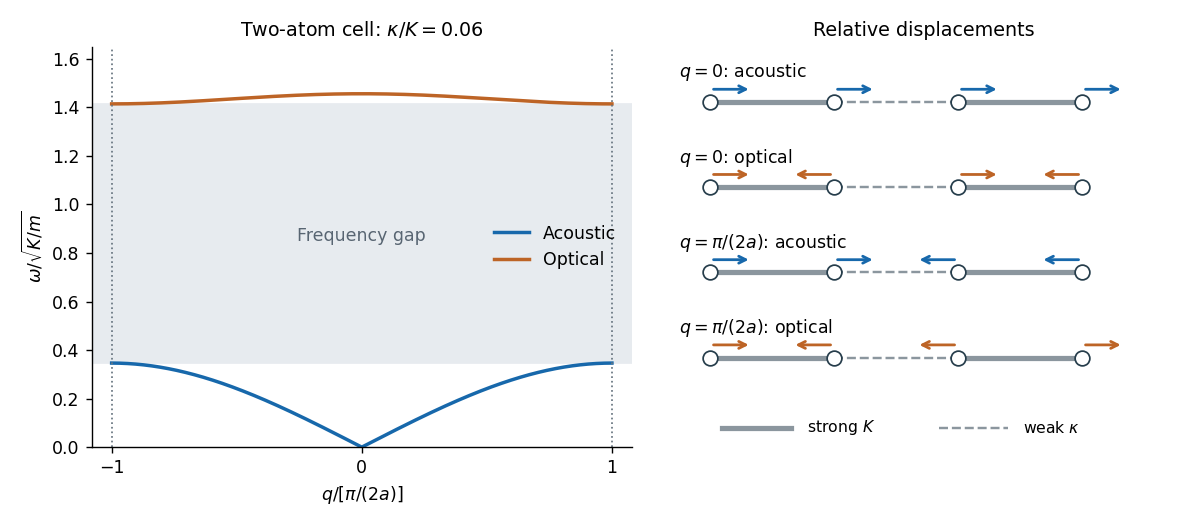
Let adjacent equal masses be separated by , with alternating strong and weak spring constants and , . The pattern repeats after , even though the masses are identical. Thus the first Brillouin zone isChoose the strong bond inside each two-atom primitive unit cell. With displacement amplitudes , the normal mode equations areThe alternating-spring chain dispersion relation is consequentlyThe lower acoustic phonon branch has in-phase motion within the strongly bound pair and . Its small- slope is the speed of sound,The upper optical phonon branch has opposite motion within each pair, with . Here “optical” names the gapped branch; equal neutral masses need not couple to light through an electric dipole.
In the strong-bond limit of the alternating-spring chain, the pairs act almost as rigid dimers in the low-frequency branch, while their internal stretch gives a high, nearly flat branch:At the zone edge the two frequencies are and , separated by a large forbidden frequency interval. Neighbouring cells are out of phase there. Both branches have horizontal tangents at the edge.

Articles by others on the same topic
There are currently no matching articles.