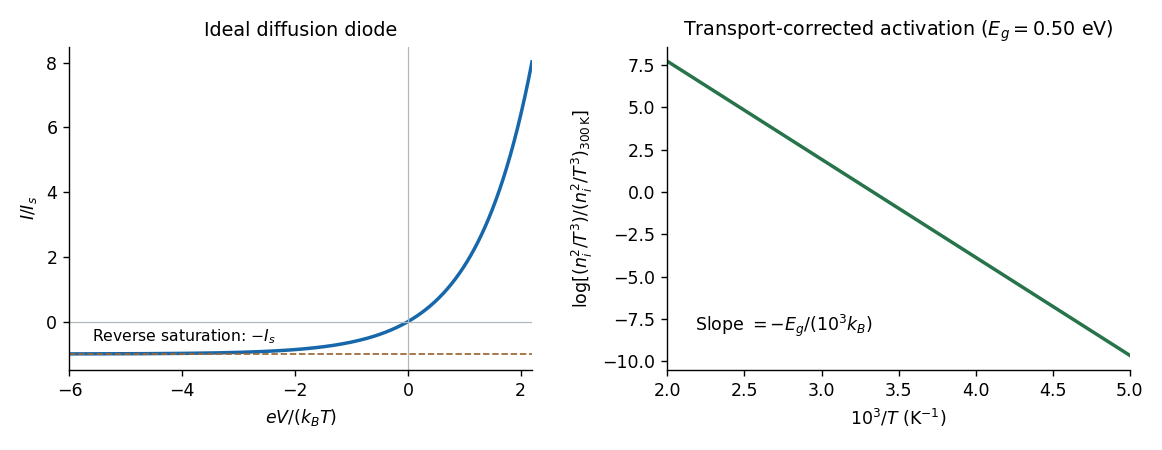
An ideal diffusion-dominated p-n junction obeys the Shockley diode equationwith diode ideality factor in the simplest model. Forward bias gives exponential current growth; reverse bias gives a nearly constant until diode reverse breakdown, outside this ideal expression.
For a long abrupt p-n junction in low carrier injection, the diode saturation current isHere is area, are ionized dopant densities, and are minority-carrier diffusion coefficients and diffusion lengths in the appropriate regions. At each temperature, extract either from the reverse-saturation plateau below breakdown or from a forward exponential fit using its measured diode ideality factor.
Extracting a semiconductor band gap from diode saturation current requires correcting for the transport prefactor:A plot against has slope when the gap and effective masses are nearly temperature-independent. Alternatively divide the measured by a known to recover the full . The prefactor cannot generally be assumed constant over an arbitrarily broad range. Junction-generation or recombination-dominated current can scale as instead, so the diffusion regime should be identified from the current-voltage behaviour.

Articles by others on the same topic
There are currently no matching articles.