Let be the action-consistent free propagator established in a. Write and putThe perturbative expansion isDivide numerator and denominator by the same free vacuum functional . For , they becomeFor , abbreviate and . Since only opposite-charge fields contract, Wick's theorem givesandThe first multiplicity is internal pairings. In the connected term, there are two choices for the vertex's contracted to the external and two for its contracted to the external ; the remaining pair forms a tadpole diagram. ThereforeExpanding the inverse denominator cancels the free-line times vacuum bubble term, leavingThe local quartic interaction vertex has factor , since cancels its denominator 4. The oriented tadpole diagram has Feynman-diagram symmetry factor 1; the isolated two-loop vacuum vertex has factor in its coefficient. Coincident kernels and the integrals require a common regularization; none is being assigned a finite numerical value here.
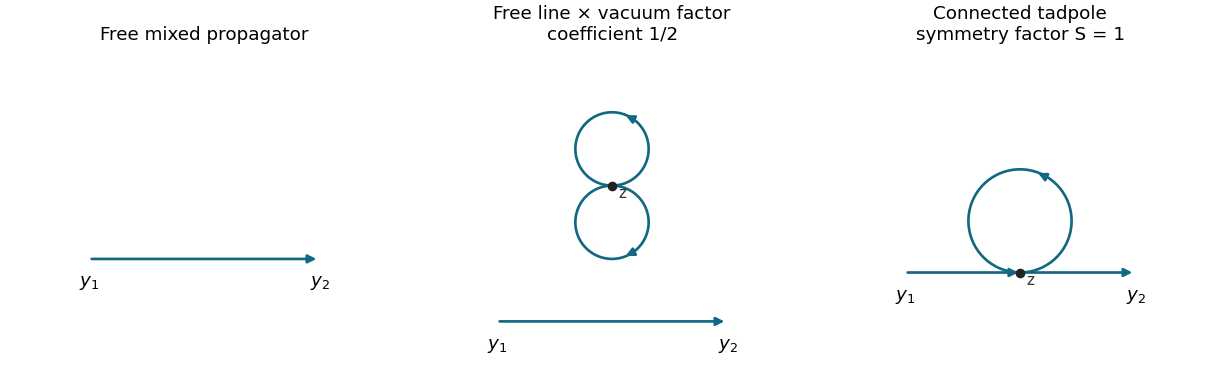

More generally, vacuum bubbles exponentiate and factor from every numerator. Here global U(1) symmetry also makes all one-point functions zero. Thus a surviving graph with the two external insertions in separate connected components would have a component with one unbalanced charge and vanish. This proves that only connected graphs contribute to this particular two-point function to all perturbative orders. Vacuum normalization alone would not remove disconnected components containing external legs in a general four-point function. If one formally chooses a different free kernel, the displayed Wick multiplicities are unchanged; replacing by gives a formal oscillator series, not the Gaussian integral of the action as printed.
Articles by others on the same topic
There are currently no matching articles.