The displayed oscillator expansion and the displayed action require two separate corrections to describe one conventional positive-energy theory. First compute what the oscillator algebra literally implies. Assume the two oscillator species commute with each other and annihilate the vacuum. Same-charge contractions vanish, soFor the two mixed contractions the printed phases give the same kernel, with :Thus . In dimensions replace and by and ; the source's explicit three-dimensional spatial measure is the specialization. The covariant integral is manifestly Lorentz invariant. Withwe have . This reversed-frequency scalar contraction has the opposite pole prescription to the usual positive-energy Feynman propagator. For a single zero-momentum mode at positive time separation, the printed contraction is , while is : this is a concrete phase counterexample, rather than an immaterial change of integration variable.
There is also a normalization of a complex scalar propagator conflict independent of those phases. The displayed Lagrangian density gives the canonical momentum . Substituting the printed modes yieldsinstead of the canonical . Reversing the mode phases repairs the sign but leaves , so it does not repair the normalization. The complex scalar field convention with unit mixed propagator normally has no in its quadratic action.[ref]
Quantum Field Theory by David Tong. §2.5, equations (2.67)–(2.73): complex-field kinetic normalization and canonical commutators
To retain the actual action in the paper, use with canonically normalized real components, or equivalently replace its mode expansion byThe corresponding path integral with the usual Feynman i-epsilon prescription haswith the two same-charge propagators still zero. This action-consistent kernel is used in b and c. Keeping conventional unit modes instead would require removing the quadratic factors from the action as well as reversing the phases. Those are distinct theories unless the field and its coupling are rescaled together.
Let be the action-consistent free propagator established in a. Write and putThe perturbative expansion isDivide numerator and denominator by the same free vacuum functional . For , they becomeFor , abbreviate and . Since only opposite-charge fields contract, Wick's theorem givesandThe first multiplicity is internal pairings. In the connected term, there are two choices for the vertex's contracted to the external and two for its contracted to the external ; the remaining pair forms a tadpole diagram. ThereforeExpanding the inverse denominator cancels the free-line times vacuum bubble term, leavingThe local quartic interaction vertex has factor , since cancels its denominator 4. The oriented tadpole diagram has Feynman-diagram symmetry factor 1; the isolated two-loop vacuum vertex has factor in its coefficient. Coincident kernels and the integrals require a common regularization; none is being assigned a finite numerical value here.
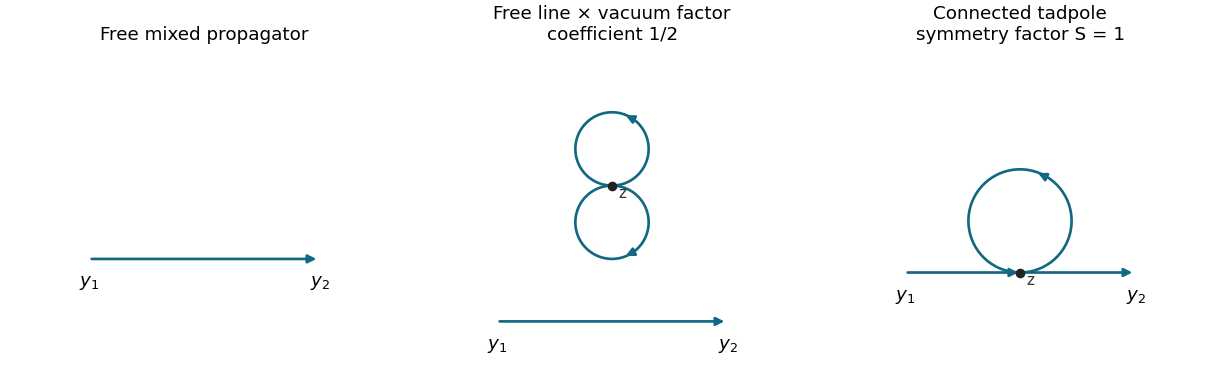

More generally, vacuum bubbles exponentiate and factor from every numerator. Here global U(1) symmetry also makes all one-point functions zero. Thus a surviving graph with the two external insertions in separate connected components would have a component with one unbalanced charge and vanish. This proves that only connected graphs contribute to this particular two-point function to all perturbative orders. Vacuum normalization alone would not remove disconnected components containing external legs in a general four-point function. If one formally chooses a different free kernel, the displayed Wick multiplicities are unchanged; replacing by gives a formal oscillator series, not the Gaussian integral of the action as printed.
Work in the symmetric vacuum and continue with the action-consistent kernel . Under global U(1) symmetry, a correlator with fields and fields picks up a phase . Invariance for every requires . Consequently ten of the sixteen ordered field-type choices vanish, and the six placements with two fields of each type can be nonzero. This is the charge selection rule for complex scalar correlators, not an assertion about a symmetry-breaking vacuum with a nonzero one-point function.
Choose external fields . Its zeroth-order full correlator is and is disconnected; its connected part starts at order . DefineThe tree term has Feynman-diagram symmetry factor 1 and is .
At second order, a connected graph has two quartic vertices, two internal lines and one loop. The three bubble integrals areThe oriented complex-scalar quartic graph factors distinguish the channels. In the two internal lines have the same orientation and can be interchanged, giving symmetry factor . In each mixed channel the two orientations are opposite; interchanging them is not an oriented graph automorphism, so . Equality of the numerical scalar kernels does not erase the field-slot distinction used in counting contractions.
There are also four connected external-leg tadpole diagrams. They must be included because a connected correlation function is neither amputated nor restricted to one-particle-irreducible Feynman diagrams. Representative integrals, with the other two obtained by the indicated external permutations, areEach oriented external-leg graph has symmetry factor 1: a directed self-loop has no independent reversal symmetry. Altogether,These expressions retain every external propagator. The physical normalization is explicit: each is , not . Equivalently set ; its quadratic action has unit mixed propagator and its interaction is , giving vertex . Multiplying a four- correlator by four converts it to the four- correlator, confirming the powers of two.
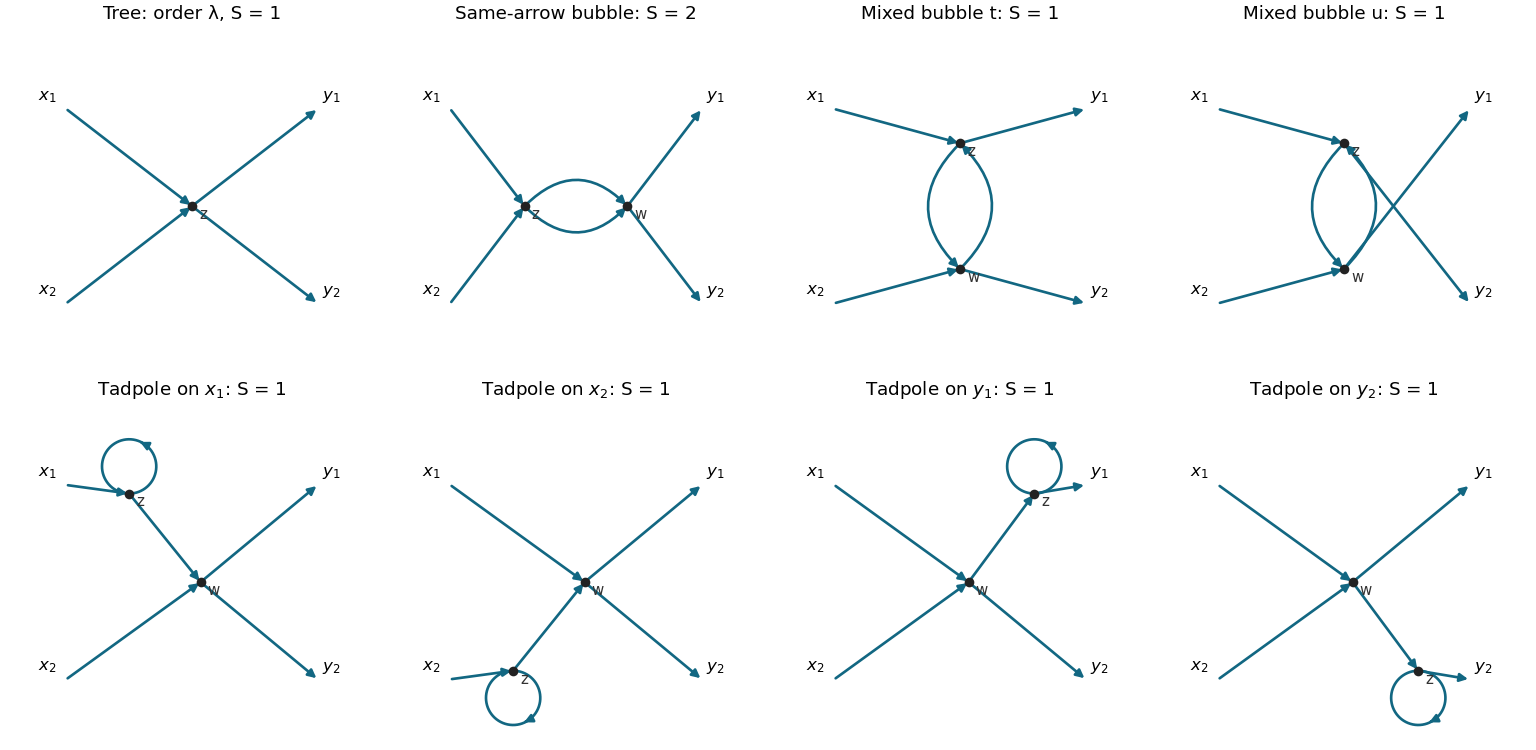
All connected four-point graphs through second order: one tree, three bubbles and four external-leg tadpoles
. Arrows follow C(u,v) from its first argument to its second. The same-orientation bubble has symmetry factor two; the other seven displayed graphs have symmetry factor one. Details.
Completeness can also be seen without a picture. With two vertices and four external legs, . Connectivity allows either two intervertex lines with a two-and-two external split, or one bridge and one self-loop with a one-and-three split. The charge assignments give exactly the three bubble attachments and four leg choices above. Direct labelled Wick contraction counting gives respectively contractions. Dividing by the expansion denominator reproduces . Vacuum factors cancel, and there are no additional connected topologies at this order.
Articles by others on the same topic
There are currently no matching articles.