For the two-point function, the original Feynman diagrams below show both one-vertex graphs and every two-vertex topology with external momentum flowing between distinct interaction vertices. All lines represent the same real scalar field. The lower row labels the number of parallel connecting lines; a small closed line at a vertex is a tadpole diagram.
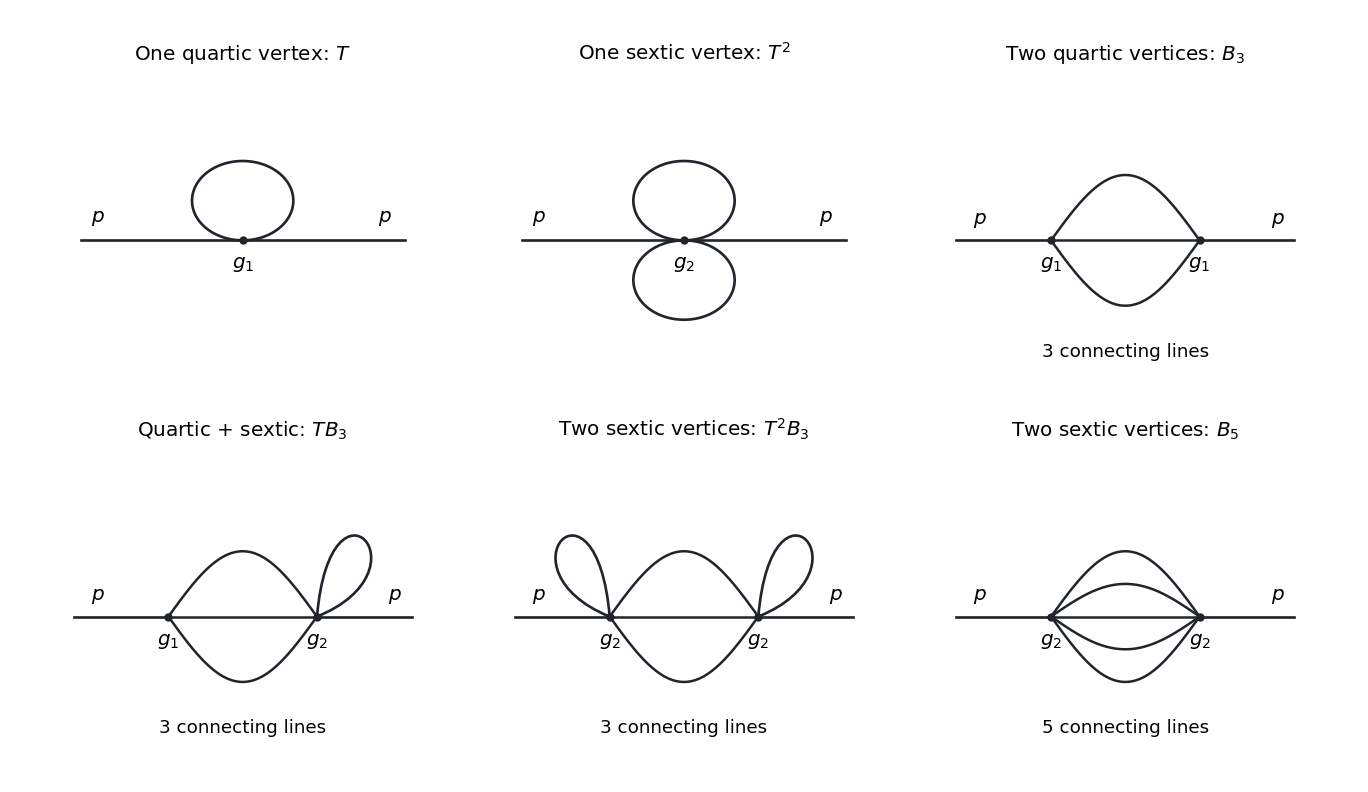
One-vertex self-energies and the four momentum-dependent two-vertex topologies in the three-dimensional quartic-sextic scalar theory.
Details. 
With a single quartic interaction vertex, the two unused line ends close into one tadpole diagram. With a single sextic interaction vertex, the four unused ends pair into two tadpole diagrams. These are the only one-vertex one-particle irreducible Feynman diagrams for the two-point function.
Define the Minkowski Feynman integralsThe amputated two-point function contributions arewhere are the reciprocals of the corresponding Feynman-diagram symmetry factors. Both are independent of external momentum, and hence affect the mass counterterm rather than wave-function renormalization. No numerical Feynman-diagram symmetry factors are needed here.
To include all momentum-dependent contributions to the two-point function, put one external line at each interaction vertex. Let be the number of lines connecting the vertices, and their numbers of tadpole diagrams. For vertex valences ,The integer is odd, and gives a one-particle-reducible Feynman diagram and is excluded. Thus the complete list is
- : , , the sunset diagram.
- : , , the sunset diagram with one tadpole diagram.
- : , , the sunset diagram with one tadpole diagram at each vertex.
- : , , the five-line banana integral topology.
The coefficient of the mixed graph includes the reflected external attachment as well as its reciprocal Feynman-diagram symmetry factor. If both external lines attach to the same interaction vertex, no external momentum enters the connecting internal lines, and that Feynman diagram cannot contribute to wave-function renormalization.
For incoming external momentum , assign the connecting lines momenta . DefineThe momentum space Feynman rules give, in the order listed,Each is a reciprocal Feynman-diagram symmetry factor, including any equivalent external attachments. There are respectively independent loop momenta.
If “contribute to wavefunction renormalization” means requiring a divergent kinetic counterterm after subtraction of all subdivergences, only the last topology qualifies. The first three still have nontrivial external momentum dependence and give finite contributions to a normalization condition; their raw divergent factors arise from mass counterterms and interaction vertex counterterms. Keeping all four here makes this distinction explicit. The ultraviolet divergence analysis in d establishes it directly.
Articles by others on the same topic
There are currently no matching articles.