Here three means the total spacetime dimension. A dimensionless action requires in mass dimensions. The kinetic term gives , so . Matching the mass dimensions of both field interaction terms givesThus has units of mass and is dimensionless. The quartic interaction is superrenormalizable by power counting, and is a marginal coupling by power counting.
Let be the number of independent loop momenta in a connected Feynman diagram. Every scalar propagator falls as , and every loop momentum integration contributes three powers, so . Counting line ends and using connectedness givesEliminating and yieldsThus increasing the sextic interaction vertex count does not worsen the superficial degree of divergence; adding a quartic interaction vertex improves it. Only finitely many external-line structures can have an overall ultraviolet divergence, even though arbitrarily high loop order is possible.
After subtracting ultraviolet subdivergences, locality and Lorentz invariance restrict the divergent counterterms to a constant vacuum energy density, a mass counterterm, a wave-function renormalization, and quartic and sextic field interaction terms. Odd powers are forbidden by the Z2 symmetry. In particular, permits a constant and , permits only a constant, and permits only a constant. This is perturbative renormalizability, not a guarantee that every superficially allowed divergence actually occurs or that every unrenormalized graph with lacks divergent subgraphs.
For the two-point function, the original Feynman diagrams below show both one-vertex graphs and every two-vertex topology with external momentum flowing between distinct interaction vertices. All lines represent the same real scalar field. The lower row labels the number of parallel connecting lines; a small closed line at a vertex is a tadpole diagram.
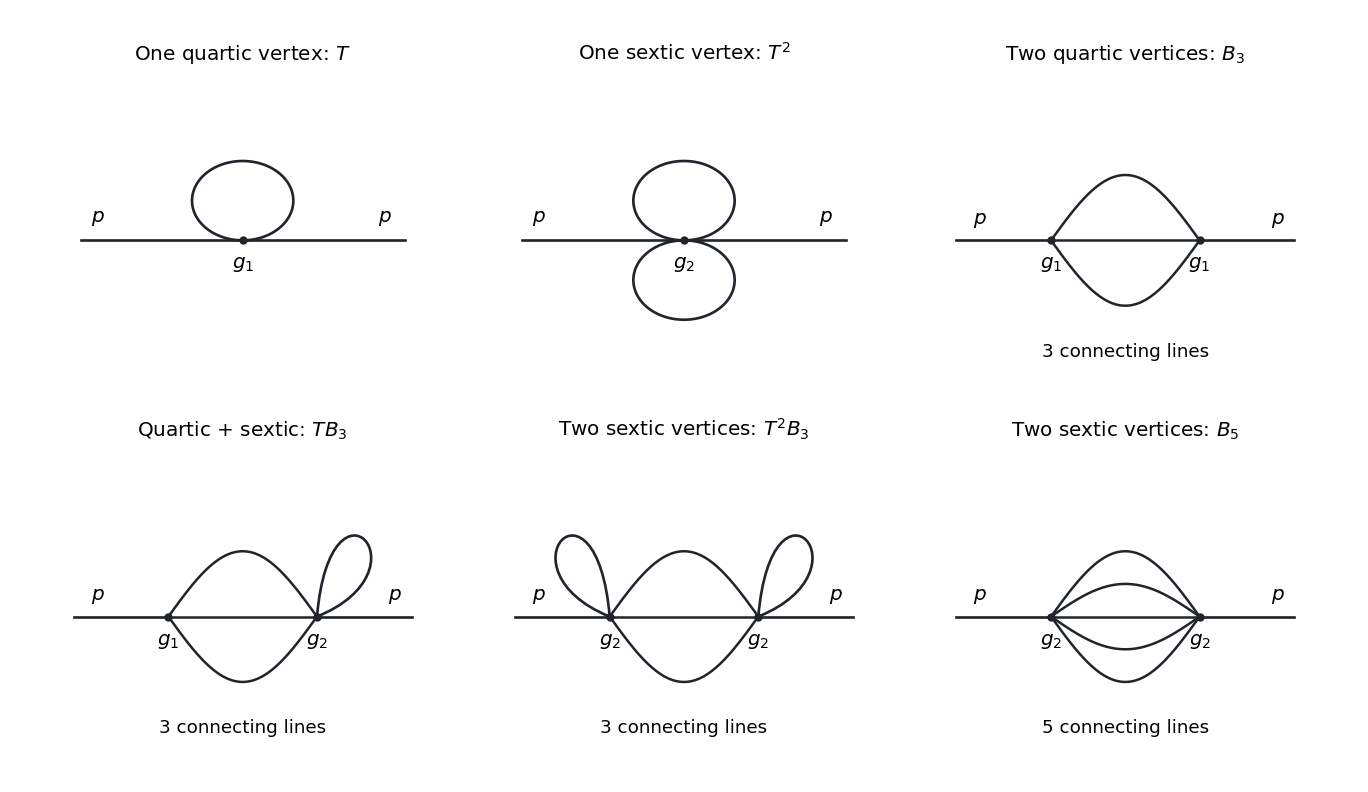
One-vertex self-energies and the four momentum-dependent two-vertex topologies in the three-dimensional quartic-sextic scalar theory.
Details. 
With a single quartic interaction vertex, the two unused line ends close into one tadpole diagram. With a single sextic interaction vertex, the four unused ends pair into two tadpole diagrams. These are the only one-vertex one-particle irreducible Feynman diagrams for the two-point function.
Define the Minkowski Feynman integralsThe amputated two-point function contributions arewhere are the reciprocals of the corresponding Feynman-diagram symmetry factors. Both are independent of external momentum, and hence affect the mass counterterm rather than wave-function renormalization. No numerical Feynman-diagram symmetry factors are needed here.
To include all momentum-dependent contributions to the two-point function, put one external line at each interaction vertex. Let be the number of lines connecting the vertices, and their numbers of tadpole diagrams. For vertex valences ,The integer is odd, and gives a one-particle-reducible Feynman diagram and is excluded. Thus the complete list is
- : , , the sunset diagram.
- : , , the sunset diagram with one tadpole diagram.
- : , , the sunset diagram with one tadpole diagram at each vertex.
- : , , the five-line banana integral topology.
The coefficient of the mixed graph includes the reflected external attachment as well as its reciprocal Feynman-diagram symmetry factor. If both external lines attach to the same interaction vertex, no external momentum enters the connecting internal lines, and that Feynman diagram cannot contribute to wave-function renormalization.
For incoming external momentum , assign the connecting lines momenta . DefineThe momentum space Feynman rules give, in the order listed,Each is a reciprocal Feynman-diagram symmetry factor, including any equivalent external attachments. There are respectively independent loop momenta.
If “contribute to wavefunction renormalization” means requiring a divergent kinetic counterterm after subtraction of all subdivergences, only the last topology qualifies. The first three still have nontrivial external momentum dependence and give finite contributions to a normalization condition; their raw divergent factors arise from mass counterterms and interaction vertex counterterms. Keeping all four here makes this distinction explicit. The ultraviolet divergence analysis in d establishes it directly.
There are three independent nonfactorized momentum integrals, namely a tadpole integral, the three-line sunset diagram integral, and the five-line banana integral. The six displayed Feynman diagrams involve six complete integral expressions:The distinction between independent building blocks and their products removes an ambiguity in counting “different momentum integrals”. For the strict divergent-wave-function renormalization interpretation of ii, the graphs in c reduce to , comprising three full integral expressions and two independent nonfactorized building blocks.
Make a Wick rotation and use to separate ultraviolet divergences from infrared divergences. Write , and let be the Euclidean versions of the integrals above, with their harmless overall factors of removed. A spherical ultraviolet cutoff givesThus the one-vertex quartic graph is linearly divergent, and the one-vertex sextic graph is quadratically divergent as .
For the other two building blocks, the spatial Fourier transform is especially transparent. The three-dimensional Euclidean scalar propagator isThe convolution theorem converts the parallel lines into . Angular integration gives, with a short-distance cutoff ,This is a different convenient cutoff regularization for the connected block; power-divergent coefficients depend on the cutoff convention, whereas the conclusions about powers and the presence of a kinetic logarithm do not. The sinc function is understood to be at .
For , the integrand starts as , soIts divergent part is independent of external momentum. In particular,The finite difference and its finite derivative show why the pure three-line sunset diagram does not need a divergent wave-function renormalization in three dimensions.
For , the small-distance Taylor expansion isConsequentlyIn particular, the nonzero term requires a genuine divergent wave-function renormalization, in addition to the mass counterterm. The coefficients here refer to the displayed position-space cutoff and have not included Feynman-diagram symmetry factors or bare couplings.
The comparison with the superficial degree of divergence isThus the actual leading power agrees with in every case. The additional logarithms in products come from ultraviolet subdivergences, which uniform power counting alone does not resolve.
For and , differentiation with respect to removes the logarithmic divergence of , but leaves divergent factors or multiplying a finite, nonpolynomial function of . These are subdivergent contributions, not new nonlocal counterterms: subtracting each tadpole diagram subdivergence and the momentum-independent subdivergence removes them. For example, in a factorized subtraction scheme , and likewise for . The remaining kinetic logarithm explains the strict interpretation in ii. A dimensional regularization scheme can suppress power divergences; it does not invalidate this cutoff-based comparison with .
Articles by others on the same topic
There are currently no matching articles.