Let be the incoming and the outgoing four-momenta, and set , , , the Mandelstam variables. The only connected tree-level Feynman diagram is the -channel exchange of , with Noether charge . The two incoming light particles attach to , and the two outgoing light particles to its conjugate. There is no four-light contact Feynman vertex, nor a charge-allowed or exchange with these external labels.
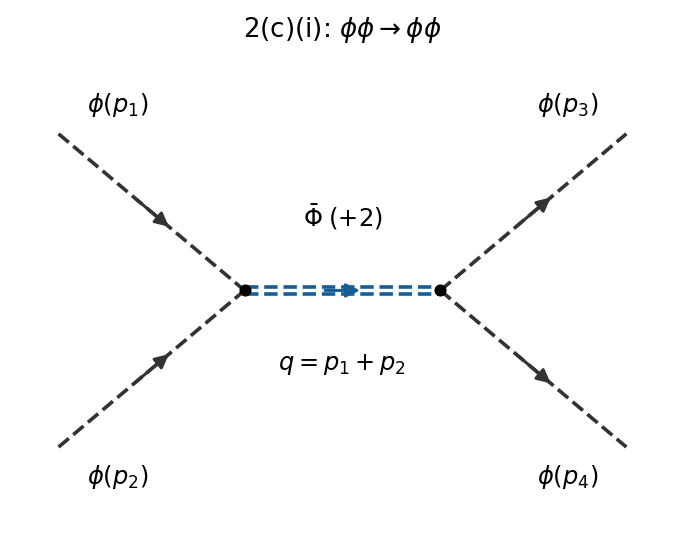

Define the invariant scattering amplitude by . ThenThe Feynman vertices already contain the identical-leg combinatorics. No extra factor of two multiplies this invariant scattering amplitude; the distinct identical final-state symmetry factor enters a cross section integral.
Keep the particle labels specified under 2. There are two connected tree-level Feynman diagrams: the quartic contact interaction vertex and an -channel light antiparticle exchange. The initial Noether charge is , exactly the charge of . At the first cubic Feynman vertex, the incoming and leave the second leg internal; the conjugate Feynman vertex supplies both outgoing particles.
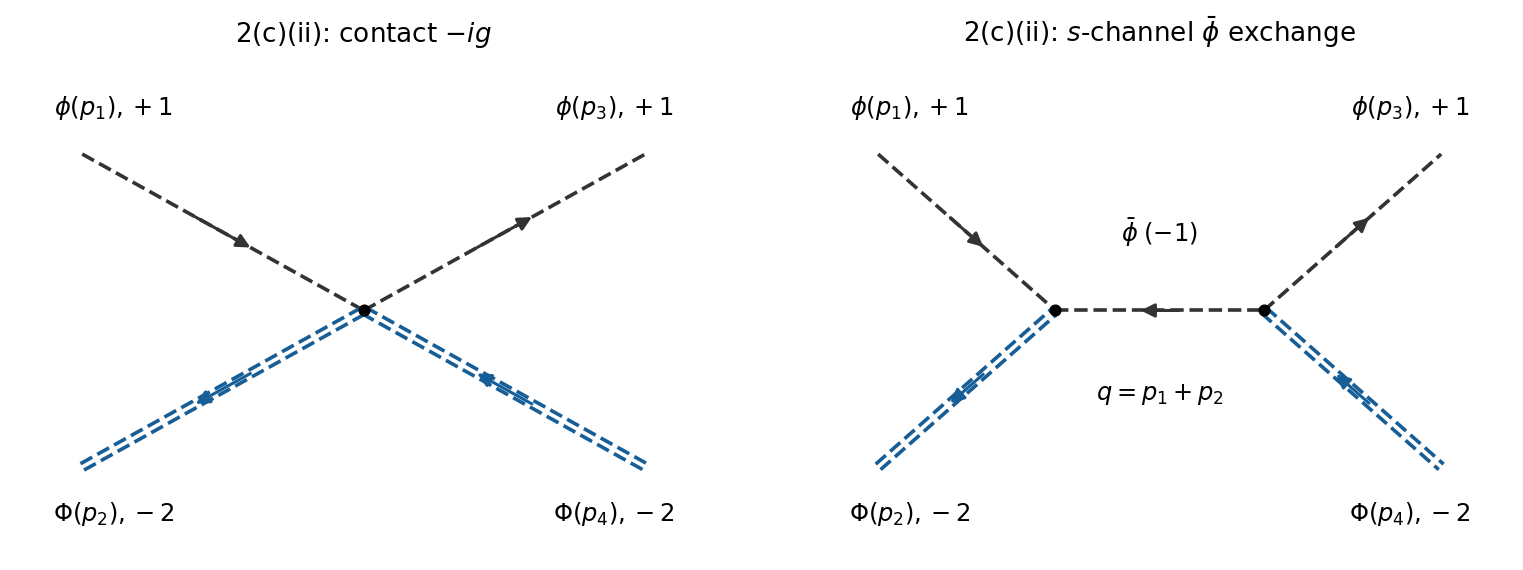
Scattering of a light particle and a heavy particle, with contact and s-channel light-antiparticle exchange diagrams
. Details. 
The distinction from antiparticles matters. If the paper's heavy “ particle” is instead intended to mean the charge- state , so that its printed decay into is allowed, the exchange diagram is crossed. For that alternative physical process,This is a consistent alternative naming convention only if it is also applied to the decay in iii; one cannot use the same heavy particle label for both charge assignments.
With the conventional particle labels, the allowed cubic decay channels areEach has one tree-level Feynman diagram, consisting of one cubic Feynman vertex. The final identical-leg contractions supply and cancel the in the Lagrangian density.
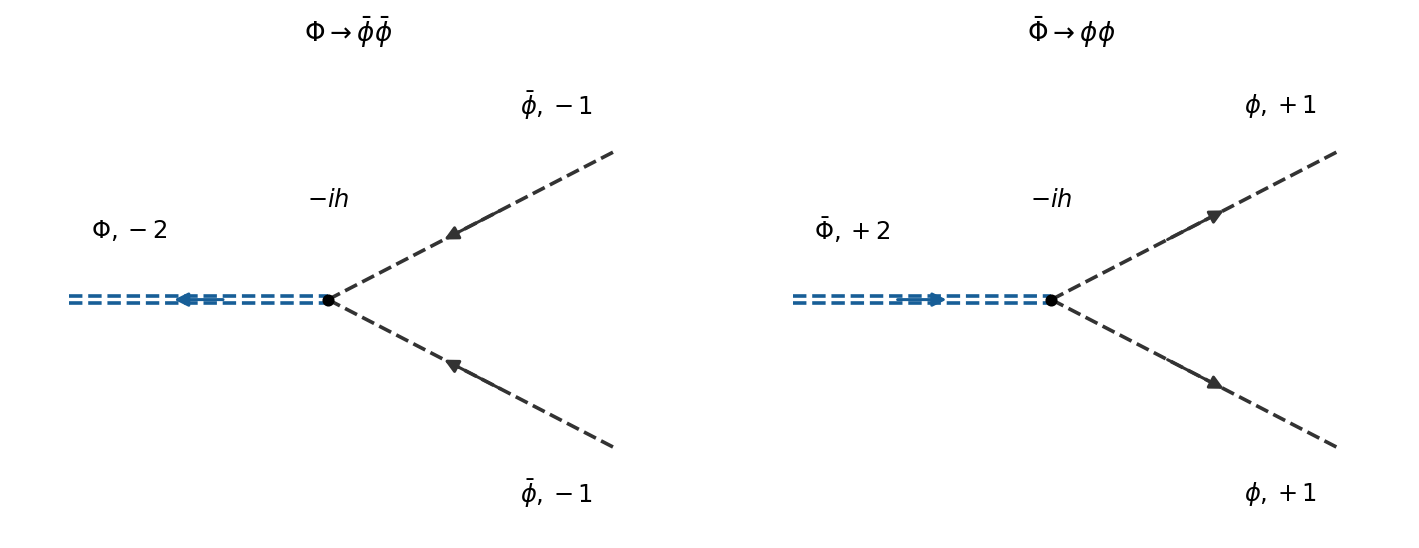
The two charge-conjugate heavy-scalar decays, with explicit antiparticle labels and conserved charge arrows
. Details. 
Taken literally with these labels, the printed channel is forbidden: its initial Noether charge is and its final Noether charge is . Its decay amplitude is zero, at every order preserving the global phase symmetry. If the source uses “” to name the heavy antiparticle instead, its intended answer is the nonzero decay amplitude for . The following decay width calculation concerns either allowed channel, whose widths are equal by charge conjugation.
Articles by others on the same topic
There are currently no matching articles.