For the complex scalar fields, use the conventional particle names: annihilates a light particle and creates a light antiparticle ; annihilates a heavy particle and creates . These choices make the distinction between particle labels and field symbols explicit throughout ii and iii. The couplings are real as required by the printed Hermitian Lagrangian density.
Independent global phase symmetries would rotate and . The cubic interaction vertex preserves only modulo . The continuous internal symmetry of a classical field theory is therefore the circle groupNormalize the Noether charge so that . Then , and . The Noether current iswhere . For example, the Euler-Lagrange field equations givewhich cancel with the relative coefficient . The quartic interaction vertex separately preserves both original phase rotations.
There is also a discrete charge conjugation symmetry for these real couplings. Including it, the internal symmetry is , with charge conjugation reversing the Noether charge. The connected symmetry and its conserved current are the above.
The nonzero free scalar propagators join a field to its adjoint:Contractions , and mixed-species contractions vanish. With all momenta incoming, the Feynman vertices areThe two identical light legs cancel the in each cubic interaction vertex; there is no remaining factor in its Feynman rule. Multiply each Feynman vertex by , and integrate an internal unconstrained four-momentum with .
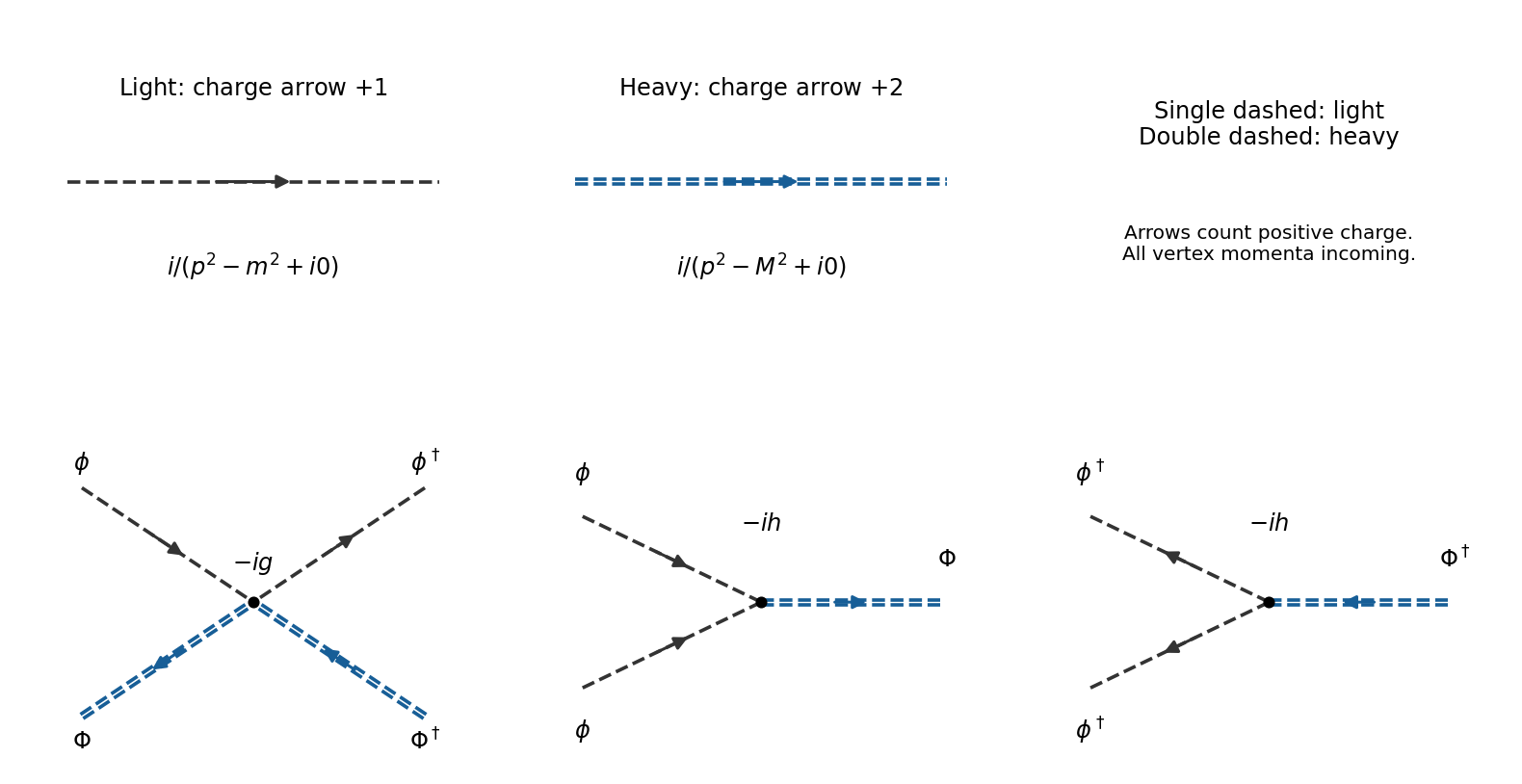
Charged scalar propagators and vertices, with arrows following positive conserved charge and heavy arrows carrying two units
. Details. The arrows in the figure follow positive Noether charge: a light arrow carries one unit and a heavy arrow two. Consequently a heavy particle travels opposite its charge arrow, whereas its antiparticle travels along it. At a Feynman vertex, two unit-charge arrows enter and a two-unit arrow leaves; the conjugate Feynman vertex reverses every arrow. The quartic Feynman vertex has one incoming and one outgoing arrow of each weight. These rules prevent attaching a propagator between two unconjugated fields.
Let be the incoming and the outgoing four-momenta, and set , , , the Mandelstam variables. The only connected tree-level Feynman diagram is the -channel exchange of , with Noether charge . The two incoming light particles attach to , and the two outgoing light particles to its conjugate. There is no four-light contact Feynman vertex, nor a charge-allowed or exchange with these external labels.
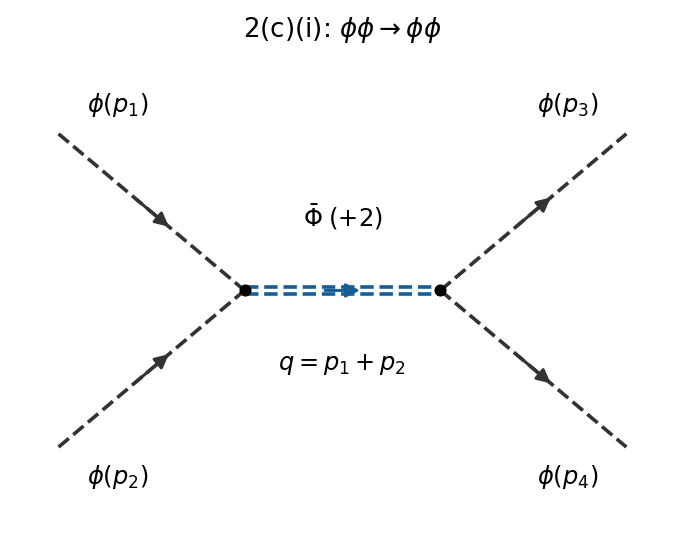


Define the invariant scattering amplitude by . ThenThe Feynman vertices already contain the identical-leg combinatorics. No extra factor of two multiplies this invariant scattering amplitude; the distinct identical final-state symmetry factor enters a cross section integral.
Keep the particle labels specified under 2. There are two connected tree-level Feynman diagrams: the quartic contact interaction vertex and an -channel light antiparticle exchange. The initial Noether charge is , exactly the charge of . At the first cubic Feynman vertex, the incoming and leave the second leg internal; the conjugate Feynman vertex supplies both outgoing particles.
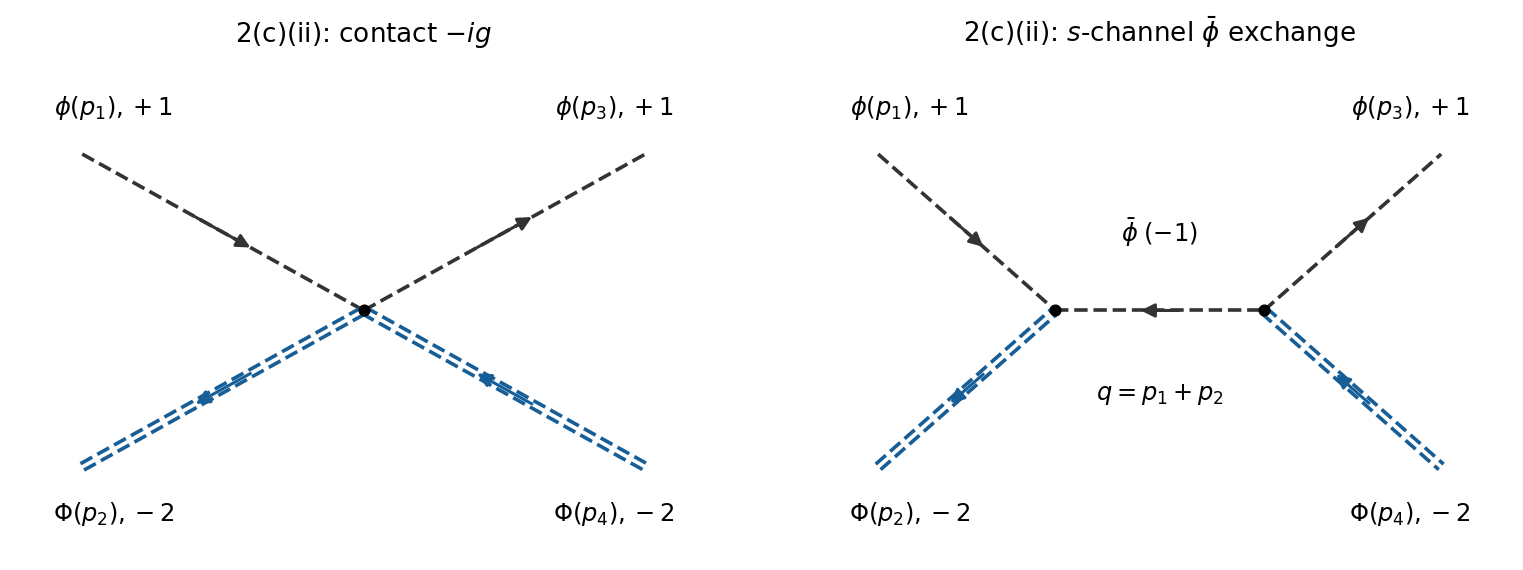
Scattering of a light particle and a heavy particle, with contact and s-channel light-antiparticle exchange diagrams
. Details. 
The distinction from antiparticles matters. If the paper's heavy “ particle” is instead intended to mean the charge- state , so that its printed decay into is allowed, the exchange diagram is crossed. For that alternative physical process,This is a consistent alternative naming convention only if it is also applied to the decay in iii; one cannot use the same heavy particle label for both charge assignments.
With the conventional particle labels, the allowed cubic decay channels areEach has one tree-level Feynman diagram, consisting of one cubic Feynman vertex. The final identical-leg contractions supply and cancel the in the Lagrangian density.
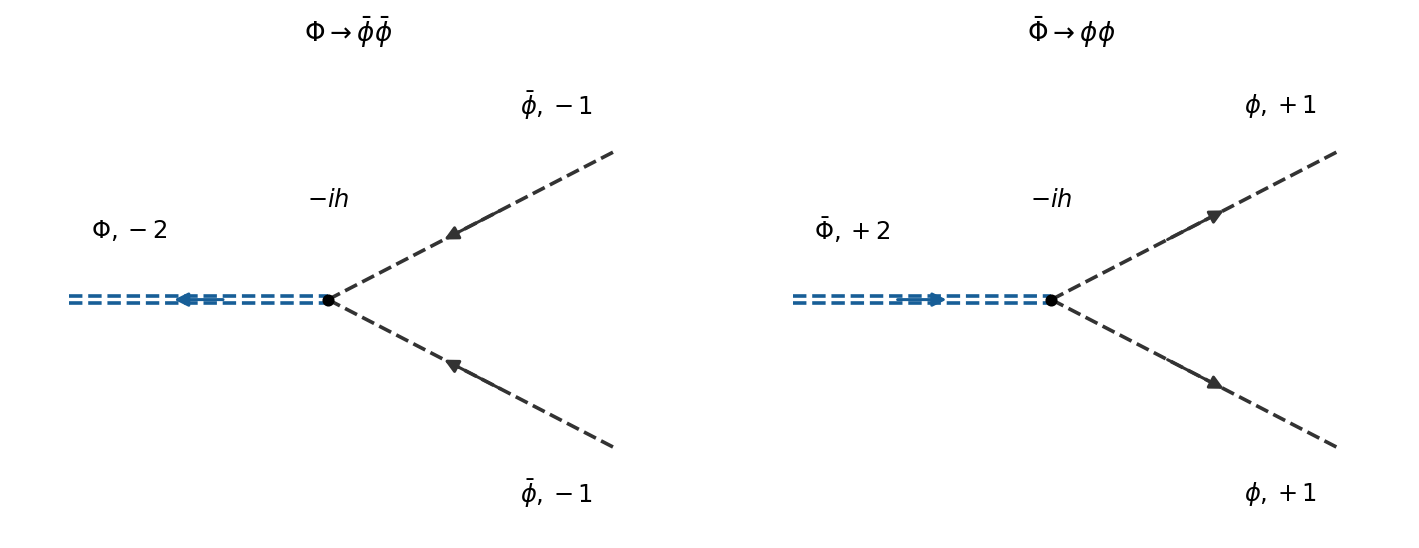
The two charge-conjugate heavy-scalar decays, with explicit antiparticle labels and conserved charge arrows
. Details. 
Taken literally with these labels, the printed channel is forbidden: its initial Noether charge is and its final Noether charge is . Its decay amplitude is zero, at every order preserving the global phase symmetry. If the source uses “” to name the heavy antiparticle instead, its intended answer is the nonzero decay amplitude for . The following decay width calculation concerns either allowed channel, whose widths are equal by charge conjugation.
For an allowed decay channel in iii, . Integrating the spatial Dirac delta distribution in the printed Lorentz-invariant phase-space measure sets . With and , its remaining value isThe positive root is , where , and the Dirac delta distribution contributes the Jacobian determinant . HenceIt follows that the literal printed integral evaluates toThe printed integration ranges count each final configuration twice, once as and once in the opposite order. For two identical final bosons, the physical decay width therefore requires an additional identical final-state symmetry factor :There is one allowed decay channel per heavy particle, not an extra factor of two from summing the two charge-conjugate heavy species. Both expressions vanish below the two-body decay threshold , and the limiting value at threshold is zero. For the literally forbidden labels , the decay width is instead zero because its decay amplitude vanishes, as explained in iii.
For , the invariant scattering amplitude from the tree-level Feynman diagram in i has a pole at . The intermediate heavy antiparticle can go on shell and live for a time of order its mean lifetime. Near this scattering resonance, inserting a single self-energy is no longer a uniformly small correction. Dyson resummation gives, to leading accuracy in a narrow decay width,Here is understood as the renormalized resonance mass; the real self-energy shifts the original pole position. The imaginary term removes the unphysical divergence of the fixed-order invariant scattering amplitude.
For equal incoming and outgoing light masses, the two-body momentum ratio cancels in the cross section. The angle-independent invariant scattering amplitude, integrated over the full solid angle with the identical final-state symmetry factor , gives . Thus the Breit-Wigner resonance cross section isAt it reproduces . At the resonance peak,This is also for , the elastic identical-boson S wave partial-wave unitarity limit when this is the only open decay channel. The approximation assumes and a resonance sufficiently far from threshold for the width to vary slowly across it.
If one mechanically uses the unsymmetrized from d, the same displayed Breit-Wigner resonance cross section would have that doubled width and predict a peak . This is the literal-width substitution, rather than the consistent physical result: the given high-energy cross section already includes the identical-final-particle factor that the printed decay width integral omits.
Articles by others on the same topic
There are currently no matching articles.