Source PDF: mmathphys.physics.ox.ac.uk/sites/g/files/vzsiac2991/files/mmathphys/documents/media/a15088h1.pdf
The solutions use natural units and the Minkowski metric . In question 1, is exactly the paper's convention: it contains no factor . The qualifications in iii, d and d distinguish the printed expressions from the results of charge conservation, identical final-state symmetry factors and fermionic time ordering.
Distinct gamma matrices anticommute, and , for . Moving a particular through the other three factors in gives three minus signs. ThereforePairing equal factors in the square involves interchanges. The Clifford algebra consequently givesIn particular ; replacing it by the conventional chirality matrix would change this answer.
The trace is unchanged by a similarity transformation. Since and , cyclic property of the trace gives . AlsoThus
The mass dimensions are , , . Up to total derivatives, power counting allows local counterterms of mass dimension at most four. A convenient basis for the counterterm Lagrangian compatible with the actual parity symmetry in quantum field theory and Dirac fermion number conservation isThe optional constant renormalizes the vacuum energy density. The wavefunction renormalization, mass counterterms and Yukawa coupling renormalization correct the terms already present. The quartic interaction must also be included: the fermion loop with four external bosonic legs is logarithmically divergent, even if the renormalized quartic coupling is set to zero at one chosen renormalization scale. The displayed original interactions alone do not form a closed set of counterterms.
If “most general” is interpreted before imposing the parity symmetry in quantum field theory examined in d, Lorentz invariance, a Hermitian action and Dirac fermion number conservation also allowHere all coefficients can be real in the paper's gamma matrix convention; the last term is Hermitian in the action up to a total derivative. It is an axial kinetic normalization, which could alternatively be removed by a suitable perturbative field redefinition. Every term in is odd under the actual parity symmetry in quantum field theory, so its coefficient vanishes in a symmetry-preserving renormalization scheme. Listing these terms makes explicit which assumption excludes a tadpole counterterm, a cubic scalar term, a scalar Yukawa interaction, a pseudoscalar Dirac mass term and an axial kinetic term.
Expanding gives the Feynman vertexThere is one scalar leg and a continuous oriented fermion line; no extra factor is absorbed into . The Dirac propagator is , where . Each closed fermion loop supplies a minus sign.
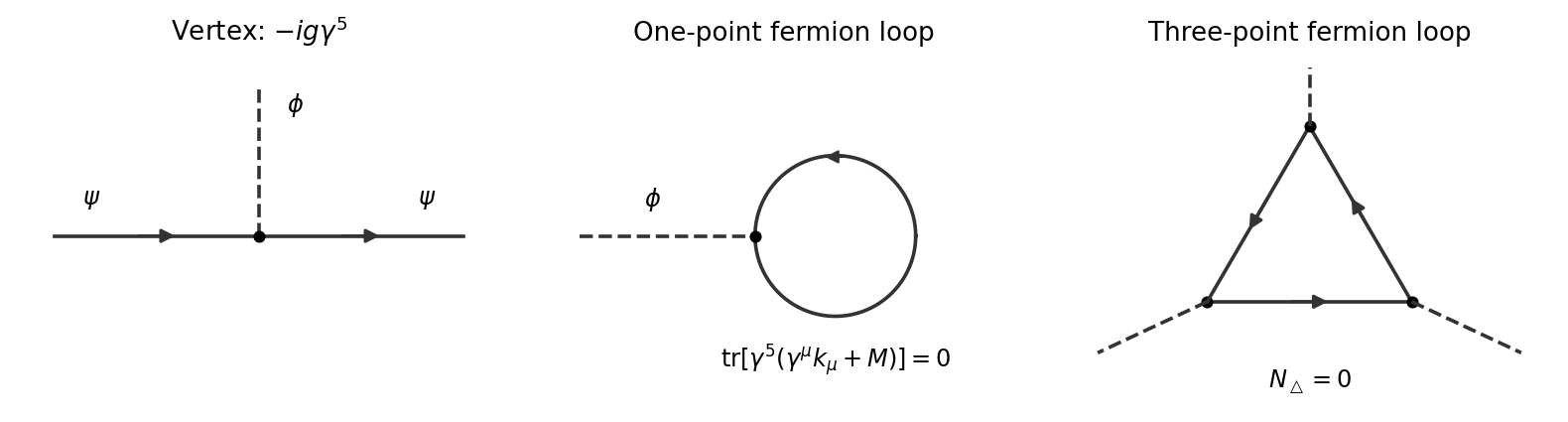
Pseudoscalar Yukawa vertex and the vanishing one-loop bosonic one-point and three-point diagrams
. Details. The tadpole diagram is proportional tobecause both numerator traces vanish by a. This is zero before the loop momentum integration.
For either orientation of the triangle Feynman diagram, let be its three internal four-momenta. Its numerator trace isAfter using cyclic property of the trace, each expanded term is a trace of times at most three ordinary gamma matrices. Such traces vanish in four dimensions. For an odd number of ordinary gamma matrices, conjugation by changes the sign. For two ordinary gamma matrices, the contracted Clifford algebra identity givesThe zero-matrix case is a. Hence both the one-point and three-point one-loop bosonic vertices vanish, independently of their external momenta. No cancellation between different loop orientations or delicate shift of a divergent integral is needed.
Writing , the standard parity transformation of a Dirac field isSince , the fermion bilinear changes sign. Invariance of the pseudoscalar Yukawa interaction therefore requiresThus is a pseudoscalar, despite having the usual scalar-form kinetic term and mass term. In this convention , but is Hermitian because of the additional in the Dirac adjoint. A real is consequently consistent with a Hermitian Lagrangian density.
In perturbation theory about the parity-invariant vacuum state, renormalization can preserve this non-anomalous parity symmetry in quantum field theory. Every local counterterm must then be parity even, at every loop order. The allowed terms are precisely in b; all coefficients in are zero. In particular, no or counterterm is generated, whereas is allowed and required. The one-point and three-point pure-boson vertices also vanish to all orders: a parity-odd Lorentz scalar cannot be formed from their at most two independent external four-momenta. This last reasoning is specific to these low-point vertices; it does not assert that parity symmetry in quantum field theory is an independent internal symmetry with the fermions held fixed.
For the complex scalar fields, use the conventional particle names: annihilates a light particle and creates a light antiparticle ; annihilates a heavy particle and creates . These choices make the distinction between particle labels and field symbols explicit throughout ii and iii. The couplings are real as required by the printed Hermitian Lagrangian density.
Independent global phase symmetries would rotate and . The cubic interaction vertex preserves only modulo . The continuous internal symmetry of a classical field theory is therefore the circle groupNormalize the Noether charge so that . Then , and . The Noether current iswhere . For example, the Euler-Lagrange field equations givewhich cancel with the relative coefficient . The quartic interaction vertex separately preserves both original phase rotations.
There is also a discrete charge conjugation symmetry for these real couplings. Including it, the internal symmetry is , with charge conjugation reversing the Noether charge. The connected symmetry and its conserved current are the above.
The nonzero free scalar propagators join a field to its adjoint:Contractions , and mixed-species contractions vanish. With all momenta incoming, the Feynman vertices areThe two identical light legs cancel the in each cubic interaction vertex; there is no remaining factor in its Feynman rule. Multiply each Feynman vertex by , and integrate an internal unconstrained four-momentum with .
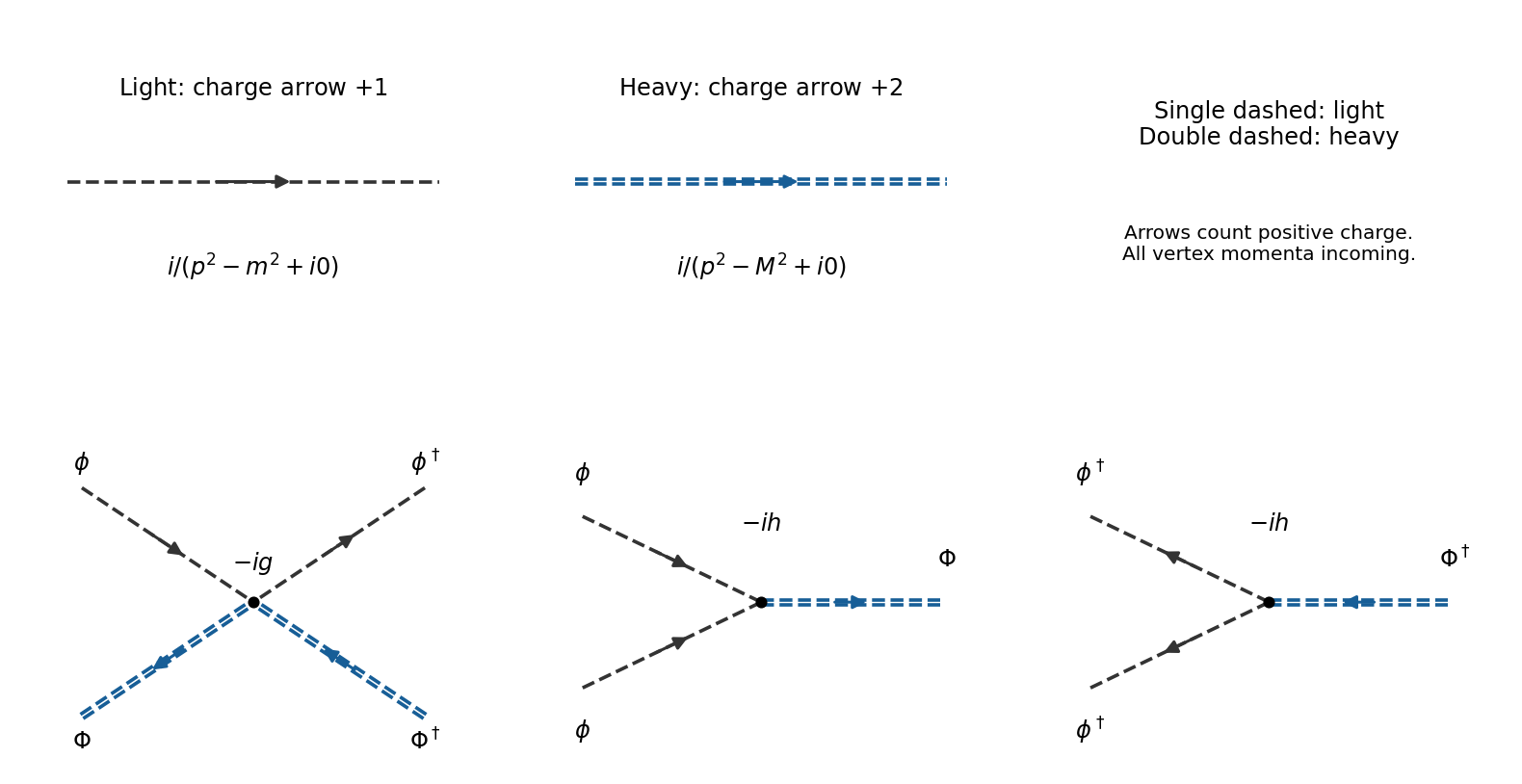
Charged scalar propagators and vertices, with arrows following positive conserved charge and heavy arrows carrying two units
. Details. The arrows in the figure follow positive Noether charge: a light arrow carries one unit and a heavy arrow two. Consequently a heavy particle travels opposite its charge arrow, whereas its antiparticle travels along it. At a Feynman vertex, two unit-charge arrows enter and a two-unit arrow leaves; the conjugate Feynman vertex reverses every arrow. The quartic Feynman vertex has one incoming and one outgoing arrow of each weight. These rules prevent attaching a propagator between two unconjugated fields.
Let be the incoming and the outgoing four-momenta, and set , , , the Mandelstam variables. The only connected tree-level Feynman diagram is the -channel exchange of , with Noether charge . The two incoming light particles attach to , and the two outgoing light particles to its conjugate. There is no four-light contact Feynman vertex, nor a charge-allowed or exchange with these external labels.
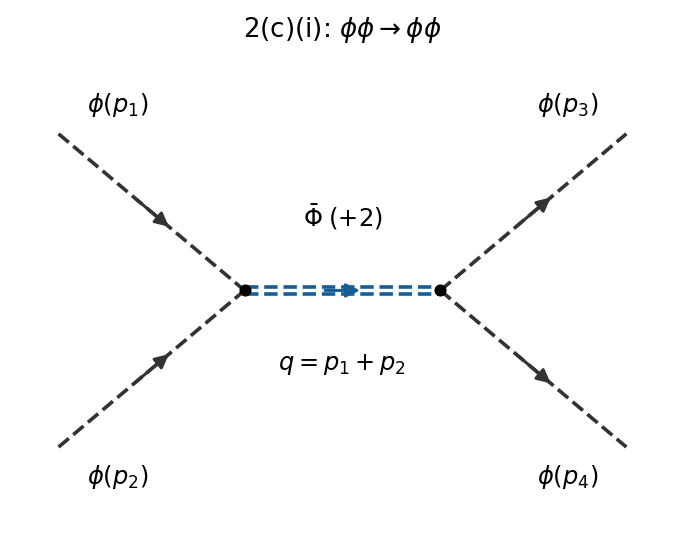


Define the invariant scattering amplitude by . ThenThe Feynman vertices already contain the identical-leg combinatorics. No extra factor of two multiplies this invariant scattering amplitude; the distinct identical final-state symmetry factor enters a cross section integral.
Keep the particle labels specified under 2. There are two connected tree-level Feynman diagrams: the quartic contact interaction vertex and an -channel light antiparticle exchange. The initial Noether charge is , exactly the charge of . At the first cubic Feynman vertex, the incoming and leave the second leg internal; the conjugate Feynman vertex supplies both outgoing particles.
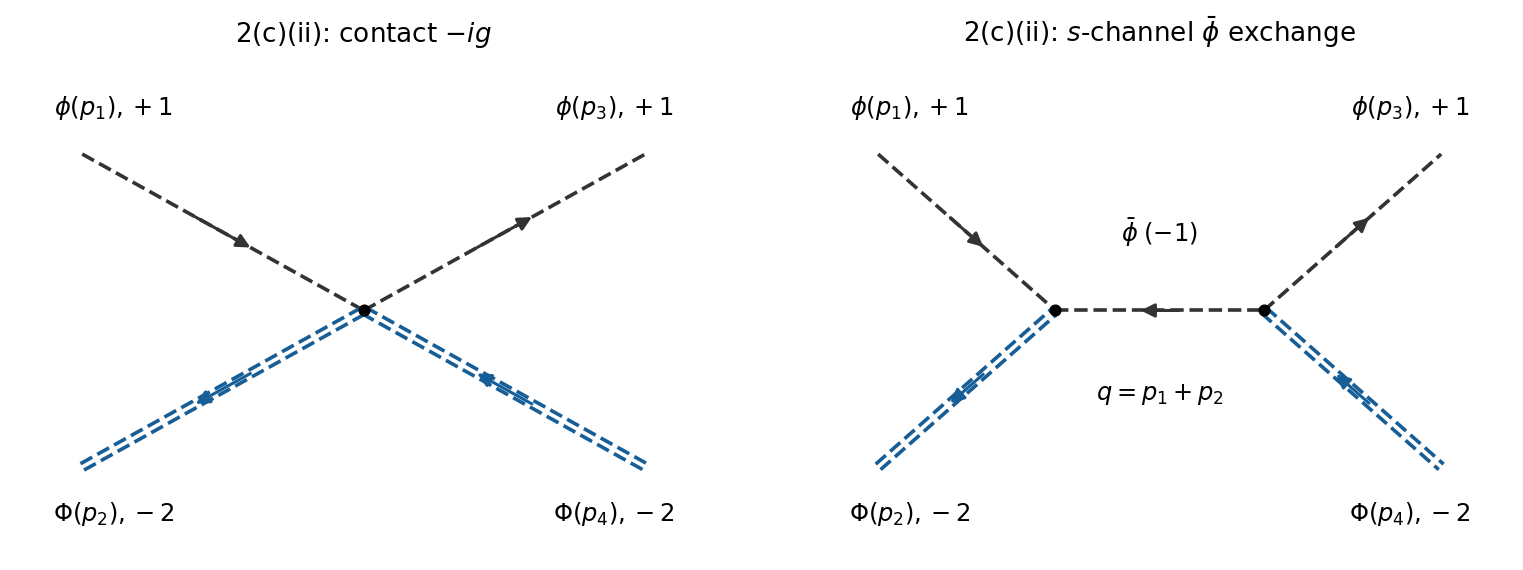
Scattering of a light particle and a heavy particle, with contact and s-channel light-antiparticle exchange diagrams
. Details. 
The distinction from antiparticles matters. If the paper's heavy “ particle” is instead intended to mean the charge- state , so that its printed decay into is allowed, the exchange diagram is crossed. For that alternative physical process,This is a consistent alternative naming convention only if it is also applied to the decay in iii; one cannot use the same heavy particle label for both charge assignments.
With the conventional particle labels, the allowed cubic decay channels areEach has one tree-level Feynman diagram, consisting of one cubic Feynman vertex. The final identical-leg contractions supply and cancel the in the Lagrangian density.
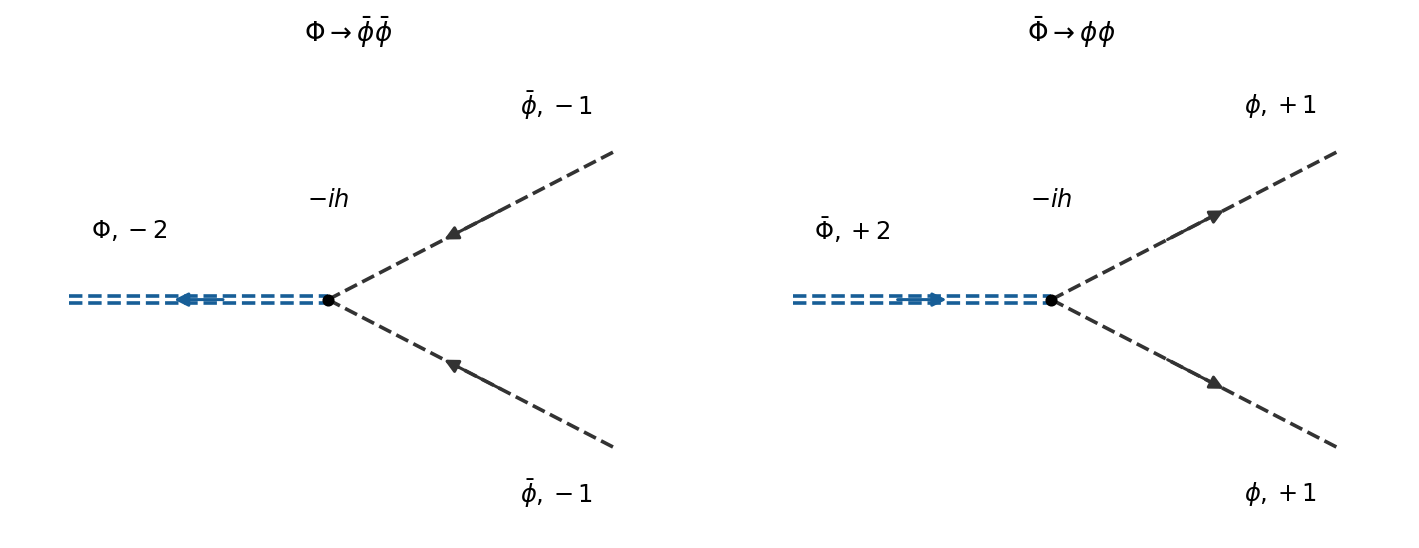
The two charge-conjugate heavy-scalar decays, with explicit antiparticle labels and conserved charge arrows
. Details. 
Taken literally with these labels, the printed channel is forbidden: its initial Noether charge is and its final Noether charge is . Its decay amplitude is zero, at every order preserving the global phase symmetry. If the source uses “” to name the heavy antiparticle instead, its intended answer is the nonzero decay amplitude for . The following decay width calculation concerns either allowed channel, whose widths are equal by charge conjugation.
For an allowed decay channel in iii, . Integrating the spatial Dirac delta distribution in the printed Lorentz-invariant phase-space measure sets . With and , its remaining value isThe positive root is , where , and the Dirac delta distribution contributes the Jacobian determinant . HenceIt follows that the literal printed integral evaluates toThe printed integration ranges count each final configuration twice, once as and once in the opposite order. For two identical final bosons, the physical decay width therefore requires an additional identical final-state symmetry factor :There is one allowed decay channel per heavy particle, not an extra factor of two from summing the two charge-conjugate heavy species. Both expressions vanish below the two-body decay threshold , and the limiting value at threshold is zero. For the literally forbidden labels , the decay width is instead zero because its decay amplitude vanishes, as explained in iii.
For , the invariant scattering amplitude from the tree-level Feynman diagram in i has a pole at . The intermediate heavy antiparticle can go on shell and live for a time of order its mean lifetime. Near this scattering resonance, inserting a single self-energy is no longer a uniformly small correction. Dyson resummation gives, to leading accuracy in a narrow decay width,Here is understood as the renormalized resonance mass; the real self-energy shifts the original pole position. The imaginary term removes the unphysical divergence of the fixed-order invariant scattering amplitude.
For equal incoming and outgoing light masses, the two-body momentum ratio cancels in the cross section. The angle-independent invariant scattering amplitude, integrated over the full solid angle with the identical final-state symmetry factor , gives . Thus the Breit-Wigner resonance cross section isAt it reproduces . At the resonance peak,This is also for , the elastic identical-boson S wave partial-wave unitarity limit when this is the only open decay channel. The approximation assumes and a resonance sufficiently far from threshold for the width to vary slowly across it.
If one mechanically uses the unsymmetrized from d, the same displayed Breit-Wigner resonance cross section would have that doubled width and predict a peak . This is the literal-width substitution, rather than the consistent physical result: the given high-energy cross section already includes the identical-final-particle factor that the printed decay width integral omits.
For three odd fermionic operators, the identityconverts the commutator with a quadratic Hamiltonian into the given canonical anticommutation relations. Writing a mode label as , this yieldsThe opposite-species number terms commute with each fermionic creation operator or fermionic annihilation operator, because two anticommutations give a positive sign. Restoring the continuous normalization, the Dirac delta distribution in the mode brackets cancels . ConsequentlySubstitute these into the mode expansion of a Dirac field. The result isSince and , this is exactlyThe Heisenberg equation of motion uses an ordinary commutator with the even Hamiltonian, despite the odd fermionic operators obeying anticommutators among themselves.
The canonical anticommutation relations give , where each label includes both momentum and spin. ThereforeThus exchanging the complete labels of the two identical fermions changes the sign of their state. If the labels coincide, ; the state vanishes, which is the Pauli exclusion principle. A negative state vector describes the same isolated physical ray, but its relative sign matters when exchange alternatives interfere.
For , interchange the entries in slots while preserving the order of all intermediate fermionic creation operators. Move left through factors, then move right through the remaining intermediate factors. The canonical anticommutation relations give the overall fermionic signHenceMore generally any permutation givesThe sign of a permutation is independent of its decomposition into adjacent interchanges. Thus the -particle sector is an exterior power of the one-particle state space, the defining antisymmetry of fermionic Fock space. Repeated complete mode labels make the state zero, so they satisfy the same identity trivially.
Put and . The Dirac adjoint of the printed mode expansion of a Dirac field isThe Fock vacuum is annihilated by . The canonical anticommutation relations therefore give the two non-time-ordered vacuum expectation valuesIn the first line, the only surviving contraction is ; in the second it is . Both of these unordered contractions have positive coefficients.
However, fermionic time ordering includes a minus sign when it interchanges two odd fields:Thus the result following from the stated canonical anticommutation relations and standard time ordering isThe second term printed with a plus sign is not correct for standard fermionic time ordering. Its plus-plus expression would be an ungraded chronological product. The missing minus cannot be absorbed by a phase choice for or , since each spin sum contains a spinor and its adjoint.
For comparison with the conventional Dirac propagator, define and let denote this free Dirac field's mass. ThenThe exchange of the spinor indices is essential: is the component of , not its component.
The corrected expression in d is a vacuum two-point function, or Wick contraction, of the free Dirac field. It equals the negative spinor transpose of the usual Dirac propagator with reversed spacetime arguments. It supplies the internal fermion lines in Feynman diagrams, rather than a position-space detection probability.
For , creates an antiparticle and annihilates it. The term describes positive-energy antiparticle propagation from to . For , creates a particle and annihilates it. The term describes positive-energy particle propagation from to , with the minus sign required by exchanging the odd operators in fermionic time ordering. Neither term describes a physical negative-energy excitation.
The Heaviside step functions select these chronological alternatives. The factors are on-shell plane waves with , and is the positive-energy Lorentz-invariant phase-space measure. The sum over includes the two spin states. With standard relativistic spinor normalization, the fermion spin sums areThey encode the spinor structure and solve the corresponding on-shell Dirac equations. In particular, the corrected answer can also be writtenThe Feynman i-epsilon prescription specifies the temporal boundary conditions of the Green function; its positive- and negative-frequency residues reproduce the two terms and their relative minus sign. With defined in d,The contact term is fixed by the equal-time canonical anticommutation relations. Choosing a value for does not change the unequal-time sign demonstrated above.
Finally, microcausality requires field anticommutators to vanish at spacelike separation; the time-ordered vacuum two-point function itself need not vanish there. These facts are compatible with relativistic causality. The plus-plus expression printed in the paper lacks the fermionic sign needed for this standard Dirac propagator interpretation.
Articles by others on the same topic
There are currently no matching articles.