Linearity of the detector's unitary time evolution maps the two input branches separately, giving the quantum premeasurement stateIn the ordered tensor product basis , its pure density matrix isA nonselective projective measurement in the indicated detector basis applies , removing the two off-diagonal terms:This is the usual nonselective meaning of von Neumann process 1. It is not equal to the pure projector . If “the detector has clicked” means conditioning on an actual up outcome, the normalized postselected state is instead , with probability . The correlated superposition describes the coherent premeasurement before that selection.
Put and . The detector rotation is real and orthogonal, so its inverse is the same transformation. Substituting it givesThus the requested orthonormal system states areThe pure density operator has not changed: this is only a different Schmidt decomposition of a maximally entangled state. But choosing a nonselective projective measurement in this new detector basis gives a different operation and generally a different state:For an explicit matrix in the original ordered basis, write and . ThenAt the entries and are , whereas they vanish in . Nevertheless, the system and detector individually each have reduced density matrix for either mixture.
This is the preferred-basis problem: the correlated state alone does not specify which detector observable becomes a stable classical record. Arbitrarily declaring collapse in a Schmidt basis changes the physical prediction. The actual detector interaction and environment must supply the basis selection, rather than a mere choice of notation.
Write , with . The orthogonal projection operators obey and . Hence , and the remaining tensor factors commute with detector operators. ThereforeThe environment interaction preserves these detector populations, making their basis a candidate pointer basis. It can change their relative coherence without flipping the stored labels.
Since , the solution of the Time-dependent Schrödinger equation isThe two detector eigenvalues generate opposite rotations of the environment. Acting on the initial state givesThese are the indicated and . Their conditional environment overlap is . The partial trace therefore multiplies the coherence between and by . This is an exactly solvable single-qubit environment dephasing model, with fully reversible global evolution.
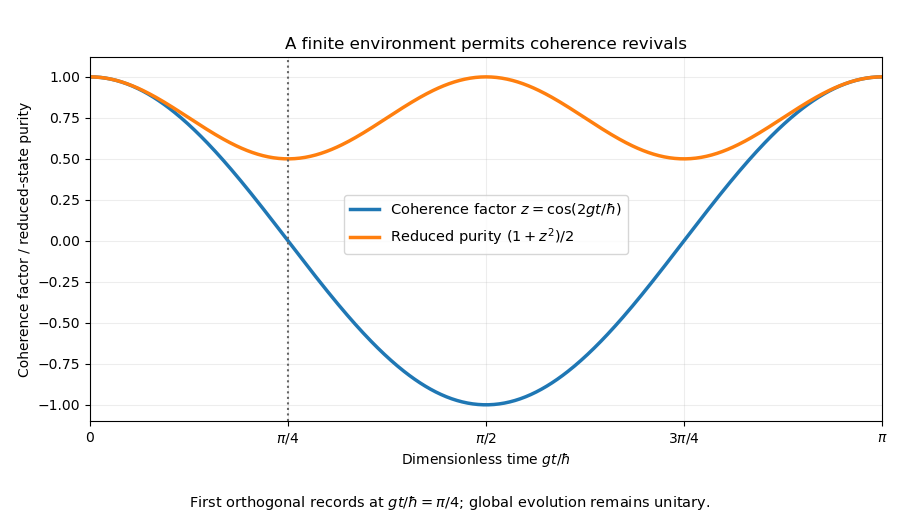
Single-qubit environmental records suppress and later restore reduced coherence
. Original ideal unitary model. Zero off-diagonal coherence at one time does not imply irreversible collapse of the full state. Details.
At , defineThey are normalized and orthogonal. The full state is the pure superposition . A nonselective von Neumann process 1 selecting the original detector records givesWithout imposing any projection on the full state, tracing out the orthogonal environment states already gives from part (a). These two global descriptions share that reduced state but differ in their global coherence. Quantum decoherence does not make a pure global state literally equal to the corresponding statistical mixture.
Inverting the detector rotation at this time givesFor a representation with one system factor and one environment factor per displayed detector state, each parenthesized system–environment vector would have to be a product state. But the first has coefficient matrix in the indicated orthonormal bases; the second has matrix . Their matrix ranks are two whenever . Equivalently, their two nonzero Schmidt coefficients are , which no independent basis changes can remove. Thus the proposed factorization is impossible when .
The exception matters: at , the detector basis is the original basis up to phases or interchange, and a factorization does exist. In particular, the literal condition is insufficient if it includes . The intended obstruction concerns genuinely mixed detector bases.
The environment has selected robust detector records: its interaction commutes with the original projectors, and orthogonal environmental records suppress their interference in the reduced density matrix. A rotated detector branch instead leaves the system and environment entangled. This is environment-induced pointer-basis selection, the issue analyzed by W. H. Zurek in his apparatus-environment model.[ref]
Pointer basis of quantum apparatus: Into what mixture does the wave packet collapse? by W. H. Zurek. 1981 abstract: the apparatus-environment interaction selects recorded observables through a commutation condition
This addresses the basis ambiguity but does not by itself select one realized outcome from the global superposition. Moreover, a two-state environment has recurrences: returns to unit modulus, so the toy model does not establish irreversible macroscopic collapse. A large environment can make records effectively persistent over experimental times, but that requires further dynamical assumptions. The distinction is part of the measurement problem, not an algebraic error cured by a partial trace.
Articles by others on the same topic
There are currently no matching articles.