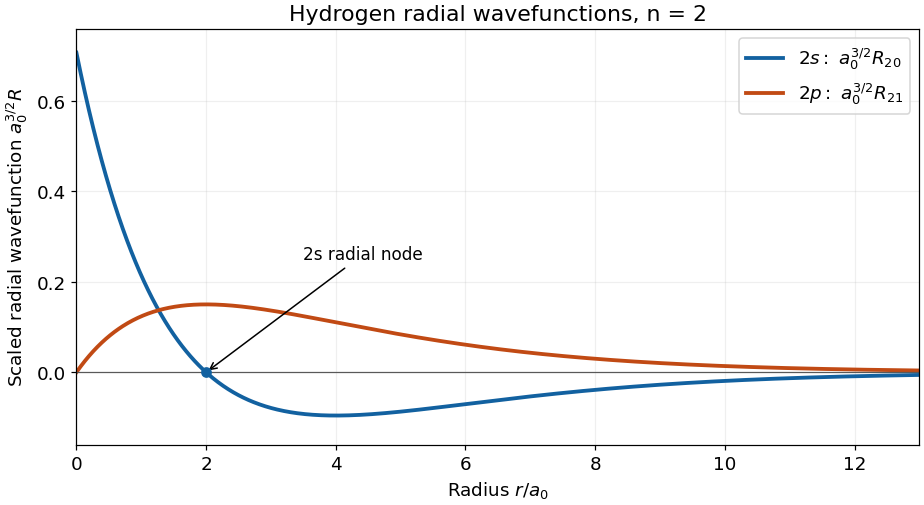
Separation of variables in the central Coulomb potential gives . The radial wavefunction depends on and , independently of . For the hydrogen radial wavefunction in the first excited shell, put . The Bohr radius is , where is the electron–proton reduced mass. Choose the real phasesNear the origin, , whereas . More generally, regular hydrogen radial wavefunctions behave as . At large , both displayed functions have a polynomial factor proportional to multiplying ; approaches zero from below and from above with these phase choices.
The radial wavefunction crosses zero once, at , and has its negative minimum at . The radial wavefunction has no radial node at positive , and reaches its maximum at . The count is ; neither the origin nor the limit at infinity is counted as a radial node. These are sketches of , rather than of or the radial probability density .

Articles by others on the same topic
There are currently no matching articles.